Educational content only. Not personalised medical advice. Clinical decisions remain the responsibility of the treating clinician.
Behçet Uveitis
Behçet's syndrome is a chronic, relapsing, multisystem inflammatory disorder, known as the Silk Route disease because of its geographical distribution [S9]. Uveitis occurs in over two-thirds of patients [S10] and is typically a bilateral, recurrent, non-granulomatous panuveitis with occlusive retinal vasculitis [S4]. Repeated posterior segment attacks cause irreversible retinal damage, so early and aggressive immunomodulatory treatment is the key to preserving vision [S4] [S12].
Key points - Behçet uveitis is more frequent and more severe in men in their third and fourth decades [S4]. - Untreated eye involvement can cause serious permanent damage, unlike skin, mucosal and joint disease [S3]. - Both the frequency and severity of attacks determine irreversible damage and visual prognosis [S2]. - Interferon-α, infliximab and adalimumab have shown superior efficacy compared with conventional therapy [S8]; anti-TNF agents are the core of therapy for damage-prone ocular disease [S12]. - Moderate to severe retinal involvement should be treated with biologics whenever available (expert opinion) [S2].
Evidence last checked: 2026-10-17 (PubMed abstracts).
Red flags
- Posterior segment inflammation or retinal vasculitis in a patient with oral or genital ulcers [S4] [S7].
- Young male patient, in whom the disease is more severe [S4] [S6].
- Poor prognostic signs: a high uveitis attack severity score, fluorescein leakage at the posterior pole and disruption of outer retinal layers on OCT [S8].
- Neurological, vascular or gastrointestinal symptoms alongside eye disease: these can cause serious damage and even death [S3].
- Delay in controlling inflammation is closely associated with irreversible damage [S12].
Recognise it
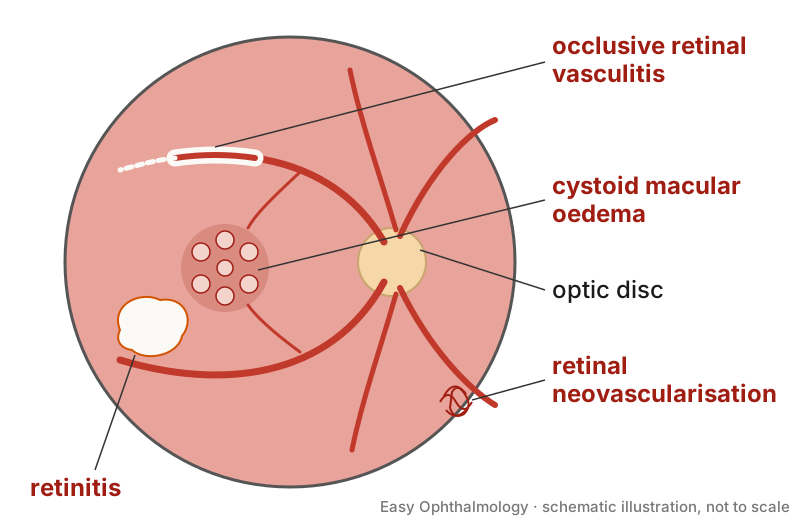
- Systemic picture. Recurrent oro-genital ulcers with uveitis [S7]; also articular, vascular, neurological and gastrointestinal features with a relapsing-remitting course [S9].
- Eye. Bilateral, chronic, recurrent, non-granulomatous uveitis [S10]; the eye is the most frequently involved organ [S4]. Posterior segment inflammation occurs in most patients [S8].
- Complications. Cystoid macular oedema, retinal neovascularisation, optic and retinal atrophy [S2]; macular ischaemia, vitreous haemorrhage and neovascular glaucoma [S10].
- Children. Anterior and posterior uveitis, panuveitis, retinal vasculitis and retinitis [S11].
- Genetics. HLA-B51 is among the genetic factors involved [S10].
Confirm it
- There are no laboratory biomarkers or pathognomonic histological features; diagnosis is clinical [S9].
- Classification criteria and a diagnostic algorithm have been developed for Behçet uveitis [S8].
- Fluorescein angiography and OCT are the routine imaging modalities; the clinical relevance of OCT angiography is unclear [S8].
Manage it
Before acting on this section, check the national and local guidelines, product information and regulatory approvals that apply where you practise. See the medical disclaimer.
Tier A (primary care / no specialist)
- In a patient with recurrent oral and genital ulcers, ask about red eye, floaters or blurred vision and refer for eye examination (timing in the table below) [S7].
- Behçet's syndrome is best managed by a multidisciplinary team, which gives faster diagnosis and integrated treatment [S3].
Tier B (general eye clinic)
- Treat by location and severity of inflammation and systemic involvement [S10]; aim for rapid inflammation suppression, preserved vision and fewer recurrences [S10].
- Corticosteroids are the mainstay, combined with other immunosuppressive agents [S3] [S10]. Conventional agents used include azathioprine, ciclosporin and cyclophosphamide [S3]. Doses are not covered by these abstracts: follow local formularies.
- Colchicine controls mucocutaneous and joint manifestations [S12], but benefit in one organ cannot be assumed in another [S12].
- Comanage with rheumatology for systemic disease and treatment monitoring [S3] [S6].
Tier C (specialist centre)
- Biologics for sight-threatening disease. Anti-TNF agents have the strongest disease-specific data for ocular disease [S12]. Infliximab outcomes were better with earlier initiation, optimisation and withdrawal after remission; adalimumab first-line was superior to conventional therapy [S8].
- Interferon-α. In a randomised trial, interferon-α was superior to ciclosporin [S8]. A 2012 review reports complete or partial remission in about 94% of patients within 2-4 weeks and suggests starting at 3-6 million IU per day (as reported in [S1]); flu-like symptoms are expected, with depression (8%) and mild leukopenia (30%) [S1].
- Refractory disease. IL-6 and IL-1 inhibitors and other targeted therapies are used [S7] [S12]; IL-1 inhibitors were reported effective and safe for difficult ocular disease [S5].
- Unanswered question. Head-to-head comparison of TNF inhibitors and interferon-α in uveitis is still needed [S3].
Refer when
| Situation | Urgency |
|---|---|
| Suspected posterior uveitis or retinal vasculitis with Behçet's features | Urgent to a uveitis specialist; timing per your local service or specialist advice [S4] [S12] |
| Known Behçet uveitis with a new attack or sudden vision loss | Same-day eye review [S2] |
Pitfalls
- Treating eye disease with the same stepwise approach as mucocutaneous disease; ocular disease needs early intensive therapy [S12].
- Relying on spontaneous resolution of acute signs; recurrent attacks accumulate damage [S2].
- Waiting for a laboratory test to confirm the diagnosis [S9].
Evidence notes
| Source | Date | Design |
|---|---|---|
| [S1] | 2012 | Narrative review (interferon-α) |
| [S2] | 2014 | Expert narrative review |
| [S3] | 2020 | Narrative review |
| [S4] | 2020 | Narrative review (Turkey) |
| [S5] | 2020 | Narrative review of drug safety |
| [S6] | 2021 | Narrative review with algorithm |
| [S7] | 2022 | Narrative review (Egypt) |
| [S8] | 2023 | Narrative review of recent trials and criteria |
| [S9] | 2024 | Narrative review (Lancet seminar) |
| [S10] | 2024 | Narrative review (China) |
| [S11] | 2025 | Narrative review, paediatric |
| [S12] | 2026 | Narrative review, severe disease |
- Thin evidence. The search sheet for this topic contained only narrative reviews and no guideline or primary trial; trial results are reported here second-hand through reviews [S8]. EULAR Behçet recommendations appeared in another topic's sheet but not this one, so they are not cited.
- The interferon-α figures come from a 2012 review and are not trial-pooled estimates [S1].
- Not covered by these sources: anti-TNF dosing, tuberculosis screening before biologics, cost and access in Silk Road low- and middle-income countries, and cataract surgery in Behçet uveitis.
Related articles
References
See the numbered source list below. Each marker [S#] links to its PubMed and DOI record.
Sources
- [S1] Deuter C, Stübiger N, Zierhut M Interferon-α therapy in noninfectious uveitis. Developments in ophthalmology. (2012). PubMed 22517207 · doi:10.1159/000336324
- [S2] Zierhut M, Abu El-Asrar AM, Bodaghi B, Tugal-Tutkun I Therapy of ocular Behçet disease. Ocular immunology and inflammation. (2014). PubMed 24377434 · doi:10.3109/09273948.2013.866257
- [S3] Karadag O, Bolek EC Management of Behcet's syndrome. Rheumatology (Oxford, England). (2020). PubMed 32348509 · doi:10.1093/rheumatology/keaa086
- [S4] Çakar Özdal P Behçet's Uveitis: Current Diagnostic and Therapeutic Approach. Turkish journal of ophthalmology. (2020). PubMed 32631005 · doi:10.4274/tjo.galenos.2019.60308
- [S5] Lopalco G, Rigante D, Lopalco A, Emmi G, Venerito V, Vitale A, et al. Safety of systemic treatments for Behçet's syndrome. Expert opinion on drug safety. (2020). PubMed 32883123 · doi:10.1080/14740338.2020.1817379
- [S6] Alpsoy E, Leccese P, Emmi G, Ohno S Treatment of Behçet's Disease: An Algorithmic Multidisciplinary Approach. Frontiers in medicine. (2021). PubMed 33996847 · doi:10.3389/fmed.2021.624795
- [S7] Aboul Naga SH, Hassan LM, El Zanaty RT, Refaat M, Amin RH, Ragab G, et al. Behçet uveitis: Current practice and future perspectives. Frontiers in medicine. (2022). PubMed 36160151 · doi:10.3389/fmed.2022.968345
- [S8] Tugal-Tutkun I Uveitis in Behçet disease - an update. Current opinion in rheumatology. (2023). PubMed 36255985 · doi:10.1097/bor.0000000000000911
- [S9] Emmi G, Bettiol A, Hatemi G, Prisco D Behçet's syndrome. Lancet (London, England). (2024). PubMed 38402885 · doi:10.1016/s0140-6736(23)02629-6
- [S10] Guan Y, Li F, Li N, Yang P Decoding Behcet's Uveitis: an In-depth review of pathogenesis and therapeutic advances. Journal of neuroinflammation. (2024). PubMed 38778397 · doi:10.1186/s12974-024-03123-6
- [S11] Nouraeinejad A Ocular Manifestations of Pediatric Behçet's Disease. Clinical medicine & research. (2025). PubMed 41285446 · doi:10.3121/cmr.2025.1912
- [S12] Abacar K, Direskeneli H, Alibaz-Oner F Management of Severe Behçet's Disease. Current rheumatology reports. (2026). PubMed 41915258 · doi:10.1007/s11926-026-01217-z