Educational content only. Not personalised medical advice. Clinical decisions remain the responsibility of the treating clinician.
Choroidal metastases
Choroidal metastases are the most common malignant intraocular lesion, found in 4-12% of necropsy series of patients with solid cancer [S2]. They arise mostly from breast and lung cancer and can be the first sign of an undiagnosed malignancy [S8] [S12]. Treatment is usually palliative, aiming to preserve vision and quality of life [S4] [S10].
Key points - The choroid accounts for 90% of uveal metastases; breast (37%) and lung (27%) are the commonest primaries [S8]. - A yellow mass with subretinal fluid, echodense on ultrasonography and "lumpy bumpy" on OCT, suggests the diagnosis [S8]. - External beam radiotherapy is the standard treatment, with complete response in about 80% [S2]; a short course of 20 Gy in 5 fractions also preserved vision in 80% of eyes [S4]. - Systemic targeted therapy or immunotherapy can shrink metastases, but ocular relapse usually needs radiotherapy [S5]. - Prognosis is poor: 32% survival at 3 years and 24% at 5 years in 1111 patients [S8].
Evidence last checked: 2026-10-17 (PubMed abstracts).
Red flags
- No known cancer. Choroidal metastasis can precede diagnosis of the primary tumour [S12]; in 16% of cases the primary site remains unknown [S8].
- Lung cancer presenting through the eye. In 55 patients whose lung cancer first presented as choroidal metastasis, most were male smokers and adenocarcinoma was the commonest type [S1].
- Bilateral or multifocal lesions. These are most often from breast cancer [S3].
- Blind painful eye. Enucleation is an option [S3].
Recognise it
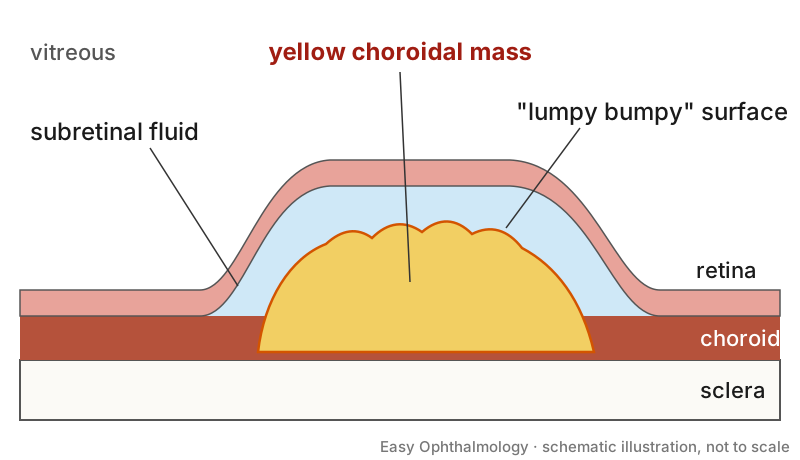
- Decreased vision was the presenting symptom in 61% of eyes in one radiotherapy series [S4].
- Typical features: mean 1.7 metastases per eye, mean base 11.6 mm and thickness 3.2 mm, yellow colour in 86% and subretinal fluid in 72% [S8].
- Unilateral, unifocal metastases are more common with lung cancer [S3].
Confirm it
- Ultrasonography: echodense mass in 80% [S8].
- OCT: "lumpy bumpy" choroidal surface in 64% [S8]. Fluorescein and indocyanine green angiography complement fundoscopy [S5].
- Biopsy: fine needle aspiration biopsy is occasionally used when the primary is unknown [S8]; choroidal biopsy can confirm the metastatic nature and help identify the primary [S5].
- Systemic workup with the oncology team; in lung cancer presentations, bronchoscopic lung biopsy was the commonest diagnostic route [S1].
Manage it
Before acting on this section, check the national and local guidelines, product information and regulatory approvals that apply where you practise. See the medical disclaimer.
Tier A (primary care / no specialist)
- A person with known cancer and new blurred vision needs an eye examination (see Refer when) [S4] [S12].
Tier B (general eye clinic)
- Suspect metastasis in a yellow choroidal mass with subretinal fluid, especially with a cancer history [S8].
- Use ultrasonography where available to confirm an echodense mass [S8].
- Coordinate with the oncology team: treatment depends on systemic status and the number, location and laterality of tumours [S3].
- Observation is an option for patients with poor systemic status or with asymptomatic or resolved disease [S3].
Tier C (specialist centre)
- External beam radiotherapy. Standard regimens of 30 Gy in 10 fractions or 40 Gy in 20 fractions, as reported in [S2], gave complete response in about 80% and improved acuity in 57% to 89% [S2]. A hypofractionated course of 20 Gy in 5 fractions, as reported in [S4], gave tumour regression in 91% of 71 eyes with few toxicities [S4]. Short-course radiotherapy for orbital and ocular metastases improved vision in 11 of 13 patients [S6]. In a small Japanese series and literature review, vision improved or stabilised in 80% of patients [S11].
- Systemic therapy. Chemotherapy, immunotherapy, hormone therapy or whole eye radiotherapy are options for active, multifocal and bilateral disease [S3]. Systemic therapy may suit pauci-symptomatic metastases in widespread disease, while radiotherapy remains necessary for symptomatic lesions [S2]. Secondary resistance is common, so local treatment alongside or after systemic therapy may give more durable control [S10].
- Focal therapy for solitary lesions. Plaque radiotherapy, transpupillary thermotherapy or photodynamic therapy suit active solitary metastases [S3]. Brachytherapy and proton therapy may be proposed for isolated metastases with long disease-free intervals [S2].
- Photodynamic therapy. In a meta-analysis of 52 tumours, thickness fell in 82% and subretinal fluid resolved in 75% of eyes, with no adverse events reported [S9].
- Gamma knife radiosurgery. A meta-analysis mostly of uveal melanoma (34 metastases) reported local control in 96% [S7].
- Office-based palliation. Photodynamic therapy and intravitreal anti-VEGF injections may preserve vision while reducing time in hospital [S5].
Refer when
| Situation | Urgency |
|---|---|
| Choroidal mass in a patient with known cancer and reduced vision | Urgent to an ocular oncology or retina service and the treating oncologist; timing per your local service or specialist advice |
| Choroidal mass suspicious for metastasis with no known primary | Urgent, for ocular and systemic workup; timing per your local service or specialist advice |
Pitfalls
- Missing a first presentation of cancer: metastasis can precede the primary diagnosis [S1] [S12].
- Assuming systemic therapy alone gives durable ocular control [S5] [S10].
- Offering long radiotherapy courses when short courses work for palliation [S4] [S6].
- Confusing metastasis with amelanotic melanoma: imaging features help separate them [S8].
Evidence notes
| Source | Date | Design |
|---|---|---|
| [S1] | 2012 | Case series (3) and systematic review of 55 patients |
| [S2] | 2014 | Systematic review |
| [S3] | 2015 | Narrative review |
| [S4] | 2017 | Retrospective series, 55 patients |
| [S5] | 2019 | Narrative review |
| [S6] | 2020 | Retrospective series, 15 patients |
| [S7] | 2020 | Systematic review and meta-analysis (mostly melanoma) |
| [S8] | 2023 | Review of large cohorts |
| [S9] | 2022 | Case series and meta-analysis of PDT |
| [S10] | 2022 | Narrative review |
| [S11] | 2023 | Retrospective series (11 patients) and literature review |
| [S12] | 2026 | Narrative review |
- There are no prospective trials of treatment; the literature is mainly retrospective, with few reports of late toxicity [S2].
- PDT outcomes come from pooled case reports, so selection bias is likely [S9].
- Not covered by these sources: anti-VEGF dosing, specific targeted agents by tumour type, and evidence-based referral timings.
Related articles
References
See the numbered source list below. Each marker [S#] links to its PubMed and DOI record.
Sources
- [S1] Singh N, Kulkarni P, Aggarwal AN, Mittal BR, Gupta N, Behera D, et al. Choroidal metastasis as a presenting manifestation of lung cancer: a report of 3 cases and systematic review of the literature. Medicine. (2012). PubMed 22732948 · doi:10.1097/md.0b013e3182574a0b
- [S2] Jardel P, Sauerwein W, Olivier T, Bensoussan E, Maschi C, Lanza F, et al. Management of choroidal metastases. Cancer treatment reviews. (2014). PubMed 25451606 · doi:10.1016/j.ctrv.2014.09.006
- [S3] Arepalli S, Kaliki S, Shields CL Choroidal metastases: origin, features, and therapy. Indian journal of ophthalmology. (2015). PubMed 25827542 · doi:10.4103/0301-4738.154380
- [S4] Hahn E, Laperriere N, Krema H, Velazquez-Martin JP, Somani S, Waldron J, et al. Clinical outcomes of hypofractionated radiation therapy for choroidal metastases: Symptom palliation, tumor control, and survival. Practical radiation oncology. (2017). PubMed 28867543 · doi:10.1016/j.prro.2017.06.012
- [S5] Mathis T, Jardel P, Loria O, Delaunay B, Nguyen AM, Lanza F, et al. New concepts in the diagnosis and management of choroidal metastases. Progress in retinal and eye research. (2019). PubMed 30240895 · doi:10.1016/j.preteyeres.2018.09.003
- [S6] Chik JYK, Leung CWL, Wong KH Palliative radiation therapy for patients with orbital and ocular metastases. Annals of palliative medicine. (2020). PubMed 32156122 · doi:10.21037/apm.2019.12.02
- [S7] Parker T, Rigney G, Kallos J, Stefko ST, Kano H, Niranjan A, et al. Gamma knife radiosurgery for uveal melanomas and metastases: a systematic review and meta-analysis. The Lancet. Oncology. (2020). PubMed 33152286 · doi:10.1016/s1470-2045(20)30459-9
- [S8] Shields CL, Kalafatis NE, Gad M, Sen M, Laiton A, Silva AMV, et al. Metastatic tumours to the eye. Review of metastasis to the iris, ciliary body, choroid, retina, optic disc, vitreous, and/or lens capsule. Eye (London, England). (2023). PubMed 35306540 · doi:10.1038/s41433-022-02015-4
- [S9] Nguyen MT, Stacey AW PHOTODYNAMIC THERAPY FOR THE TREATMENT OF CHOROIDAL METASTASES: A Case Series and Meta-analysis. Retina (Philadelphia, Pa.). (2022). PubMed 35594078 · doi:10.1097/iae.0000000000003433
- [S10] Thariat J, Boudin L, Loria O, Nguyen AM, Kodjikian L, Mathis T How to Manage a Patient with Ocular Metastases? Biomedicines. (2022). PubMed 36551800 · doi:10.3390/biomedicines10123044
- [S11] Niwa M, Tomita N, Miyakawa A, Ayakawa S, Takama N, Torii A, et al. Clinical Outcomes of Radiation Therapy for Choroidal Metastases and A Literature Review. The Kurume medical journal. (2023). PubMed 37793893 · doi:10.2739/kurumemedj.ms69120012
- [S12] Nag A Intraocular and Ocular Adnexal Metastases: A Comprehensive Review. Ocular oncology and pathology. (2026). PubMed 42325542 · doi:10.1159/000551923