Educational content only. Not personalised medical advice. Clinical decisions remain the responsibility of the treating clinician.
Geographic Atrophy: Beyond Complement Inhibition
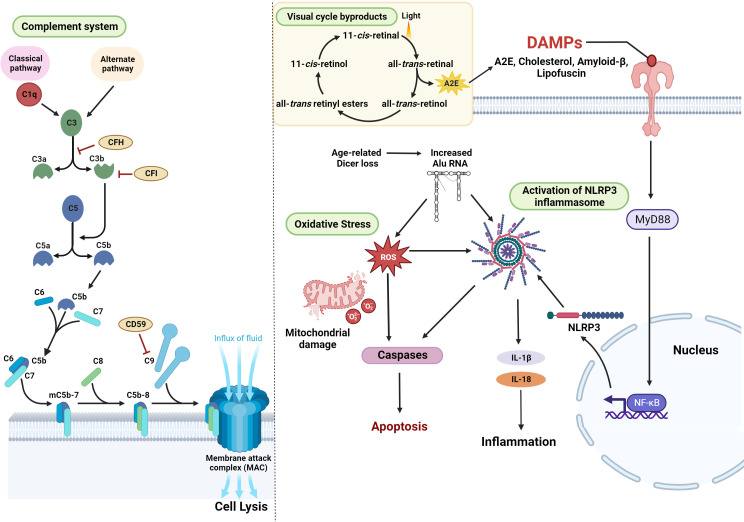
Geographic atrophy (GA) is the progressive, irreversible atrophic form of advanced age-related macular degeneration (AMD) [S1]. Intravitreal complement C3 and C5 inhibitors slow lesion growth but have not been shown to improve visual acuity [S5]. Other approaches (supplements, photobiomodulation, neuroprotection, gene therapy, cell therapy and prostheses) range from modest to experimental [S6] [S7] [S10] [S12] [S13] [S14].
Resource tiers: this is a specialist research topic outside the Tier A / Tier B / Tier C low-resource focus of this library, so no resource tiers are defined here.
Red flags
- Slowing growth is not restoring vision. Complement inhibition likely reduces GA growth but likely does not improve visual acuity at 12 months [S5].
- New neovascular AMD on treatment. Complement inhibition likely increases new-onset neovascular AMD [S5]; in GATHER1 macular neovascularisation occurred in 11.9% and 15.7% of treated eyes vs 2.7% and 2.4% with sham [S3].
- Inflammation with some investigational drugs. The anti-HtrA1 drug galegenimab caused intraocular inflammation in 7.1% of treated patients and its trial was stopped early [S9].
- Promises of "reversal". No therapy in this shortlist reverses established atrophy; the implant and cell approaches are early-stage [S13] [S14].
Recognise it
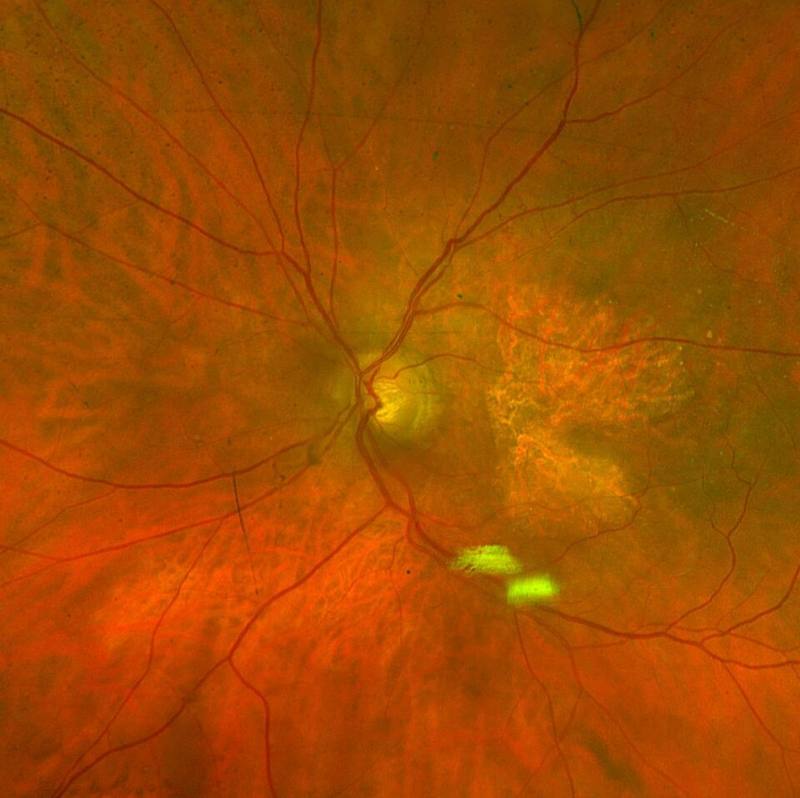
- GA lesions grow at a pooled mean of 1.66 mm² per year in natural history studies, with larger lesions growing faster [S15].
Confirm it
- Trials measured GA area with fundus autofluorescence [S1] [S3]; colour fundus photographs were used in AREDS analyses [S6].
Manage it
Before acting on this section, check the national and local guidelines, product information and regulatory approvals that apply where you practise. See the medical disclaimer.
Specialist management (retina services)
Complement inhibitors
- Pegcetacoplan (C3 inhibitor). In OAKS and DERBY (2023), monthly and every-other-month injections slowed lesion growth at 24 months by 22% and 18% vs sham, as reported in the abstract [S1]. In DERBY alone the 12-month reduction was not statistically significant [S1]. In the GALE extension (2025), reductions in growth rate reached up to 32% vs projected sham over up to 36 months [S2].
- Avacincaptad pegol (C5 inhibitor). GATHER1 (2021) reduced the mean rate of GA growth by about 27% at 12 months [S3]. In GATHER2 (2026), growth from baseline to year 2 was 14% lower with monthly dosing and 19% lower with every-other-month dosing in year 2 [S4].
- What the pooled evidence says. A living meta-analysis (2024): likely slower growth, likely no gain in visual acuity at 12 months, more ocular adverse events and likely more new neovascular AMD [S5].
Beyond complement inhibition
- Oral supplements (AREDS formulations). A post hoc analysis of two trials (2025) found slower progression toward the fovea with antioxidants (50.7 vs 72.9 µm per year) and with lutein/zeaxanthin (80.1 vs 114.4 µm per year), but no difference in total lesion area growth [S6].
- Photobiomodulation. A 2024 meta-analysis of 3 small RCTs (247 eyes, all at high risk of bias) found a statistically significant gain of 1.76 letters that was not clinically meaningful, and no difference in GA area [S7]. LIGHTSITE III (2026) reported a 6.2-letter gain at 21 months and less progression to GA in dry AMD (6.8% vs 24.0%) [S8]. The two conclusions conflict; the evidence is not settled [S7] [S8].
- Neuroprotection. A brimonidine implant (BEACON, 2023) was stopped early; GA growth at 24 months was 7% lower than sham, not statistically significant [S10].
- Visual cycle modulators. A Cochrane review (2020) of 3 RCTs (emixustat, fenretinide; 821 participants) found high risk of attrition bias, largely due to ocular adverse effects [S11].
- Other targets that failed. Galegenimab (anti-HtrA1) did not slow GA growth at 72 weeks [S9].
- Gene therapy. JNJ-1887 had a manageable safety profile over 24 months in a phase 1 study of 17 patients; efficacy is untested [S12].
- Cell therapy. A stem-cell-derived RPE implant was safe at a median 3 years of follow-up in 15 implanted patients (phase 1/2a) [S13].
- Vision restoration for advanced GA. The PRIMA subretinal photovoltaic implant gave a clinically meaningful acuity gain in 26 of 32 participants assessed at 12 months, in a single-arm trial [S14].
Regulatory approval differs by country and is not covered here: check your national regulator.
Refer when
| Situation | Urgency |
|---|---|
| Sudden distortion or vision drop in an eye with GA, especially on complement inhibitors (possible new neovascular AMD) | Urgent to a retina service; timing per your local service or specialist advice [S5] |
| Pain, redness or vision loss after an intravitreal injection | Immediate, same-day |
| Stable GA, patient asks about treatment | Routine retina referral |
Pitfalls
- Promising better vision from complement inhibitors [S5].
- Missing new neovascular AMD in treated eyes [S3] [S5].
- Overstating photobiomodulation: evidence conflicts [S7] [S8].
- Treating all "beyond complement" agents as promising: several have failed [S9] [S10].
Evidence notes
| Source | Date | Design |
|---|---|---|
| [S1] | 2023 | Two phase 3 sham-controlled RCTs |
| [S2] | 2025 | Open-label extension, projected sham comparator |
| [S3] | 2021 | Phase 2/3 RCT |
| [S4] | 2026 | Phase 3 RCT, 2-year results |
| [S5] | 2024 | Living systematic review and meta-analysis |
| [S6] | 2025 | Post hoc analysis of AREDS and AREDS2 RCTs |
| [S7] | 2024 | Meta-analysis of 3 RCTs |
| [S8] | 2026 | RCT, 100 participants, 24-month analysis [S8] |
| [S9] | 2025 | Phase 2 RCT, stopped early |
| [S10] | 2023 | Phase 2b RCT, stopped early |
| [S11] | 2020 | Cochrane systematic review |
| [S12] | 2024 | Phase 1, 17 patients |
| [S13] | 2024 | Phase 1/2a, 16 enrolled |
| [S14] | 2026 | Single-arm trial, 38 participants |
| [S15] | 2021 | Meta-analysis of natural history studies |
- GALE compares against a projected sham, not a concurrent control [S2].
- LIGHTSITE III enrolled dry AMD broadly, not only GA [S8].
- Not covered by these sources: cost, injection burden and real-world outcomes of complement inhibitors.
Related articles
- Next-Generation Anti-VEGF and Long-Acting Retinal Drugs
- OCT interpretation: macula and retinal nerve fibre layer
- Low-vision rehabilitation
References
See the numbered source list below. Each marker [S#] links to its PubMed and DOI record.
Sources
- [S1] Heier JS, Lad EM, Holz FG, Rosenfeld PJ, Guymer RH, Boyer D, et al. Pegcetacoplan for the treatment of geographic atrophy secondary to age-related macular degeneration (OAKS and DERBY): two multicentre, randomised, double-masked, sham-controlled, phase 3 trials. Lancet (London, England). (2023). PubMed 37865470 · doi:10.1016/s0140-6736(23)01520-9
- [S2] Wykoff CC, Holz FG, Chiang A, Boyer D, Dhoot DS, Loewenstein A, et al. Pegcetacoplan Treatment for Geographic Atrophy in Age-Related Macular Degeneration Over 36 Months: Data From OAKS, DERBY, and GALE. American journal of ophthalmology. (2025). PubMed 40280279 · doi:10.1016/j.ajo.2025.04.016
- [S3] Jaffe GJ, Westby K, Csaky KG, Monés J, Pearlman JA, Patel SS, et al. C5 Inhibitor Avacincaptad Pegol for Geographic Atrophy Due to Age-Related Macular Degeneration: A Randomized Pivotal Phase 2/3 Trial. Ophthalmology. (2021). PubMed 32882310 · doi:10.1016/j.ophtha.2020.08.027
- [S4] Khanani AM, Danzig CJ, Heier JS, Jaffe GJ, Kaiser PK, Lally DR, et al. Avacincaptad Pegol for Geographic Atrophy Secondary to Age-Related Macular Degeneration: Two-Year Efficacy and Safety Results from the GATHER2 Phase 3 Trial. Ophthalmology. (2026). PubMed 41407269 · doi:10.1016/j.ophtha.2025.12.011
- [S5] Garg A, Nanji K, Tai F, Phillips M, Zeraatkar D, Garg SJ, et al. The effect of complement C3 or C5 inhibition on geographic atrophy secondary to age-related macular degeneration: A living systematic review and meta-analysis. Survey of ophthalmology. (2024). PubMed 38008405 · doi:10.1016/j.survophthal.2023.11.008
- [S6] Keenan TDL, Agrón E, Keane PA, Domalpally A, Chew EY, Age-Related Eye Disease Study Research Group, et al. Oral Antioxidant and Lutein/Zeaxanthin Supplements Slow Geographic Atrophy Progression to the Fovea in Age-Related Macular Degeneration. Ophthalmology. (2025). PubMed 39025435 · doi:10.1016/j.ophtha.2024.07.014
- [S7] Rassi TNO, Barbosa LM, Pereira S, Novais EA, Penha F, Roisman L, et al. Photobiomodulation efficacy in age-related macular degeneration: a systematic review and meta-analysis of randomized clinical trials. International journal of retina and vitreous. (2024). PubMed 39148091 · doi:10.1186/s40942-024-00569-x
- [S8] Jaffe GJ, Boyer D, Hu A, Warrow D, Xavier S, Gonzalez V, et al. LONG-TERM EFFICACY AND SAFETY OF PHOTOBIOMODULATION IN DRY AGE-RELATED MACULAR DEGENERATION (LIGHTSITE III: 24-MONTH ANALYSIS). Retina (Philadelphia, Pa.). (2026). PubMed 41791029 · doi:10.1097/iae.0000000000004822
- [S9] Eichenbaum DA, Holekamp N, Khanani AM, Pieramici D, Hershberger V, Sheth V, et al. Phase 2 Study of the Anti-High Temperature Requirement A1 (HtrA1) Fab Galegenimab (FHTR2163) in Geographic Atrophy Secondary to Age-Related Macular Degeneration. American journal of ophthalmology. (2025). PubMed 40089174 · doi:10.1016/j.ajo.2025.03.021
- [S10] Freeman WR, Bandello F, Souied E, Guymer RH, Garg SJ, Chen FK, et al. Randomized Phase IIb Study of Brimonidine Drug Delivery System Generation 2 for Geographic Atrophy in Age-Related Macular Degeneration. Ophthalmology. Retina. (2023). PubMed 36906177 · doi:10.1016/j.oret.2023.03.001
- [S11] Yeong JL, Loveman E, Colquitt JL, Royle P, Waugh N, Lois N Visual cycle modulators versus placebo or observation for the prevention and treatment of geographic atrophy due to age-related macular degeneration. The Cochrane database of systematic reviews. (2020). PubMed 33331670 · doi:10.1002/14651858.cd013154.pub2
- [S12] Heier JS, Cohen MN, Chao DL, Pepio A, Shiraga Y, Capuano G, et al. Phase 1 Study of JNJ-81201887 Gene Therapy in Geographic Atrophy Secondary to Age-Related Macular Degeneration. Ophthalmology. (2024). PubMed 38909914 · doi:10.1016/j.ophtha.2024.06.013
- [S13] Humayun MS, Clegg DO, Dayan MS, Kashani AH, Rahhal FM, Avery RL, et al. Long-term Follow-up of a Phase 1/2a Clinical Trial of a Stem Cell-Derived Bioengineered Retinal Pigment Epithelium Implant for Geographic Atrophy. Ophthalmology. (2024). PubMed 38160882 · doi:10.1016/j.ophtha.2023.12.028
- [S14] Holz FG, Le Mer Y, Muqit MMK, Hattenbach LO, Cusumano A, Grisanti S, et al. Subretinal Photovoltaic Implant to Restore Vision in Geographic Atrophy Due to AMD. The New England journal of medicine. (2026). PubMed 41124203 · doi:10.1056/nejmoa2501396
- [S15] Wang J, Ying GS Growth Rate of Geographic Atrophy Secondary to Age-Related Macular Degeneration: A Meta-Analysis of Natural History Studies and Implications for Designing Future Trials. Ophthalmic research. (2021). PubMed 32721951 · doi:10.1159/000510507