Educational content only. Not personalised medical advice. Clinical decisions remain the responsibility of the treating clinician.
GLP-1 receptor agonists and the eye
Glucagon-like peptide-1 receptor agonists (GLP-1 RAs) such as semaglutide are widely used for type 2 diabetes and obesity and offer considerable cardiovascular benefit [S5]. Two eye questions matter in clinic: early worsening of diabetic retinopathy (DR) with rapid glucose lowering [S1] [S6], and a possible small increase in non-arteritic anterior ischaemic optic neuropathy (NAION) [S11]. Expert consensus holds that the benefits outweigh the ocular risks, with screening and shared decision-making [S6] [S11].
Key points - Most meta-analyses found no overall increase in DR with GLP-1 RAs [S3] [S5] [S7]; worsening events are thought to be linked primarily to rapid glucose lowering rather than a direct drug effect [S6]. - Larger HbA1c reductions in cardiovascular outcome trials were associated with greater retinopathy risk; retinopathy status should be assessed when intensifying glucose-lowering therapy [S2]. - Observational and pooled data suggest a modest increase in NAION risk (OR 1.70 in one meta-analysis), but absolute risk is low, about 0.09% [S8]; a meta-analysis restricted to RCTs found no significant increase in optic nerve or vision-threatening events [S9]. - The North American Neuro-Ophthalmology Society and AAO advise shared decision-making on starting, continuing or stopping GLP-1 RAs [S11]. - Retrospective data suggest GLP-1 RAs may be associated with less glaucoma, but interpretation should be cautious [S4].
Evidence last checked: 2026-10-18 (PubMed abstracts).
Red flags
- Suspected NAION (new optic nerve-related vision loss) in a patient on a GLP-1 RA, particularly semaglutide [S8] [S10] [S11].
- Pre-existing DR with poor glycaemic control and insulin treatment when semaglutide is started: the SUSTAIN 6 excess in DR complications was mostly in this group [S1].
- Diabetes duration over 10 years or HbA1c above 10% (86 mmol/mol) at the start of treatment: high risk, screen before starting [S6].
- Sight loss in one eye or previous NAION: discuss ocular risk before prescribing [S6].
Recognise it
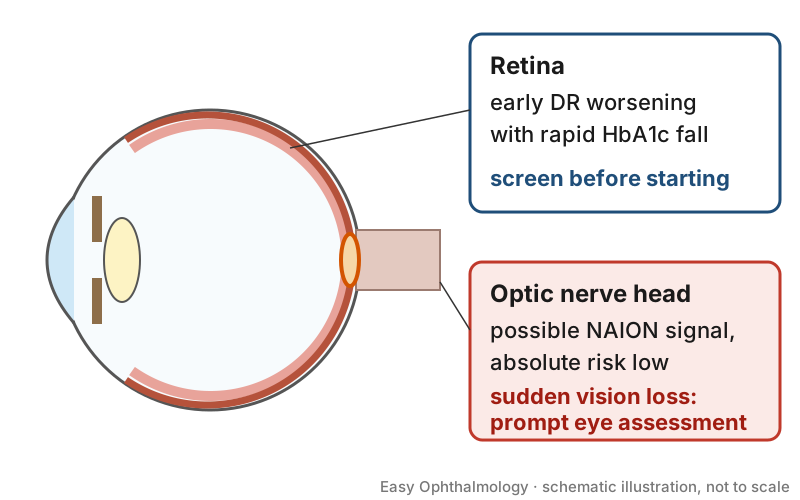
- Diabetic retinopathy. In SUSTAIN 6, semaglutide was associated with a significant increase in DR complications vs placebo, mostly attributed to the magnitude and rapidity of HbA1c reduction in the first 16 weeks [S1]. There was no imbalance in DR adverse events across SUSTAIN 1 to 5 and the Japanese trials [S1].
- Pooled DR data. A meta-analysis of 20 RCTs (24,832 patients) found no increased DR risk (OR 1.17) [S3]; a meta-analysis of 78 semaglutide trials found no change in DR (OR 1.04) [S5]; a 2025 review of RCTs and observational studies found RR 1.00 [S7].
- NAION. A Bayesian meta-analysis of 5 observational studies found semaglutide associated with higher NAION risk (RR 2.52), more so in diabetes; incidence was 118 per 100,000 semaglutide users (low to moderate certainty) [S10]. Semaglutide trials showed significant odds of NAION (OR 3.92), but the data were insufficient for definitive conclusions [S5].
Confirm it
- For suspected NAION, the consensus notes that the evidence comes mainly from retrospective electronic health record and claims studies with limitations [S11]; the diagnostic work-up itself is not covered by these sources.
- For DR, assess retinopathy status before and during intensification of glucose-lowering therapy [S2] [S6].
Manage it
Before acting on this section, check the national and local guidelines, product information and regulatory approvals that apply where you practise. See the medical disclaimer.
Tier A (primary care / diabetes clinic, no eye specialist)
- Make sure people with diabetes have DR screening before starting a GLP-1 RA, especially those at high risk [S6].
- Do not withhold GLP-1 RAs because of eye concerns alone: consensus is that benefits outweigh potential ocular risks and should not limit access [S6].
- Tell patients to report sudden vision loss promptly (see Refer when) [S11].
- Dosing and titration are not covered here: follow local formularies and diabetes guidelines.
Tier B (general eye clinic)
- Grade retinopathy at baseline and follow patients with pre-existing DR more closely when rapid HbA1c reduction is expected; similar recommendations to those for insulin-related early worsening may be appropriate for semaglutide [S1] [S2].
- When a patient with NAION or sight loss in one eye is on, or considering, a GLP-1 RA, discuss the low absolute risk and the uncertainty, and share the decision with the prescriber [S6] [S11].
Tier C (specialist centre)
- Confirm NAION and coordinate with the prescribing team on whether to continue or stop, using shared decision-making [S11].
- Report suspected ocular adverse events; long-term post-marketing safety studies are needed [S8].
Refer when
| Situation | Urgency |
|---|---|
| Sudden vision loss or field defect on a GLP-1 RA | Same-day eye assessment [S11] |
| Starting a GLP-1 RA with no recent DR screen, or with known DR and high HbA1c | Urgent, before or soon after starting, for retinopathy screening [S6]; timing per your local service or specialist advice |
| Stable patient on a GLP-1 RA | Routine DR screening at the usual interval [S6] |
Pitfalls
- Stopping a GLP-1 RA on eye grounds without weighing its cardio-metabolic benefits [S6] [S8].
- Missing early DR worsening in patients with pre-existing retinopathy and rapid HbA1c falls [S1] [S2].
- Overstating NAION risk: absolute risk is low and RCT data do not show a significant increase [S8] [S9].
- Dismissing the NAION signal: semaglutide-specific observational data show a consistent association [S10].
Evidence notes
| Source | Date | Design |
|---|---|---|
| [S1] | 2018 | Post hoc analysis of SUSTAIN RCT programme |
| [S2] | 2021 | Meta-analysis and meta-regression of 6 CVOTs |
| [S3] | 2023 | Meta-analysis of 20 RCTs |
| [S4] | 2025 | Meta-analysis of 5 retrospective studies |
| [S5] | 2025 | Meta-analysis of 78 RCTs |
| [S6] | 2025 | European modified Delphi consensus (58 experts) |
| [S7] | 2025 | Systematic review and meta-analysis (24 RCTs, 15 observational) |
| [S8] | 2026 | Meta-analysis of 15 longitudinal studies |
| [S9] | 2026 | Meta-analysis of 20 RCTs |
| [S10] | 2026 | Bayesian meta-analysis of 5 observational studies |
| [S11] | 2026 | NANOS and AAO consensus statement |
- Conflict on NAION: pooled observational data and semaglutide trials suggest increased risk [S5] [S8] [S10], whereas a meta-analysis of RCTs did not [S9]. RCTs reported vision events as adverse events, not prespecified outcomes [S9]; observational data rely on health records and claims [S11].
- Cardiovascular outcome trials were not powered for retinopathy, and median follow-up of 3.4 years was short [S2].
- The glaucoma finding depended on excluding one study and had high heterogeneity [S4].
- Not covered by these sources: dual GIP/GLP-1 agonists such as tirzepatide, use in people without diabetes in detail, periocular or ocular surface effects, and DR screening intervals.
Related articles
References
See the numbered source list below. Each marker [S#] links to its PubMed and DOI record.
Sources
- [S1] Vilsbøll T, Bain SC, Leiter LA, Lingvay I, Matthews D, Simó R, et al. Semaglutide, reduction in glycated haemoglobin and the risk of diabetic retinopathy. Diabetes, obesity & metabolism. (2018). PubMed 29178519 · doi:10.1111/dom.13172
- [S2] Bethel MA, Diaz R, Castellana N, Bhattacharya I, Gerstein HC, Lakshmanan MC HbA1c Change and Diabetic Retinopathy During GLP-1 Receptor Agonist Cardiovascular Outcome Trials: A Meta-analysis and Meta-regression. Diabetes care. (2021). PubMed 33444163 · doi:10.2337/dc20-1815
- [S3] Jiao X, Peng P, Zhang Q, Shen Y Glucagon-Like Peptide-1 Receptor Agonist and Risk of Diabetic Retinopathy in Patients with Type 2 Diabetes Mellitus: A Systematic Review and Meta-analysis of Randomized Placebo-Controlled Trials. Clinical drug investigation. (2023). PubMed 37938535 · doi:10.1007/s40261-023-01319-x
- [S4] Amaral DC, Guedes J, Cruz MRB, Cheidde L, Nepomuceno M, Magalhães PLM, et al. GLP-1 Receptor Agonists Use and Incidence of Glaucoma: A Systematic Review and Meta-Analysis. American journal of ophthalmology. (2025). PubMed 39732312 · doi:10.1016/j.ajo.2024.12.024
- [S5] Natividade GR, Spiazzi BF, Baumgarten MW, Bassotto C, Pereira AA, Fraga BL, et al. Ocular Adverse Events With Semaglutide: A Systematic Review and Meta-Analysis. JAMA ophthalmology. (2025). PubMed 40810985 · doi:10.1001/jamaophthalmol.2025.2489
- [S6] Carter P, Simó R, Lövestam-Adrian M, Pearce I, Bain SC, Dinah C, et al. Addressing the risk of ocular complications of GLP-1RAs; a multi-disciplinary expert consensus. Diabetes, obesity & metabolism. (2025). PubMed 41058255 · doi:10.1111/dom.70160
- [S7] Alwafi H, Al-Harbi SS, Aladwani GA, Alsanosi SM, Oyelade T, Almalki F, et al. Association of glucagon-like peptide-1 (GLP-1) receptor agonists and diabetic retinopathy (DR) - a systematic review and meta-analysis. Frontiers in medicine. (2025). PubMed 41488069 · doi:10.3389/fmed.2025.1639704
- [S8] Nogueira A, Rassi TNO, Iqbal A, Felix N, Alghaith O, Khan A, et al. Association Between GLP-1 Receptor Agonists and Ischemic Optic Neuropathy: A Meta-analysis. Diabetes care. (2026). PubMed 41498755 · doi:10.2337/dc25-1238
- [S9] Li HY, Chan TK, Co Shih K, Cheung BMY, Yiu KH, Tse HF, et al. GLP-1 Receptor Agonists and Risk of Optic Nerve or Vision-Threatening Events in Patients With Type 2 Diabetes or Cardiometabolic Diseases: A Meta-analysis of Randomized Controlled Trials. Diabetes care. (2026). PubMed 41587563 · doi:10.2337/dc25-1929
- [S10] Dhivagaran T, Butt F, Arunasalam L, Bae I, Mikhail D, Tao BK, et al. Glucagon-like Peptide-1 Receptor Agonists and Risk of Nonarteritic Anterior Ischemic Optic Neuropathy: Systematic Review and Meta-Analysis. Neurology. (2026). PubMed 42060879 · doi:10.1212/wnl.0000000000214864
- [S11] DeParis SW, Oke I, Gaier ED, Moss HE, MacIntosh PW, Gilbert AL, et al. Glucagon-Like Peptide-1 Receptor Agonists and the Risk of Non-Arteritic Anterior Ischemic Optic Neuropathy: A Consensus Statement by the North American Neuro-Ophthalmology Society and the American Academy of Ophthalmology. Ophthalmology. (2026). PubMed 42132708 · doi:10.1016/j.ophtha.2026.04.008