Educational content only. Not personalised medical advice. Clinical decisions remain the responsibility of the treating clinician.
Intermittent exotropia
Intermittent exotropia (IXT) is the most prevalent subtype of exotropia in children [S8]. Most untreated children aged 3 to 10 years remain stable or improve slightly over 3 years [S3], so observation, part-time patching, overminus lenses and surgery are all options, and evidence on which is best remains limited [S7].
Key points - Deterioration to constant exotropia or loss of stereoacuity over 3 years without treatment was uncommon in children aged 3 to 10 years (PEDIG cohort) [S3]. - Part-time patching improved alignment compared with active observation at six months (Cochrane, high-certainty evidence) [S7], but both patching and observation are reasonable [S1]. - Overminus lenses improve control while worn, but the benefit was not maintained after stopping and they increase myopic shift, which persisted at 3 years [S6] [S11]. - After surgery, unilateral recession-resection may give better 8-year outcomes than bilateral lateral rectus recession, though the primary outcome did not differ significantly [S9].
Evidence last checked: 2026-10-17 (PubMed abstracts).
Red flags
- Progression to a constant exotropia (10 prism dioptres or more at distance and near), the motor deterioration criterion used in trials [S3] [S5].
- Loss of near stereoacuity of 2 octaves or more [S3].
- Double vision: diplopia was one reason treatment was started in the observation cohort [S3].
- Myopic shift on overminus lenses: 17% of treated children had a shift of more than 1.00 D at 12 months vs 1% without overminus [S6].
Recognise it
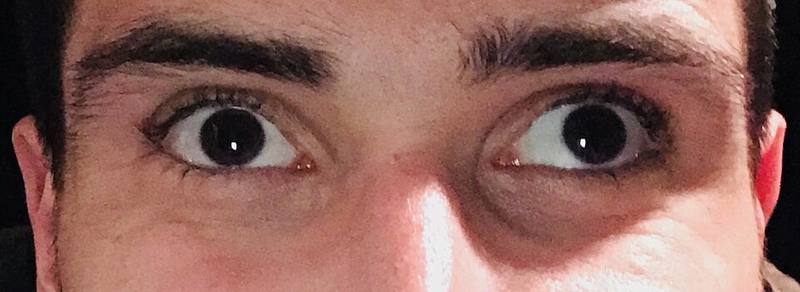
- Trial definitions: IXT at distance, or constant exotropia at distance with IXT or exophoria at near, with an exodeviation of at least 15 PD at distance or near and at least 10 PD at distance by prism and alternate cover test (PACT) [S1] [S2].
- Parents may seek treatment for social concern: 7 of 25 deteriorations in one cohort were treatment started for social concern [S3].
Confirm it
- Measure the angle with PACT at distance and near, grade distance and near control, and measure near stereoacuity: these were the outcomes used across trials [S1] [S6] [S7].
- A masked examiner and confirmation by retest were used to define deterioration in trials [S1].
Manage it
Before acting on this section, check the national and local guidelines, product information and regulatory approvals that apply where you practise. See the medical disclaimer.
Tier A (primary care / no specialist)
- Refer children with an outward-drifting eye to an eye clinic. Deterioration over 6 months was uncommon with or without patching [S1], so this is not an emergency unless other signs are present.
Tier B (general eye clinic)
- Observation. In children aged 3 to 10 years, the cumulative probability of deterioration by 3 years was 15%, likely an overestimate; control, stereoacuity and angle stayed stable or improved slightly [S3]. In children aged 12 to 35 months, motor deterioration by 3 years was 10%, and watchful waiting may be reasonable [S5]. Trials reviewed children at 3 months, 6 months, then every 6 months [S3] [S5].
- Part-time patching. In children aged 3 to 10 years, patching 3 hours daily for 5 months reduced deterioration at 6 months (0.6% vs 6.1%), but both approaches were judged reasonable [S1]. In children aged 12 to 35 months, patching did not significantly reduce deterioration (2.2% vs 4.6%), and there was insufficient evidence to recommend it [S2]. A meta-analysis of 4 RCTs found better control, smaller distance deviation and better near stereoacuity with patching than observation [S8].
- Overminus lenses. In a PEDIG RCT of 386 children aged 3 to 10 years, overminus spectacles (-2.50 D for 12 months, then -1.25 D for 3 months, as reported in [S6]) improved distance control at 12 months (1.8 vs 2.8 points), but not at 18 months after tapering [S6]. The greater myopic shift remained at 3 years (-0.74 D vs -0.44 D), and the risk should be discussed with parents [S11]. A meta-analysis of 4 RCTs found better control and smaller angles with overminus lenses, without better near stereopsis [S10].
Tier C (specialist centre)
- Choice of procedure. The Cochrane review found that bilateral lateral rectus recession likely results in little difference in alignment compared with unilateral recession-resection (moderate-certainty evidence) [S7]. In the 8-year follow-up (bilateral recession vs recession-resection), suboptimal outcome was 68% vs 53% (not significant), complete or near-complete resolution 15% vs 37%, and reoperation 30% vs 11%, the last two favouring recession-resection [S9].
- Age at surgery. In a secondary analysis, suboptimal outcome by 3 years was 28% for children aged 3 to under 5 years vs 50% for those aged 5 to under 11 years [S4]; a randomised trial of immediate vs delayed surgery is needed to confirm this [S4].
- Comparing non-surgical options. A network meta-analysis of 11 RCTs (1411 patients) ranked overminus lenses first; part-time occlusion, binocular vision training and base-in prisms showed no significant effect on control or angle, and none improved near stereoacuity [S12].
Refer when
| Situation | Urgency |
|---|---|
| Exotropia with new double vision, or a deviation that becomes constant | Emergency, within 24 hours, for new double vision; otherwise to a strabismus service, timing per your local service or specialist advice [S3] [EIC expert opinion] |
| Measured loss of stereoacuity or worsening control on follow-up | Routine, at the next available strabismus clinic [S3] |
| Newly noticed intermittent outward drift in a child | Routine, within months, to an eye clinic [S1] [S3] |
Pitfalls
- Operating on every child at diagnosis: most remain stable over 3 years [S3].
- Prescribing overminus lenses without discussing myopic shift [S11].
- Expecting overminus benefit to persist after stopping [S6].
- Patching very young children (12 to 35 months) with high expectations: benefit was not shown [S2].
- Promising better stereopsis from non-surgical treatment [S10] [S12].
Evidence notes
| Source | Date | Design |
|---|---|---|
| [S1] | 2014 | Multicentre RCT, 358 children aged 3 to 10 years |
| [S2] | 2015 | Multicentre RCT, 201 children aged 12 to 35 months |
| [S3] | 2019 | Observation arm of an RCT, 183 children, 3 years |
| [S4] | 2020 | Secondary analysis of an RCT, 197 children |
| [S5] | 2020 | Observation arm of an RCT, 97 children, 3 years |
| [S6] | 2021 | Multicentre RCT, 386 children |
| [S7] | 2021 | Cochrane systematic review, 6 RCTs, 890 participants |
| [S8] | 2023 | Meta-analysis of 4 RCTs, 617 participants |
| [S9] | 2024 | 8-year follow-up of an RCT, 123 of 197 children |
| [S10] | 2023 | Meta-analysis of 4 RCTs, 561 participants |
| [S11] | 2024 | Extension of an RCT, 223 of 386 children |
| [S12] | 2024 | Network meta-analysis, 11 RCTs, 1411 patients |
- Conflict: the patching meta-analysis found better near stereoacuity with patching [S8], while the Cochrane review found little or no difference (low-certainty evidence) [S7] and the network meta-analysis found no significant effect of patching on control [S12].
- Most RCTs were from the United States; the Cochrane review included two trials from Turkey and India [S7]. Masking of participants was not possible, giving high risk of performance bias [S7].
- The 8-year surgical follow-up continued in 123 of 197 randomised children [S9]; long-term follow-up of the overminus trial lost 42% [S11].
- Not covered by these sources: convergence insufficiency-type IXT, surgical doses, orthoptic exercises in detail, and evidence from low-income settings.
Related articles
References
See the numbered source list below. Each marker [S#] links to its PubMed and DOI record.
Sources
- [S1] Pediatric Eye Disease Investigator Group, Cotter SA, Mohney BG, Chandler DL, Holmes JM, Repka MX, et al. A randomized trial comparing part-time patching with observation for children 3 to 10 years of age with intermittent exotropia. Ophthalmology. (2014). PubMed 25234012 · doi:10.1016/j.ophtha.2014.07.021
- [S2] Pediatric Eye Disease Investigator Group, Mohney BG, Cotter SA, Chandler DL, Holmes JM, Chen AM, et al. A Randomized Trial Comparing Part-time Patching with Observation for Intermittent Exotropia in Children 12 to 35 Months of Age. Ophthalmology. (2015). PubMed 26072346 · doi:10.1016/j.ophtha.2015.04.025
- [S3] Pediatric Eye Disease Investigator Group, Writing Committee, Mohney BG, Cotter SA, Chandler DL, Holmes JM, et al. Three-Year Observation of Children 3 to 10 Years of Age with Untreated Intermittent Exotropia. Ophthalmology. (2019). PubMed 30690128 · doi:10.1016/j.ophtha.2019.01.015
- [S4] Repka MX, Chandler DL, Holmes JM, Donahue SP, Hoover DL, Mohney BG, et al. The Relationship of Age and Other Baseline Factors to Outcome of Initial Surgery for Intermittent Exotropia. American journal of ophthalmology. (2020). PubMed 31862447 · doi:10.1016/j.ajo.2019.12.008
- [S5] Cotter SA, Mohney BG, Chandler DL, Holmes JM, Wallace DK, Melia BM, et al. Three-year observation of children 12 to 35 months old with untreated intermittent exotropia. Ophthalmic & physiological optics : the journal of the British College of Ophthalmic Opticians (Optometrists). (2020). PubMed 32202318 · doi:10.1111/opo.12668
- [S6] Chen AM, Erzurum SA, Chandler DL, Hercinovic A, Melia BM, Bhatt AR, et al. Overminus Lens Therapy for Children 3 to 10 Years of Age With Intermittent Exotropia: A Randomized Clinical Trial. JAMA ophthalmology. (2021). PubMed 33662112 · doi:10.1001/jamaophthalmol.2021.0082
- [S7] Pang Y, Gnanaraj L, Gayleard J, Han G, Hatt SR Interventions for intermittent exotropia. The Cochrane database of systematic reviews. (2021). PubMed 34516656 · doi:10.1002/14651858.cd003737.pub4
- [S8] Song D, Yang M, Qian J, Chen Z, Zhou Q, Chen J The Influence of Part-Time Occlusion Therapy on Control of Intermittent Exotropia: A Meta-Analysis of Randomized Controlled Trials. Ophthalmic research. (2023). PubMed 36996767 · doi:10.1159/000530059
- [S9] Donahue SP, Chandler DL, Wu R, Marsh JD, Law C, Areaux RG, et al. Eight-Year Outcomes of Bilateral Lateral Rectus Recessions versus Unilateral Recession-Resection in Childhood Basic-Type Intermittent Exotropia. Ophthalmology. (2024). PubMed 37696452 · doi:10.1016/j.ophtha.2023.09.004
- [S10] Song D, Li J, Qian J, Lou B, Chen Z The Influence of Overminus Lens Therapy on Control of Intermittent Exotropia: A Meta-Analysis of Randomized Clinical Trials. Ophthalmic research. (2023). PubMed 37905429 · doi:10.1159/000529638
- [S11] Writing Committee for the Pediatric Eye Disease Investigator Group, Pediatric Eye Disease Investigator Group, Chen AM, Erzurum SA, Chandler DL, Hercinovic A, et al. Refractive Error Change and Overminus Lens Therapy for Childhood Intermittent Exotropia. JAMA ophthalmology. (2024). PubMed 38536764 · doi:10.1001/jamaophthalmol.2024.0276
- [S12] Song D, Ma Y, Ji H, Zhou Q, Cheng H Non-surgical therapy for intermittent exotropia: a systematic review and network analysis. BMC ophthalmology. (2024). PubMed 39696091 · doi:10.1186/s12886-024-03804-z