Educational content only. Not personalised medical advice. Clinical decisions remain the responsibility of the treating clinician.
Manual small-incision cataract surgery
Manual small-incision cataract surgery (MSICS) removes the lens through a self-sealing scleral tunnel without a phacoemulsification machine, and is widely used in low- and middle-income countries [S7] [S9]. Systematic reviews of randomised trials find best-corrected vision similar to phacoemulsification at a fraction of the cost, which makes MSICS a key technique for high-volume programmes [S4] [S11].
Key points - Best-corrected visual acuity (BCVA) after MSICS is similar to phacoemulsification; phacoemulsification gives better early uncorrected acuity (UCVA) and less surgically induced astigmatism (SIA) [S3] [S4] [S11]. - MSICS costs much less than phacoemulsification: more than four times less in one trial reported in the Cochrane review [S4], Rs 720.99 ($15.34) vs Rs 1978.89 ($42.10) per case in an Indian costing study [S2]. - A temporal frown incision produces the least SIA; an incision on the steep meridian can neutralise around 1 D of pre-existing astigmatism [S12]. - Intracameral antibiotics are associated with fewer cases of endophthalmitis after MSICS [S7]. - Posterior capsule rupture (PCR) is the commonest intraoperative complication in one Nigerian series and strongly predicts a poor outcome where no vitrector is available [S8].
Evidence last checked: 2026-10-17 (PubMed abstracts).
Red flags
- Posterior capsule rupture without vitrectomy access. In a Nigerian series of 405 MSICS cases, PCR (4.7%) made a borderline or poor outcome (<6/18) 7.0 times more likely; only 26.3% of PCR eyes reached 6/18 or better at final follow-up vs 71.5% without PCR [S8].
- Postoperative corneal oedema and iritis. Extensive intracameral manoeuvres during nucleus delivery increase the chance of both [S9].
- Endophthalmitis. Higher rates have been reported after MSICS than after phacoemulsification [S7]. See Refer when for timing.
- Toxic anterior segment syndrome (TASS). An expert consensus stresses prompt management and a review of operating room protocols [S10].
Recognise it: when MSICS is a good choice
- An international expert panel (AAPPO, 2025) agreed that manual surgery has a significant role in eyes with large, dense nuclei and in populations that need low-cost, high-volume surgery, and preferred a manual sutureless approach where appropriate [S10].
- Hard brunescent cataracts form a sizeable proportion of cases in developing countries, and MSICS is instrumental for them [S9].
- In a masked RCT of 400 eyes in India, both techniques were safe and effective [S1].
Confirm it: outcomes to expect
- Cochrane review (2013), 8 RCTs, 1708 participants (India, Nepal, South Africa): BCVA 6/18 or better at 6 to 8 weeks did not differ (RR 0.99, 95% CI 0.98 to 1.01); UCVA 6/18 or better favoured phacoemulsification (RR 0.90, 95% CI 0.84 to 0.96). The review was underpowered for rare outcomes such as BCVA below 6/60 and lacked long-term data [S4].
- Meta-analysis of 6 RCTs (1315 eyes): no difference in BCVA, endothelial cell loss or complications; phacoemulsification gave more eyes with UCVA 6/9 or better and less SIA [S3].
- Meta-analysis of 11 comparative studies (76,838 eyes): comparable UCVA and BCVA at 6/18 and 6/60, similar endothelial cell loss and complications; MSICS took less time, cost less than half, gave better uncorrected near vision and was safer during the learning phase [S6].
- Umbrella review (2025) of 4 systematic reviews: no consistent BCVA difference at any time point; early UCVA advantages for phacoemulsification were not maintained; complication profiles broadly similar [S11].
- RCT detail [S1]: presenting acuity 6/18 or better at 6 weeks in 81.08% (phacoemulsification) vs 71.1% (MSICS); best-corrected 98.4% in both. Posterior capsular rents: 7 with phacoemulsification vs 12 with MSICS; more day-1 corneal oedema with phacoemulsification.
- MSICS vs extracapsular extraction (ECCE): a Cochrane review (2014) of 3 trials (953 participants) found more MSICS patients achieved good unaided acuity in two trials and less SIA than ECCE, but not more than 50% achieved good functional vision in those two trials; data were insufficient for meta-analysis [S5].
Manage it: technique and safety
Before acting on this section, check the national and local guidelines, product information and regulatory approvals that apply where you practise. See the medical disclaimer.
Tier A (primary care / no specialist)
- Identify people with cataract and refer them to a surgical programme; MSICS is the technique many such programmes use for high-volume, low-cost surgery [S4] [S10].
- After surgery, refer any patient with pain, worsening vision or a very red eye using the timings in Refer when.
Tier B (general eye clinic)
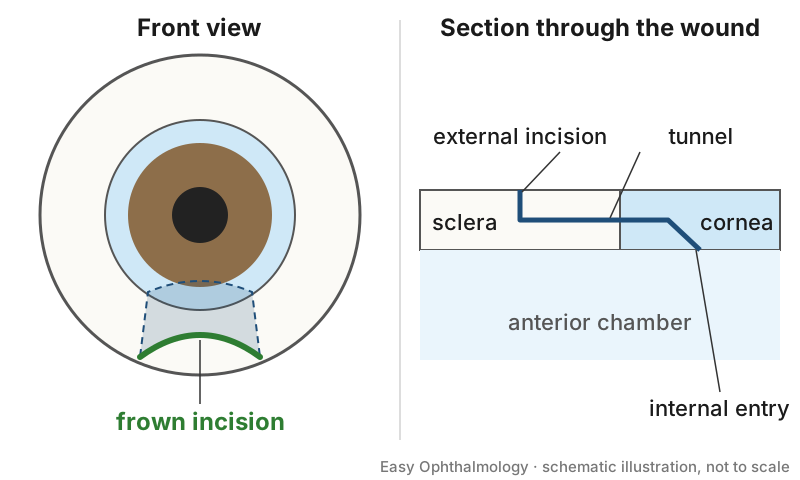
- Incision. Pooled mean SIA was 1.10 D for superior and 0.82 D for temporal incisions; straight incisions caused more SIA than frown incisions (temporal 1.02 D vs 0.72 D). With no pre-existing astigmatism, a temporal frown incision is preferred; around 1 D of astigmatism can be neutralised by placing the incision on the steep meridian [S12].
- Tunnel and capsule. A poorly constructed sclero-corneal tunnel or a small capsulorhexis hampers nucleus extraction [S9].
- Learning curve. Replicable outcomes need a significant learning curve [S9]; MSICS was safer than phacoemulsification during the learning phase in one meta-analysis [S6].
- Infection prophylaxis. A meta-analysis of 12 studies (1,494,307 eyes) found an endophthalmitis risk ratio of 2.94 (95% CI 1.07 to 8.12) in eyes without intracameral antibiotics [S7]. The specific drug and dose are not given in the abstract: follow local protocols and formularies.
Tier C (specialist centre)
- Provide vitrectomy capability and referral pathways for PCR: outcomes after PCR were poor in a centre without an automated vitrector [S8].
- Audit outcomes and complications; the consensus panel advised reassessing operating room protocols when TASS occurs [S10].
Refer when
| Situation | Urgency |
|---|---|
| Pain, redness and falling vision after cataract surgery (possible endophthalmitis) | Immediate, same-day [G1] [S7] |
| Posterior capsule rupture with retained lens matter or vitreous in the anterior chamber, no vitrector on site | Urgent to a vitreoretinal service; timing per your local service or specialist advice [S8] |
| Visually significant cataract | Routine to a surgical programme; timing per your local service or specialist advice |
Pitfalls
- Judging MSICS by unaided acuity alone: BCVA is equivalent, and the early UCVA gap narrows [S4] [S11].
- Using a straight superior incision by default; temporal frown incisions produce less SIA [S12].
- Starting a high-volume service without intracameral antibiotic prophylaxis [S7].
- Underestimating the impact of PCR where vitrectomy is unavailable [S8].
- Assuming MSICS is only for low-income settings: experts recognise a role for dense nuclei anywhere [S10].
Evidence notes
| Source | Date | Design |
|---|---|---|
| [S1] | 2005 | Masked RCT, 400 eyes, India |
| [S2] | 2007 | Cost analysis within an RCT, 400 patients |
| [S3] | 2013 | Meta-analysis of 6 RCTs |
| [S4] | 2013 | Cochrane systematic review, 8 RCTs |
| [S5] | 2014 | Cochrane systematic review, 3 RCTs (vs ECCE) |
| [S6] | 2015 | Meta-analysis of 11 comparative studies |
| [S7] | 2021 | Meta-analysis of 12 observational studies |
| [S8] | 2021 | Retrospective case review, 405 patients, Nigeria |
| [S9] | 2022 | Narrative review |
| [S10] | 2025 | International expert consensus (25 experts) |
| [S11] | 2025 | Umbrella review of 4 systematic reviews |
| [S12] | 2026 | Systematic review and meta-analysis, 28 studies |
- The randomised trials were mostly conducted in India, Nepal and South Africa, with unclear masking and follow-up, and most reported outcomes only at 6 to 8 weeks [S4] [S5].
- The SIA meta-analysis had very high heterogeneity (I² above 97%), and the effect of sutures was not assessed [S12].
- The intracameral antibiotic meta-analysis pooled observational studies; the abstract does not name the antibiotic or dose [S7].
- The consensus statements reached agreement on only about 60% of items, reflecting variation in practice [S10].
- Not covered by these sources: step-by-step nucleus delivery techniques, anaesthesia, long-term posterior capsule opacification, and paediatric MSICS.
Related articles
- Phacoemulsification: outcomes and techniques
- Effective cataract surgical coverage and outcomes
- Complications of cataract surgery
References
See the numbered source list below. Each marker [S#] links to its PubMed and DOI record.
Sources
- [S1] Gogate PM, Kulkarni SR, Krishnaiah S, Deshpande RD, Joshi SA, Palimkar A, et al. Safety and efficacy of phacoemulsification compared with manual small-incision cataract surgery by a randomized controlled clinical trial: six-week results. Ophthalmology. (2005). PubMed 15878068 · doi:10.1016/j.ophtha.2004.11.055
- [S2] Gogate P, Deshpande M, Nirmalan PK Why do phacoemulsification? Manual small-incision cataract surgery is almost as effective, but less expensive. Ophthalmology. (2007). PubMed 17296230 · doi:10.1016/j.ophtha.2006.08.057
- [S3] Zhang JY, Feng YF, Cai JQ Phacoemulsification versus manual small-incision cataract surgery for age-related cataract: meta-analysis of randomized controlled trials. Clinical & experimental ophthalmology. (2013). PubMed 22958062 · doi:10.1111/j.1442-9071.2012.02868.x
- [S4] Riaz Y, de Silva SR, Evans JR Manual small incision cataract surgery (MSICS) with posterior chamber intraocular lens versus phacoemulsification with posterior chamber intraocular lens for age-related cataract. The Cochrane database of systematic reviews. (2013). PubMed 24114262 · doi:10.1002/14651858.cd008813.pub2
- [S5] Ang M, Evans JR, Mehta JS Manual small incision cataract surgery (MSICS) with posterior chamber intraocular lens versus extracapsular cataract extraction (ECCE) with posterior chamber intraocular lens for age-related cataract. The Cochrane database of systematic reviews. (2014). PubMed 25405603 · doi:10.1002/14651858.cd008811.pub3
- [S6] Gogate P, Optom JJ, Deshpande S, Naidoo K Meta-analysis to Compare the Safety and Efficacy of Manual Small Incision Cataract Surgery and Phacoemulsification. Middle East African journal of ophthalmology. (2015). PubMed 26180478 · doi:10.4103/0974-9233.159763
- [S7] Rana K, Bahrami B, van Zyl L, Esterman A, Goggin M Efficacy of intracameral antibiotics following manual small incision cataract surgery in reducing the rates of endophthalmitis: A meta-analysis. Clinical & experimental ophthalmology. (2021). PubMed 33426771 · doi:10.1111/ceo.13890
- [S8] Oladigbolu KK, Bunce C, Raji LA, Abah ER, Umar MM, Buchan JC Visual outcome following posterior capsule rupture during manual small incision cataract surgery. Nigerian journal of clinical practice. (2021). PubMed 34121746 · doi:10.4103/njcp.njcp_272_20
- [S9] Goel R, Shah S, Malik KPS, Sontakke R, Golhait P, Gaonker T Complications of manual small-incision cataract surgery. Indian journal of ophthalmology. (2022). PubMed 36308100 · doi:10.4103/ijo.ijo_1812_22
- [S10] Srinivas SP, Young AL, Behndig A, Chang DF, Dhubhghaill SN, Eom Y, et al. Controversies, consensuses and guidelines on modern cataract surgery by the academy of Asia-Pacific professors of ophthalmology (AAPPO). Asia-Pacific journal of ophthalmology (Philadelphia, Pa.). (2025). PubMed 40628343 · doi:10.1016/j.apjo.2025.100224
- [S11] Haji O, Gronczewska LP, Green AS, Patel S Phacoemulsification Versus Manual Small Incision Cataract Surgery: An Umbrella Review of Systematic Reviews. Cureus. (2025). PubMed 41393572 · doi:10.7759/cureus.96753
- [S12] Raman R, Prasad S, Jerrome S, Archana G, Shekhar M, Kumaragurupari T, et al. The effect of incision site on surgically induced astigmatism in manual small incision cataract surgery: a systematic review and meta-analysis. Graefe's archive for clinical and experimental ophthalmology = Albrecht von Graefes Archiv fur klinische und experimentelle Ophthalmologie. (2026). PubMed 41530563 · doi:10.1007/s00417-025-07052-9
Guidelines
- [G1] NHS Scotland (Community Eyecare Guidelines, eyes.nhs.scot). 7.4 Endophthalmitis, Post-Operative, (Exogenous Endophthalmitis) (2026). https://www.eyes.nhs.scot/eyecare-guidelines/section-7-uvea/74-endophthalmitis-post-operative-exogenous-endophthalmitis/