Educational content only. Not personalised medical advice. Clinical decisions remain the responsibility of the treating clinician.
Mydriatics, cycloplegics and their risks
Mydriatic and cycloplegic drops are essential for examining the eye, measuring refractive error in children and preparing for cataract surgery [S6] [S8]. They are usually safe, but pupil dilation can trigger acute angle closure in predisposed eyes [S1], and systemic absorption can cause serious adverse reactions in susceptible patients such as preterm infants and young children [S3] [S8].
Key points - Dilating drops (and many systemic drugs) can precipitate acute angle closure in predisposed eyes; this is potentially blinding [S1]. - Of the common cycloplegics, tropicamide has the fewest side effects and atropine the most [S5]; tropicamide may substitute for cyclopentolate, except with caution in infants, high hyperopia and strabismus [S2]. - Cyclopentolate systemic reactions (speech problems, hallucinations, ataxia) are rare and occur mainly in patients with risk factors [S8]. - In preterm infants, the evidence on mydriatic regimens is limited and underpowered; lower doses and microdrops appear safer [S3] [S4]. - Punctal (nasolacrimal) occlusion after instillation limits systemic absorption [S8].
Evidence last checked: 2026-10-17 (PubMed abstracts).
Red flags
- Suspected acute angle closure after dilation or after starting a systemic drug in a predisposed patient: a potentially blinding emergency that must be recognised promptly [S1].
- Confusion, hallucinations, unsteadiness or speech disturbance after cyclopentolate, especially in a child, an older adult, or a person with a neurological disorder or Down syndrome [S8].
- Raised blood pressure in a preterm infant after packing or insert-based dilation techniques [S4].
- Repeated requests for cyclopentolate: cases of abuse have been reported [S8].
Recognise it: who is at risk
- Angle closure. Risk is higher in people predisposed to angle closure [S1]. Triggers include mydriatics and sympathetic agents, and systemic antihistamines, anti-epileptics, antiparkinsonian and antispasmodic drugs, and botulinum toxin, prescribed across many specialties [S1].
- Systemic anticholinergic toxicity. Higher-risk groups for cyclopentolate reactions are children, older adults, people with neurological disorders or Down syndrome, people with low pseudocholinesterase, users of CNS-active substances and people with a history of drug addiction [S8].
- Local effects. Burning, photophobia, hyperaemia, punctate keratitis, synechiae and blurred vision are relatively frequent but mild and temporary with cyclopentolate [S8].
- Low-dose atropine for myopia. In a meta-analysis of 33 RCTs, higher atropine concentrations were associated with reduced accommodation, larger pupils and more photophobia [S10].
Confirm it: choosing the agent
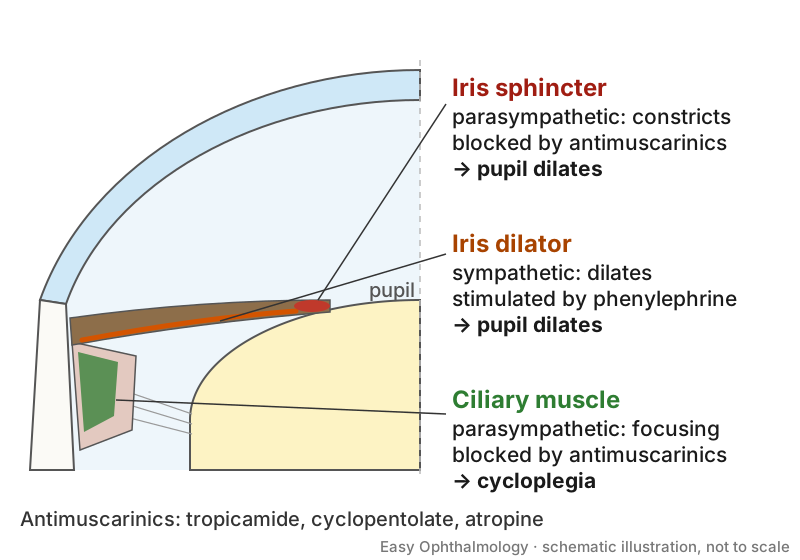
- Strength of cycloplegia. Atropine is the strongest and is recommended for large accommodative esotropia; cyclopentolate is effective even for moderate to high hyperopia and is the standard for paediatric cycloplegic examination [S5].
- Cyclopentolate vs tropicamide. A meta-analysis of 6 studies (3 RCTs, 3 case-control) found no statistically significant overall difference in refraction (0.175 D more plus with cyclopentolate), with very high heterogeneity; cyclopentolate was stronger in children, hyperopes and with retinoscopy [S2].
Manage it: safe use
Before acting on this section, check the national and local guidelines, product information and regulatory approvals that apply where you practise. See the medical disclaimer.
Tier A (primary care / no specialist)
- Before dilating, ask about previous angle closure and about systemic drugs listed above [S1].
- Teach and use punctal occlusion after each drop to reduce systemic absorption [S8].
- Warn patients about blurred vision and photophobia, which are expected and temporary [S8].
Tier B (general eye clinic)
- Paediatric refraction. Doses and concentrations: as reported in [S5], American Optometric Association guidance recommends cyclopentolate 0.5% in infants and cyclopentolate 1% over one year of age; American Academy of Ophthalmology guidance recommends a cyclopentolate-phenylephrine combination under six months and cyclopentolate 1% over six months. The two guidelines differ on the age cut-off [S5].
- One review advises avoiding 2% cyclopentolate and using lower concentrations, preferably combined with another mydriatic such as phenylephrine, as reported in [S8].
- Drops and spray instillation were equally efficacious [S5].
- Traumatic iridocyclitis. A Cochrane review found no RCTs of mydriatics added to topical corticosteroids, so their benefit is unproven [S7].
- For all other dosing, follow your local formulary.
Tier C (specialist centre)
- Retinopathy of prematurity screening. As reported in [S3], the lowest effective combination appeared to be phenylephrine 1% with cyclopentolate 0.2% (1 drop), and current guideline doses may be unnecessarily high; this rests on underpowered studies [S3]. Microdrops appear the safest effective technique; conjunctival fornix packing and inserts raised blood pressure [S4].
- Cataract surgery. A Cochrane review of 14 RCTs (1670 eyes) could not establish the superiority of topical, intracameral or depot mydriasis [S6]. In one RCT, ocular discomfort was greater with topical than intracameral mydriatics at one week (RR 10.57) and one month (RR 2.51) [S6]. Intracameral agents help in small pupils and floppy iris, but improper preparation or dosing can cause ocular toxicity [S9].
- Atropine for myopia control. Efficacy rose with concentration but may plateau; estimates above 0.1% rest on fewer, smaller trials, as reported in [S10]. Specific prescribing is outside this article; follow local protocols.
Refer when
| Situation | Urgency |
|---|---|
| Suspected acute angle closure after dilation (for example a painful red eye with reduced vision) | Immediate, same-day to an eye unit [S1] [G1] |
| Neuropsychiatric symptoms or unsteadiness after cycloplegic drops | Medical emergency assessment [S8]; follow your national protocol [EIC expert opinion] |
| Patient with suspected narrow angles who needs dilated examination | Routine, for angle assessment; timing per your local service or specialist advice |
Pitfalls
- Forgetting that systemic drugs from other specialties can also trigger angle closure [S1].
- Using high-concentration cyclopentolate in small children and other susceptible patients [S8].
- Relying on tropicamide alone in infants, high hyperopia or strabismus [S2].
- Assuming that standard doses suit preterm infants [S3].
Evidence notes
| Source | Date | Design |
|---|---|---|
| [S1] | 2012 | Narrative literature review (44 articles) |
| [S2] | 2018 | Meta-analysis of 6 studies (3 RCTs, 3 case-control) |
| [S3] | 2019 | Systematic review |
| [S4] | 2020 | Review of 5 primary studies |
| [S5] | 2020 | Narrative review, summarises AOA and AAO guidance |
| [S6] | 2021 | Cochrane systematic review, 14 RCTs |
| [S7] | 2020 | Cochrane systematic review, no eligible RCTs |
| [S8] | 2022 | Narrative mini review |
| [S9] | 2025 | Narrative review |
| [S10] | 2026 | Dose-response meta-analysis of 33 RCTs |
- Most evidence on safety is from narrative reviews and case reports; the ROP literature is underpowered with unclear to high risk of bias [S3].
- The Cochrane cataract review rated most evidence low or very low certainty; cardiovascular adverse events were rarely reported [S6].
- Guideline doses cited in [S5] are as summarised by that review, not taken from the guideline documents.
- Not covered by these sources: incidence of angle closure after diagnostic dilation, phenylephrine cardiovascular risk in adults, management of anticholinergic toxicity, and reversal agents.
Related articles
References
See the numbered source list below. Each marker [S#] links to its PubMed and DOI record.
Sources
- [S1] Lai JS, Gangwani RA Medication-induced acute angle closure attack. Hong Kong medical journal = Xianggang yi xue za zhi. (2012). PubMed 22477738
- [S2] Yazdani N, Sadeghi R, Momeni-Moghaddam H, Zarifmahmoudi L, Ehsaei A Comparison of cyclopentolate versus tropicamide cycloplegia: A systematic review and meta-analysis. Journal of optometry. (2018). PubMed 29132914 · doi:10.1016/j.optom.2017.09.001
- [S3] Kremer LJ, Reith DM, Medlicott N, Broadbent R Systematic review of mydriatics used for screening of retinopathy in premature infants. BMJ paediatrics open. (2019). PubMed 31206081 · doi:10.1136/bmjpo-2019-000448
- [S4] Seliniotaki AK, Prousali E, Lithoxopoulou M, Kokkali S, Ziakas N, Soubasi V, et al. Alternative mydriasis techniques for retinopathy of prematurity screening. International ophthalmology. (2020). PubMed 32772218 · doi:10.1007/s10792-020-01542-x
- [S5] Major E, Dutson T, Moshirfar M Cycloplegia in Children: An Optometrist's Perspective. Clinical optometry. (2020). PubMed 32904515 · doi:10.2147/opto.s217645
- [S6] Iftikhar M, Abariga SA, Hawkins BS, Zafar S, Mir TA, Jampel H, et al. Pharmacologic interventions for mydriasis in cataract surgery. The Cochrane database of systematic reviews. (2021). PubMed 34043237 · doi:10.1002/14651858.cd012830.pub2
- [S7] Hom J, Sarwar S, Kaleem MA, Messina CR, Abariga SA, Nguyen QD Topical mydriatics as adjunctive therapy for traumatic iridocyclitis. The Cochrane database of systematic reviews. (2020). PubMed 35659470 · doi:10.1002/14651858.cd013260.pub2
- [S8] Contreras-Salinas H, Orozco-Ceja V, Romero-López MS, Barajas-Virgen MY, Baiza-Durán LM, Rodríguez-Herrera LY Ocular Cyclopentolate: A Mini Review Concerning Its Benefits and Risks. Clinical ophthalmology (Auckland, N.Z.). (2022). PubMed 36411874 · doi:10.2147/opth.s388982
- [S9] Bektas C, Yuksel E Intracameral medications in cataract surgery. International ophthalmology. (2025). PubMed 40381121 · doi:10.1007/s10792-025-03554-x
- [S10] Zhang XJ, Liu M, Yu M, Ho ECF, Wong RTC, Zaabaar E, et al. Efficacy, tolerability, and threshold effect of atropine eye drops for myopia control: A systematic review and dose-response meta-analysis. Survey of ophthalmology. (2026). PubMed 42070753 · doi:10.1016/j.survophthal.2026.04.002
Guidelines
- [G1] NHS Scotland Community Eyecare Guidelines. 6.4 Glaucoma, Acute Angle Closure (n.d.). https://www.eyes.nhs.scot/eyecare-guidelines/section-6-glaucoma/64-glaucoma-acute-angle-closure/