Educational content only. Not personalised medical advice. Clinical decisions remain the responsibility of the treating clinician.
Optical myopia control: spectacle lenses, contact lenses and orthokeratology
Optical myopia control uses spectacle lenses, soft multifocal contact lenses or orthokeratology (ortho-K) to slow refractive progression and axial elongation in children [S8]. Randomised trials show meaningful effects for several designs, but the 2025 Cochrane review rates much of the evidence as low or very low certainty [S8]. Spectacles are the least invasive option and have the lowest dropout [S9] [S11].
Key points - Myopia control spectacle lenses reduced axial elongation by 0.15 mm and refractive progression by 0.31 D versus single-vision lenses in a 2026 meta-analysis of 23 RCTs [S9]. - Highly aspherical lenslet (HAL) and DIMS spectacle lenses had the largest effects among spectacle designs [S9]; longer daily wear improved HAL efficacy [S4]. - Daily disposable dual-focus and high-add (+2.50 D) multifocal soft contact lenses slowed progression over 3 years [S2] [S3]. - Ortho-K reduces axial elongation (moderate-certainty evidence) [S8] but carried a higher adverse event risk than conventional contact lenses in one meta-analysis [S5]. - Dropout ranged from 6% to 21% per year, lowest for spectacles and highest for soft contact lenses [S11].
Evidence last checked: 2026-10-17 (PubMed abstracts).
Red flags
- Painful red eye in a contact lens or ortho-K wearer. Ortho-K wearers were up to 3.79 times more likely to have an adverse event than conventional contact lens wearers [S5]. Corneal infiltrative events were seen in a soft lens trial [S2].
- Progression above guideline thresholds on treatment. More than 0.50 D per year, or axial elongation above 0.3 mm (until age 10) or 0.2 mm (above 11) [S6].
- Stopping ortho-K. Axial elongation rebounded after discontinuation (MD 0.10 mm) [S5].
Recognise it: who may benefit
- Trials enrolled children aged about 7 to 13 years with low to moderate myopia, for example -1.00 to -5.00 D (DIMS) [S1], -0.75 to -4.75 D (HAL) [S4] and -0.75 to -4.00 D (MiSight) [S2].
- Most trials were done in China or other Asian countries (66.3%) [S8]; a Polish RCT found DIMS effective in European children [S10].
Confirm it: baseline and monitoring
- The Brazilian guideline recommends corneal topography, cycloplegic refraction every 6 months and annual optical biometry, more often for fast progressors [S6].
- Trials measured outcomes by cycloplegic autorefraction and axial length [S1] [S3].
Manage it
Before acting on this section, check the national and local guidelines, product information and regulatory approvals that apply where you practise. See the medical disclaimer.
Tier A (primary care / no specialist)
- Correct myopia and refer a child with myopia for assessment of myopia control where it is available [S6].
- Where only single-vision spectacles are available, these remain the control comparator in all the trials, not an active treatment [S9].
Tier B (general eye clinic)
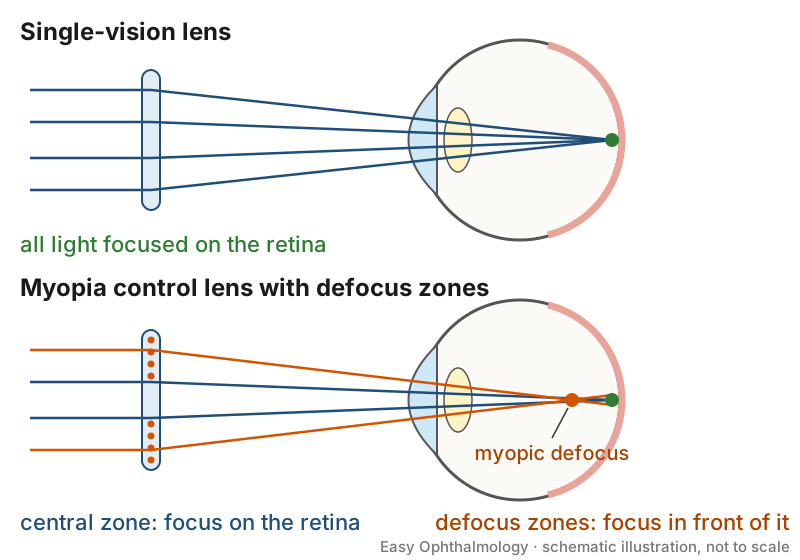
- Spectacle lenses (first-line where available and affordable). - DIMS (+3.50 D myopic defocus segments): over 2 years, progression -0.41 D vs -0.85 D with single vision; axial elongation 0.21 vs 0.55 mm [S1]. - HAL: over 2 years, refractive progression slowed by 0.80 D and axial elongation by 0.35 mm vs single vision; in children wearing HAL at least 12 hours a day, by 0.99 D and 0.41 mm [S4]. - Pooled: HAL -0.28 mm and -0.52 D; DIMS -0.45 D, with only one RCT reporting axial length; other lens types had modest or variable effects [S9]. - In Polish children, DIMS gave less axial elongation than 0.01% atropine at 12 months (0.11 vs 0.19 mm), mainly in 6 to 11 year olds [S10].
- Encourage full-time wear. Efficacy depended on wearing time for HAL [S4].
- Duration. The guideline advises sustained treatment for at least 2 years [S6].
Tier C (specialist centre)
- Soft multifocal contact lenses. - MiSight 1-day (dual-focus daily disposable): over 3 years, -0.51 vs -1.24 D and 0.30 vs 0.62 mm compared with a single-vision daily lens; no serious ocular adverse events [S2]. - BLINK: high add (+2.50 D) slowed 3-year progression by 0.46 D vs single vision; medium add (+1.50 D) did not differ significantly [S3]. - After stopping high-add lenses in older teenagers, growth returned to age-expected rates without loss of the earlier effect [S7].
- Orthokeratology. Cochrane: MD -0.18 mm axial elongation at 1 year, moderate certainty [S8]. A meta-analysis found 1-year axial elongation 0.16 mm lower than other modalities, but noted selection bias favouring ortho-K and an underdeveloped safety evidence base [S5].
- Combinations. Ortho-K plus low-dose atropine probably reduces axial elongation more than ortho-K alone (MD -0.12 mm, moderate certainty) [S8]. The guideline lists combinations for uncontrolled cases [S6].
- Retention. Discuss handling and follow-up burden; reasons for dropout differ by modality [S11].
Refer when
| Situation | Urgency |
|---|---|
| Contact lens or ortho-K wearer with pain, redness, photophobia or reduced vision | Same-day |
| Progression above guideline thresholds despite optical treatment | Routine, for combined treatment [S6]; timing per your local service or specialist advice |
| Child with myopia where no myopia control is available locally | Routine; timing per your local service or specialist advice |
Pitfalls
- Treating all "myopia control" lenses as equal: effects vary by design [S9] and add power [S3].
- Ignoring wearing time [S4].
- Underestimating ortho-K risks and rebound on stopping [S5].
- Generalising Asian trial data without caution, although European data are emerging [S8] [S10].
Evidence notes
| Source | Date | Design |
|---|---|---|
| [S1] | 2020 | Double-masked RCT, 183 Chinese children (DIMS) |
| [S2] | 2019 | Multicentre double-masked RCT, 3 years (MiSight) |
| [S3] | 2020 | Double-masked RCT, 294 children, USA (BLINK) |
| [S4] | 2022 | Double-masked RCT, China (HAL, SAL) |
| [S5] | 2024 | Systematic review and meta-analysis, 45 papers (ortho-K) |
| [S6] | 2024 | National guideline (Brazil), expert consensus |
| [S7] | 2025 | Cohort follow-up of BLINK trial (BLINK2) |
| [S8] | 2025 | Cochrane living systematic review and NMA, 104 RCTs |
| [S9] | 2026 | Meta-analysis of 23 RCTs (spectacle lenses) |
| [S10] | 2025 | RCT, 110 Polish children, 1-year interim |
| [S11] | 2025 | Systematic review of 57 trials (dropout) |
- Cochrane certainty for optical interventions ranges from very low to moderate, with heterogeneous results and limited data beyond 2 years [S8].
- The Polish trial is an interim 1-year report of an ongoing study [S10].
- The ortho-K meta-analysis searched only to 2021 [S5].
- The authors of BLINK state that the clinical importance of the observed differences needs further research [S3].
- Not covered by these sources: cost and availability in low-income settings, lens hygiene protocols and ortho-K fitting technique.
Related articles
- Low-dose atropine for myopia control
- Contact lens complications and safe wear
- Outdoor time and the prevention of myopia
References
See the numbered source list below. Each marker [S#] links to its PubMed and DOI record.
Sources
- [S1] Lam CSY, Tang WC, Tse DY, Lee RPK, Chun RKM, Hasegawa K, et al. Defocus Incorporated Multiple Segments (DIMS) spectacle lenses slow myopia progression: a 2-year randomised clinical trial. The British journal of ophthalmology. (2020). PubMed 31142465 · doi:10.1136/bjophthalmol-2018-313739
- [S2] Chamberlain P, Peixoto-de-Matos SC, Logan NS, Ngo C, Jones D, Young G A 3-year Randomized Clinical Trial of MiSight Lenses for Myopia Control. Optometry and vision science : official publication of the American Academy of Optometry. (2019). PubMed 31343513 · doi:10.1097/opx.0000000000001410
- [S3] Walline JJ, Walker MK, Mutti DO, Jones-Jordan LA, Sinnott LT, Giannoni AG, et al. Effect of High Add Power, Medium Add Power, or Single-Vision Contact Lenses on Myopia Progression in Children: The BLINK Randomized Clinical Trial. JAMA. (2020). PubMed 32780139 · doi:10.1001/jama.2020.10834
- [S4] Bao J, Huang Y, Li X, Yang A, Zhou F, Wu J, et al. Spectacle Lenses With Aspherical Lenslets for Myopia Control vs Single-Vision Spectacle Lenses: A Randomized Clinical Trial. JAMA ophthalmology. (2022). PubMed 35357402 · doi:10.1001/jamaophthalmol.2022.0401
- [S5] Sartor L, Hunter DS, Vo ML, Samarawickrama C Benefits and risks of orthokeratology treatment: a systematic review and meta-analysis. International ophthalmology. (2024). PubMed 38904856 · doi:10.1007/s10792-024-03175-w
- [S6] Ejzenbaum F, Schaefer TMC, Cunha C, Rossetto JD, Godinho IF, Nakanami CR, et al. Guidelines for preventing and slowing myopia progression in Brazilian children. Arquivos brasileiros de oftalmologia. (2024). PubMed 39109702 · doi:10.5935/0004-2749.2023-0009
- [S7] Berntsen DA, Ticak A, Orr DJ, Giannoni AG, Sinnott LT, Mutti DO, et al. Axial Growth and Myopia Progression After Discontinuing Soft Multifocal Contact Lens Wear. JAMA ophthalmology. (2025). PubMed 39821272 · doi:10.1001/jamaophthalmol.2024.5885
- [S8] Lawrenson JG, Huntjens B, Virgili G, Ng S, Dhakal R, Downie LE, et al. Interventions for myopia control in children: a living systematic review and network meta-analysis. The Cochrane database of systematic reviews. (2025). PubMed 39945354 · doi:10.1002/14651858.cd014758.pub3
- [S9] D'Andrea L, Rinaldi M, Piscopo R, Iorio F, La Padula S, Maqsood S, et al. Efficacy of spectacle lenses for myopia control: a meta-analysis of randomised controlled trials. The British journal of ophthalmology. (2026). PubMed 40912901 · doi:10.1136/bjo-2025-327629
- [S10] Wnękowicz-Augustyn E, Wylęgała E, Kobielnik M, Teper S Defocus Incorporated Multiple Segments (DIMS) spectacle lenses versus 0.01% atropine for myopia control: a randomised trial in children from Central Europe. BMJ open ophthalmology. (2025). PubMed 41225785 · doi:10.1136/bmjophth-2025-002329
- [S11] Santodomingo-Rubido J, Martínez-Pérez C, Villa-Collar C Dropout rates among optical interventions for myopia control: a systematic review. Contact lens & anterior eye : the journal of the British Contact Lens Association. (2025). PubMed 41481944 · doi:10.1016/j.clae.2025.102601