Educational content only. Not personalised medical advice. Clinical decisions remain the responsibility of the treating clinician.
Acquired Nasolacrimal Duct Obstruction and Dacryocystorhinostomy
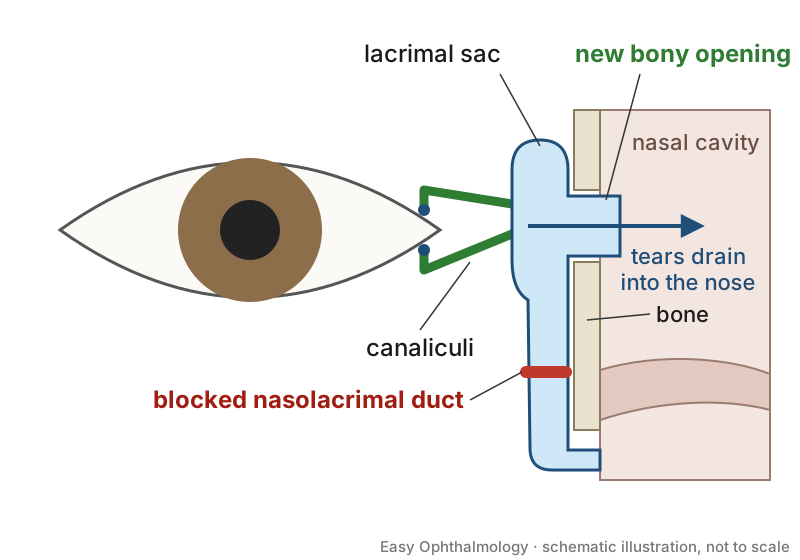
Acquired nasolacrimal duct obstruction (NLDO) causes overflow of tears (epiphora) or infection of the lacrimal sac (dacryocystitis); it mostly affects women, and its cause is not fully understood [S6]. Dacryocystorhinostomy (DCR) restores drainage by creating a bony ostium between the lacrimal sac and the nasal cavity, by an external or endonasal route [S3]. DCR is an effective and safe treatment [S1].
Key points - External DCR and endoscopic (endonasal) DCR are the treatments of choice for distal acquired obstruction, with mean success of 89.8% and 89.5% in a meta-analysis of 9337 procedures [S7]. - Mechanical endoscopic DCR gives results comparable to external DCR without a skin scar; laser-assisted endonasal DCR does worse [S2] [S3]. - Mitomycin C at DCR improves functional success beyond six months (moderate certainty) [S6]. Silicone stents give at most a small benefit [S4] [S5]. - In acute dacryocystitis, early DCR gives faster symptom relief with comparable or better success than delayed surgery [S11] [S9].
Evidence last checked: 2026-10-17 (PubMed abstracts).
Red flags
- Acute dacryocystitis spreading: in an RCT, patients waiting for delayed DCR developed skin fistulae (10 patients) and orbital cellulitis (4 patients) before surgery [S9].
- Orbital signs (proptosis, reduced eye movements or vision) with a red, swollen sac: treat as orbital cellulitis.
- Atypical sac mass or bloody tears: consider tumour; DCR is also performed during tumour surgery [S2]. Detailed tumour features are not covered here.
Recognise it

- Epiphora (watering) and dacryocystitis (sac infection) are the two presentations [S6].
- Post-canalicular (distal) lacrimal obstruction is the primary cause of epiphora [S7].
- Partial and complete obstruction behave differently with minimally invasive treatment [S8].
Confirm it
- Syringing (irrigation) demonstrates patency; trials used anatomical patency on irrigation, or fluorescein seen endoscopically at the ostium, as success measures [S3].
- Symptoms: subjective success is resolution of watering after at least six months [S3]. Outcome measures were not consistent across DCR studies [S1].
- Dacryoscintigraphy was used in some studies to confirm patency [S2].
Manage it
Before acting on this section, check the national and local guidelines, product information and regulatory approvals that apply where you practise. See the medical disclaimer.
Tier A (primary care / no specialist)
- Recognise the watering eye and the swollen, tender medial canthus of acute dacryocystitis; refer [S9].
- Acute dacryocystitis: start systemic antibiotics per local protocol and refer promptly; in the RCT the delayed group received 2 to 5 days of systemic antibiotics before surgery [S9]. Antibiotic choice and doses are not covered by these sources.
Tier B (general eye clinic)
- Syringe to confirm obstruction and distinguish partial from complete [S8].
- Balloon dacryoplasty: mean success 73.29% for partial NLDO but 36.67% for complete NLDO; it is not effective for complete obstruction and recurrence is high [S8].
- Non-surgical options overall: balloon dacryoplasty (48.9%) and probing-stenting (54.4%) had lower success than DCR in the meta-analysis [S7].
- External DCR is still considered the gold standard for distal obstruction [S12]; success ranged from 65% to 100% in older series, with overall intraoperative and postoperative complication rates of 1.0% and 6% [S1].
Tier C (specialist centre)
- Endoscopic DCR: mechanical endoscopic DCR was comparable to external DCR (RR 1.02), with much less scarring and infection [S2]. In the Cochrane review, mechanical endonasal and external DCR both succeeded in 90%, while laser-assisted endonasal DCR succeeded in 63% vs 91% for external DCR [S3]; the evidence was very low certainty.
- Mitomycin C: a Cochrane review of 23 trials: no effect on functional success at six months (low certainty) but improved functional (RR 1.15) and anatomical success beyond six months (moderate certainty); adverse events were rare [S6]. Doses varied between trials and are not given in the abstract: follow local protocols.
- Silicone stents: a meta-analysis of 14 RCTs found a 5% improvement in success with intubation [S4]; for endoscopic DCR, success was 94% with stents vs 90.6% without, with low-quality evidence [S5]. Another meta-analysis found no difference with stenting [S7].
- Acute dacryocystitis: in an RCT of 160 adults, immediate endoscopic DCR gave quicker resolution and higher 12-month success (94.2% vs 83.8%) than DCR after 2 to 5 days of antibiotics [S9]. A meta-analysis of 6 studies (288 patients) found comparable success with faster symptom resolution [S11].
- Revision DCR: the approach the surgeon is most comfortable with can be used, except that failed transcanalicular laser DCR should be revised externally [S10].
Refer when
| Situation | Urgency |
|---|---|
| Acute dacryocystitis with orbital signs or reduced vision | Immediate, same-day [G1] |
| Acute dacryocystitis without orbital signs | Within days, for antibiotics and consideration of early DCR [S9] [S11] |
| Chronic epiphora with confirmed obstruction | Routine, within months, for DCR [S7] [G2] |
Pitfalls
- Offering balloon dacryoplasty for complete obstruction [S8].
- Assuming all endonasal DCR is equal: laser-assisted techniques do worse [S2] [S3].
- Revising a failed laser DCR with the same laser method [S10].
- Delaying surgery in acute dacryocystitis while complications develop [S9].
Evidence notes
| Source | Date | Design |
|---|---|---|
| [S1] | 2010 | Systematic review, 73 studies, mostly level 4 |
| [S2] | 2014 | Meta-analysis, 4 RCTs and 15 cohorts |
| [S3] | 2017 | Cochrane review, 2 small RCTs |
| [S4] | 2018 | Meta-analysis of 14 RCTs |
| [S5] | 2020 | Meta-analysis of RCTs, endoscopic DCR |
| [S6] | 2020 | Cochrane review, antimetabolites |
| [S7] | 2020 | Meta-analysis, 55 studies |
| [S8] | 2021 | Systematic review, 13 studies |
| [S9] | 2022 | RCT, 160 patients (stated level of evidence 3) |
| [S10] | 2023 | Meta-analysis, revision DCR |
| [S11] | 2024 | Meta-analysis, 6 studies |
| [S12] | 2025 | Systematic review, 64 articles |
- External vs endonasal evidence from RCTs is very low certainty and conflicting [S3]; observational meta-analyses favour mechanical endoscopic DCR as equivalent [S2] [S7].
- Stent evidence conflicts between meta-analyses [S4] [S5] [S7].
- Outcome definitions vary widely across DCR studies [S1].
- Not covered by these sources: canalicular obstruction, lacrimal tumours, antibiotic regimens, and outcomes from low- and middle-income settings.
Related articles
References
See the numbered source list below. Each marker [S#] links to its PubMed and DOI record.
Sources
- [S1] Leong SC, Macewen CJ, White PS A systematic review of outcomes after dacryocystorhinostomy in adults. American journal of rhinology & allergy. (2010). PubMed 20109333 · doi:10.2500/ajra.2010.24.3393
- [S2] Huang J, Malek J, Chin D, Snidvongs K, Wilcsek G, Tumuluri K, et al. Systematic review and meta-analysis on outcomes for endoscopic versus external dacryocystorhinostomy. Orbit (Amsterdam, Netherlands). (2014). PubMed 24354575 · doi:10.3109/01676830.2013.842253
- [S3] Jawaheer L, MacEwen CJ, Anijeet D Endonasal versus external dacryocystorhinostomy for nasolacrimal duct obstruction. The Cochrane database of systematic reviews. (2017). PubMed 28231605 · doi:10.1002/14651858.cd007097.pub3
- [S4] Ing EB, Bedi H, Hussain A, Zakrewski H, Ing R, Nijhawan N, et al. Meta-analysis of randomized controlled trials in dacryocystorhinostomy with and without silicone intubation. Canadian journal of ophthalmology. Journal canadien d'ophtalmologie. (2018). PubMed 30340712 · doi:10.1016/j.jcjo.2017.12.006
- [S5] Orsolini MJ, Schellini SA, Souza Meneguim RLF, Catâneo AJM Success of endoscopic dacryocystorhinostomy with or without stents: systematic review and meta-analysis. Orbit (Amsterdam, Netherlands). (2020). PubMed 31662017 · doi:10.1080/01676830.2019.1677726
- [S6] Phelps PO, Abariga SA, Cowling BJ, Selva D, Marcet MM Antimetabolites as an adjunct to dacryocystorhinostomy for nasolacrimal duct obstruction. The Cochrane database of systematic reviews. (2020). PubMed 32259290 · doi:10.1002/14651858.cd012309.pub2
- [S7] Vinciguerra A, Nonis A, Giordano Resti A, Bussi M, Trimarchi M Best treatments available for distal acquired lacrimal obstruction: A systematic review and meta-analysis. Clinical otolaryngology : official journal of ENT-UK ; official journal of Netherlands Society for Oto-Rhino-Laryngology & Cervico-Facial Surgery. (2020). PubMed 32304619 · doi:10.1111/coa.13551
- [S8] Poignet B, Sultanik P, Beaujeux P, Koch E, Benkhatar H Primary balloon dacryoplasty for nasolacrimal duct obstruction in adults: a systematic review. Orbit (Amsterdam, Netherlands). (2021). PubMed 32912011 · doi:10.1080/01676830.2020.1818264
- [S9] Yu B, Tu Y, Zhou G, Hong H, Wu W Immediate Endoscopic Dacryocystorhinostomy in Patients With New Onset Acute Dacryocystitis. The Laryngoscope. (2022). PubMed 34125440 · doi:10.1002/lary.29693
- [S10] Van Swol JM, Myers WK, Nguyen SA, Eiseman AS Revision dacryocystorhinostomy: systematic review and meta-analysis. Orbit (Amsterdam, Netherlands). (2023). PubMed 35942566 · doi:10.1080/01676830.2022.2109178
- [S11] Li J, Wang J, Sun C Early Endonasal Dacryocystorhinostomy for Acute Dacryocystitis: A Systematic Review and Meta-Analysis. American journal of rhinology & allergy. (2024). PubMed 38444220 · doi:10.1177/19458924241237009
- [S12] Locatello LG, De Zan ER, Tarantini A, Lanzetta P, Miani C External dacryocystorhinostomy: A critical overview of the current evidence. European journal of ophthalmology. (2025). PubMed 38689455 · doi:10.1177/11206721241249214
Guidelines
- [G1] NHS Scotland Community Eyecare Guidelines. 2.3 Dacryocystitis, Acute (2026). https://www.eyes.nhs.scot/eyecare-guidelines/section-2-orbitlacrimal-system/23-dacryocystitis-acute/
- [G2] NHS Scotland Community Eyecare Guidelines. 2.8 Nasolacrimal Duct Obstruction, Acquired (n.d.). https://www.eyes.nhs.scot/eyecare-guidelines/section-2-orbitlacrimal-system/28-nasolacrimal-duct-obstruction-acquired/