Educational content only. Not personalised medical advice. Clinical decisions remain the responsibility of the treating clinician.
Normal-Tension Glaucoma
Normal-tension glaucoma (NTG) is glaucomatous optic neuropathy with open angles and intraocular pressure (IOP) within the normal range, below 21 mmHg [S3] [S5]. It is described as more prevalent in Asia than in Western countries [S5], and it is a diagnosis made by excluding other, non-glaucomatous optic neuropathies [S5].
Key points - NTG is a diagnosis of exclusion: neurological disease can mimic it on disc appearance, and ocular ischaemic syndrome can present with it [S1] [S2] [S5]. - Lowering IOP, even from "normal" levels, is the mainstay of treatment in narrative reviews; IOP-independent treatments remain unproven [S5] [S7]. - Across open-angle glaucoma including NTG, disc haemorrhage, bilateral disease and female sex were associated with progression, and treatment was protective (low to moderate certainty) [S10]. - Untreated NTG progressed more slowly on average than high-tension glaucoma or pseudoexfoliation glaucoma, but individual rates vary widely [S6].
Evidence last checked: 2026-10-17 (PubMed abstracts).
Red flags
- Signs that suggest another cause: findings of ocular ischaemic syndrome such as iris neovascularisation, asymmetric cataract, mid-peripheral retinal haemorrhages or narrowed retinal arteries point to carotid disease [S1].
- Disc appearance that may be neurological: neurological diseases may mimic NTG, and a focused systemic work-up can uncover life-threatening disease [S2].
- Disc haemorrhage: associated with progression in open-angle glaucoma (adjusted HR 2.03, low certainty) [S10].
Recognise it: features and associations
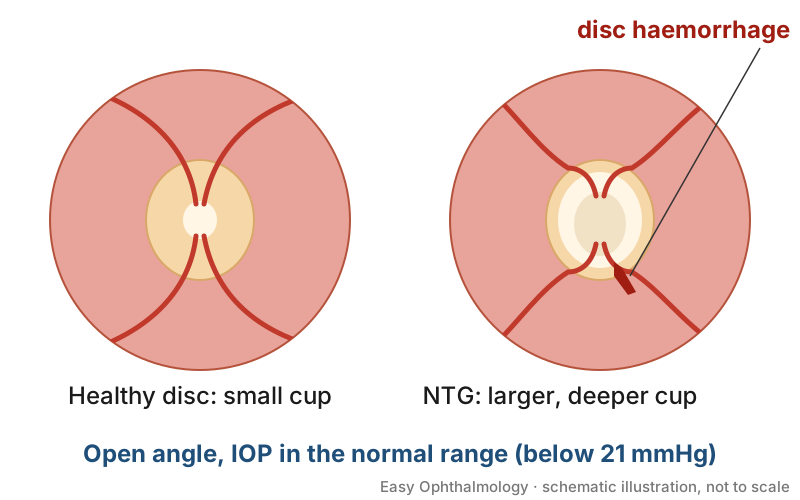
- Compared with high-pressure POAG, NTG shows larger and deeper cupping, more central field defects and more disc haemorrhages, according to a narrative review [S5].
- Proposed associations include low vascular perfusion, Raynaud phenomenon, migraine, nocturnal systemic hypotension and over-treated systemic hypertension [S3]. In the Cochrane prognostic review, migraine, Raynaud syndrome, systemic hypertension and cardiovascular disease did not show consistent effects on progression (very low to low certainty) [S10]. These sources conflict.
- Nocturnal hypotension and sleep apnoea may contribute to progression [S2].
Confirm it
- Tools listed in a narrative review: Goldmann applanation tonometry, gonioscopy, slit-lamp examination, OCT and visual field analysis [S3].
- Exclude ocular ischaemic syndrome with carotid imaging and fluorescein angiography where suspected [S1].
- Consider a systemic work-up where features suggest a secondary or neurological cause [S2].
- Repeated follow-up examinations are needed to estimate an individual's rate of progression [S6].
Manage it
Before acting on this section, check the national and local guidelines, product information and regulatory approvals that apply where you practise. See the medical disclaimer.
Tier A (primary care / no specialist)
- Refer people with a suspicious optic disc even when IOP is normal.
- Review blood pressure treatment with the patient's physician: antihypertensive choice and low blood pressure may matter in NTG (expert opinion) [S4].
Tier B (general eye clinic)
- Lower IOP. Reviews describe controlling IOP as low as possible with medication, laser trabeculoplasty or surgery as the key to management [S5]. One review states a goal of 30% reduction from baseline to 12 to 14 mmHg (expert opinion, not trial data in the abstract) [S3].
- Drug choice. Betaxolol, brimonidine and prostaglandin analogues are listed in a narrative review [S3]. Ophthalmic beta blockers and systemic antihypertensives need balancing in patients with low blood pressure [S4].
- Nocturnal IOP. Peak IOP often occurs at night, and many current treatments lower nighttime IOP less than daytime IOP (narrative review) [S8].
Tier C (specialist centre)
- Surgery. Trabeculectomy is listed for refractory cases [S3].
- Neuroprotection. In a 12-week crossover RCT of 53 NTG patients already on IOP-lowering therapy, oral nicotinamide (1 g/day for 6 weeks, then 2 g/day for 6 weeks, as reported in [S9]) improved electroretinogram responses but not visual field indices [S9]. Long-term data are needed [S9].
- Other IOP-independent options (vasoactive, antioxidant, anti-inflammatory) remain inconclusive [S7]. Systemic calcium channel blockers are mentioned in one review without supporting data in the abstract [S3].
- Ocular ischaemic syndrome needs referral to neurology, vascular surgery and cardiology [S1].
Refer when
| Situation | Urgency |
|---|---|
| Signs of ocular ischaemic syndrome (carotid disease) | Urgent to vascular or neurology services [S1]; timing per your local service or specialist advice |
| Disc or field findings not typical of glaucoma (possible neurological cause) | Urgent for neuro-ophthalmic work-up [S2]; timing per your local service or specialist advice |
| Suspected NTG with normal IOP | Routine to a glaucoma service; timing per your local service or specialist advice |
Pitfalls
- Dismissing glaucoma because IOP is normal [S3] [S5].
- Labelling every pale or cupped disc as NTG without excluding other optic neuropathies [S2] [S5].
- Over-treating systemic hypertension in patients with NTG (expert opinion) [S3] [S4].
- Promising benefit from supplements or vascular drugs [S7] [S9].
Evidence notes
| Source | Date | Design |
|---|---|---|
| [S1] | 2012 | Systematic review (ocular ischaemic syndrome) |
| [S2] | 2014 | Narrative review |
| [S3] | 2016 | Narrative review |
| [S4] | 2020 | Expert opinion review |
| [S5] | 2020 | Narrative review (Asia) |
| [S6] | 2023 | Systematic review of 43 natural history studies |
| [S7] | 2023 | Narrative review |
| [S8] | 2024 | Narrative review |
| [S9] | 2026 | Crossover RCT, 53 patients, 12 weeks |
| [S10] | 2025 | Cochrane prognostic review, 22 studies, 6082 participants |
- Thin evidence. The search sheet for this topic held mostly narrative reviews; no randomised trial of IOP lowering in NTG was available, so the article is shorter and treatment statements rest largely on expert opinion [S3] [S5] [S7].
- The Cochrane review covered POAG, NTG and pseudoexfoliation glaucoma together, and 86% of its studies were at high risk of bias [S10].
- The nicotinamide trial was short, without washout between periods, and measured electrophysiology rather than progression [S9].
- Not covered by these sources: randomised evidence for IOP lowering in NTG, the role of neuroimaging, 24-hour blood pressure monitoring protocols, and NTG in African populations.
Related articles
- Primary Open-Angle Glaucoma: Diagnosis and Treatment Targets
- Optic disc assessment in glaucoma
- Visual field testing and interpretation
References
See the numbered source list below. Each marker [S#] links to its PubMed and DOI record.
Sources
- [S1] Terelak-Borys B, Skonieczna K, Grabska-Liberek I Ocular ischemic syndrome - a systematic review. Medical science monitor : international medical journal of experimental and clinical research. (2012). PubMed 22847215 · doi:10.12659/msm.883260
- [S2] Emanuel ME, Gedde SJ Indications for a systemic work-up in glaucoma. Canadian journal of ophthalmology. Journal canadien d'ophtalmologie. (2014). PubMed 25433739 · doi:10.1016/j.jcjo.2014.10.001
- [S3] Mallick J, Devi L, Malik PK, Mallick J Update on Normal Tension Glaucoma. Journal of ophthalmic & vision research. (2016). PubMed 27413503 · doi:10.4103/2008-322x.183914
- [S4] Shukla AG, Razeghinejad R, Myers JS Balancing treatments for patients with systemic hypertension and glaucoma. Expert opinion on pharmacotherapy. (2020). PubMed 32835542 · doi:10.1080/14656566.2020.1810235
- [S5] Chen MJ Normal tension glaucoma in Asia: Epidemiology, pathogenesis, diagnosis, and management. Taiwan journal of ophthalmology. (2020). PubMed 33437596 · doi:10.4103/tjo.tjo_30_20
- [S6] Lauwers A, Barbosa Breda J, Stalmans I The natural history of untreated ocular hypertension and glaucoma. Survey of ophthalmology. (2023). PubMed 36563707 · doi:10.1016/j.survophthal.2022.12.001
- [S7] Salvetat ML, Pellegrini F, Spadea L, Salati C, Zeppieri M Pharmaceutical Approaches to Normal Tension Glaucoma. Pharmaceuticals (Basel, Switzerland). (2023). PubMed 37631087 · doi:10.3390/ph16081172
- [S8] Huang AS, Mai AP, Goldberg JL, Samuelson TW, Morgan WH, Herndon L, et al. The Benefit of Nocturnal IOP Reduction in Glaucoma, Including Normal Tension Glaucoma. Clinical ophthalmology (Auckland, N.Z.). (2024). PubMed 39525872 · doi:10.2147/opth.s494949
- [S9] Ha A, Kim YK, Lee CK, Williams PA, Morgan JE, Shin YI, et al. Effects of nicotinamide supplementation in normal-tension glaucoma: a crossover placebo-controlled randomised clinical trial. The British journal of ophthalmology. (2026). PubMed 41167798 · doi:10.1136/bjo-2025-328096
- [S10] Piyasena MP, Daka Q, Qureshi R, Roberti G, Michelessi M, Liu SH, et al. Prognostic factors associated with progression of open-angle glaucoma in adults. The Cochrane database of systematic reviews. (2025). PubMed 41370133 · doi:10.1002/14651858.cd015436.pub2