Educational content only. Not personalised medical advice. Clinical decisions remain the responsibility of the treating clinician.
Nutritional and Toxic Optic Neuropathy
Nutritional optic neuropathy causes bilateral, symmetrical, progressive loss of central vision, contrast and colour, with a central or centrocaecal scotoma [S6]. It is under-recognised but often reversible when diagnosed and treated in time [S7]. Toxic-environmental causes such as methanol in illicit or homemade alcohol can cause permanent blindness and death, and are a public health problem in lower socioeconomic populations and where alcohol access is restricted [S9] [S11] [S12]. Drug-induced optic neuropathy is covered in the pharmacology article.
Key points - Clear evidence links optic neuropathy to deficiency of cobalamin (vitamin B12), folic acid, thiamine and copper; the roles of niacin, riboflavin and pyridoxine need further study [S6]. - Deficiency was long seen as a problem of developing countries, but bariatric surgery, restrictive diets and alcohol dependence now cause it worldwide [S7]. - Treatment is to identify and replace deficient nutrients and remove contributory toxins, while addressing social and economic factors [S5]. - Methanol optic neuropathy is an emergency; MRI shows optic nerve injury in about one-third of poisoned patients [S12]. Steroids and erythropoietin are used, but evidence is limited to uncontrolled or non-randomised studies [S2] [S4] [S10]. - In parts of Africa, monotonous cassava diets are associated with tropical ataxic neuropathy, which includes bilateral optic atrophy [S1].
Evidence last checked: 2026-10-17 (PubMed abstracts).
Red flags
- Sudden visual loss after drinking homemade or illicit alcohol: suspect methanol poisoning [S2] [S4]; it is potentially fatal [S12].
- Bilateral central loss after bariatric surgery or on a strict vegan or restrictive diet [S6] [S7].
- Optic neuropathy with hearing loss and painful sensory neuropathy (Strachan syndrome), often after dietary restriction [S8].
- Optic atrophy with sensory ataxia and deafness in someone living on cassava with little protein [S1].
- Late diagnosis: delay risks irreversible optic atrophy [S6].
Recognise it
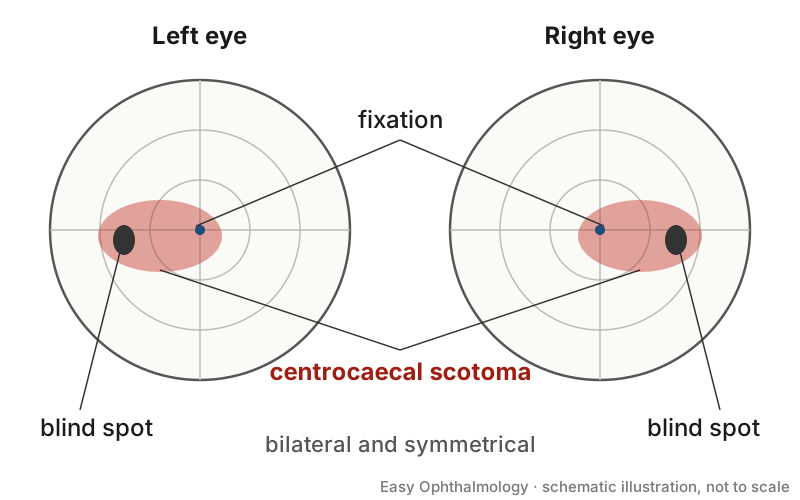
- Clinical picture: bilateral, symmetrical, progressive loss of central acuity and contrast sensitivity, dyschromatopsia and a central or centrocaecal scotoma [S6]. These signs are not pathognomonic: hereditary and toxic optic neuropathies look similar [S6] [S5].
- Who is at risk: people after bariatric surgery, those on strict vegetarian or vegan or restrictive diets, and people with alcohol dependence [S6] [S7]. Social, economic and societal factors contribute [S5].
- Epidemics: the Cuban epidemic optic neuropathy of the early 1990s shaped current understanding [S5].
- Strachan syndrome: optic, auditory and painful peripheral neuropathy, more common in people who are black British, often of Jamaican descent; riboflavin and B12 deficiency are implicated [S8].
- Cassava-associated disease: tropical ataxic neuropathy affects elderly people on a monotonous cassava diet; thiamine deficiency has been proposed as the cause, and the aetiology remains unknown [S1].
- Methanol: methanol is metabolised to formaldehyde and formic acid, inhibiting mitochondrial function [S9].
Confirm it
- Measure the relevant nutrients; cobalamin, folate, thiamine and copper have the clearest evidence [S6].
- OCT: in 45 adults with vitamin B12 deficiency, average and temporal peripapillary nerve fibre layer were thinner than in controls, and temporal thickness correlated with B12 level [S3].
- Methanol: in a meta-analysis of MRI findings, putaminal necrosis was present in 47.6% and optic nerve injury in 36.1%; in-hospital mortality was 7.8% [S12].
- Consider hereditary causes, which overlap clinically [S5] [S6].
Manage it
Before acting on this section, check the national and local guidelines, product information and regulatory approvals that apply where you practise. See the medical disclaimer.
Tier A (primary care / no specialist)
- Ask about diet, alcohol, bariatric surgery and unusual alcohol sources in anyone with bilateral central vision loss [S6] [S7].
- Suspected methanol poisoning: send immediately to emergency care. Systemic treatments discussed in a review include decontamination, ethanol or fomepizole, haemodialysis, fluids and electrolyte correction [S9]; doses are not given in these abstracts, so follow local poisoning protocols.
- Start dietary improvement and supplementation where deficiency is likely, as nutritional replacement is the mainstay of treatment [S5]. Supplement doses are not covered by these abstracts: follow local formularies.
Tier B (general eye clinic)
- Record acuity, colour vision, fields and OCT if available [S3] [S6].
- Replace deficient nutrients and remove toxins; involve physicians and dietitians, as a multidisciplinary approach is fundamental [S5] [S6].
- Riboflavin may benefit Strachan syndrome (case-based review) [S8].
Tier C (specialist centre)
Methanol optic neuropathy (adjunct to systemic toxicology care) 1. High-dose corticosteroids: in a case series of 6 men, acuity improved after intravenous methylprednisolone 250 mg every 6 hours for 4 days, then oral prednisolone 1 mg/kg for 10 days (as reported in [S2]). 2. Erythropoietin: in a non-randomised study, adding intravenous EPO 10,000 IU twice daily for 3 days (as reported in [S4]) to methylprednisolone gave better final acuity than a historical control group (22 patients) [S4]. A systematic review of 11 studies (192 treated patients) found acuity improved in 184, but concurrent steroids and lack of controls prevent judging EPO alone [S10]. Another review found results conflicting compared with steroids alone and no reported adverse events [S11]. 3. MRI helps assess methanol neurotoxicity [S12].
Refer when
| Situation | Urgency |
|---|---|
| Visual loss after homemade or illicit alcohol | Immediate emergency care: potentially fatal [S12] |
| Bilateral progressive central vision loss | Urgent, for diagnosis and nutrient tests; timing per your local service or specialist advice [S7] |
| Optic neuropathy with ataxia, hearing loss or neuropathy | Urgent to neurology; timing per your local service or specialist advice [S1] [S8] |
| Stable patient on supplementation | Routine review; timing per your local service or specialist advice, to confirm the response to replacement [S5] |
Pitfalls
- Assuming nutritional optic neuropathy only occurs in poorer countries [S7].
- Missing a hereditary or toxic cause with an identical picture [S5] [S6].
- Overstating erythropoietin or steroid benefit in methanol poisoning [S10] [S11].
- Treating the eye without addressing diet, alcohol and social circumstances [S5].
Evidence notes
| Source | Date | Design |
|---|---|---|
| [S1] | 2011 | Narrative review (Africa, cassava) |
| [S2] | 2011 | Case series, 6 patients |
| [S3] | 2013 | Controlled cross-sectional study, 45 patients |
| [S4] | 2016 | Non-randomised study with historical controls, 22 patients |
| [S5] | 2019 | Narrative review |
| [S6] | 2020 | Narrative review |
| [S7] | 2022 | Narrative review |
| [S8] | 2024 | Case-based review |
| [S9] | 2025 | Narrative review, methanol |
| [S10] | 2024 | Systematic review, uncontrolled studies |
| [S11] | 2025 | Systematic review, 9 studies |
| [S12] | 2026 | Meta-analysis of MRI prevalence, 13 studies |
- Thin evidence: the sheet held no RCT; all treatment evidence is observational, case-based or non-randomised. The two EPO reviews overlap in content [S10] [S11].
- Conflict: one EPO review reports improvement in almost all treated patients [S10]; the other finds results conflicting compared with steroids alone [S11].
- Cassava-related disease has an unknown cause and no known treatment; cyanide and thiamine theories are debated [S1].
- Not covered by these sources: supplement doses and routes, tobacco-alcohol optic neuropathy outcomes, vitamin A deficiency, copper deficiency details, and prognosis by nutrient.
Related articles
- Drug-induced optic neuropathy: ethambutol, linezolid and amiodarone
- Leber Hereditary Optic Neuropathy
- Vitamin A deficiency and xerophthalmia
References
See the numbered source list below. Each marker [S#] links to its PubMed and DOI record.
Sources
- [S1] Adamolekun B Neurological disorders associated with cassava diet: a review of putative etiological mechanisms. Metabolic brain disease. (2011). PubMed 21327546 · doi:10.1007/s11011-011-9237-y
- [S2] Abrishami M, Khalifeh M, Shoayb M, Abrishami M Therapeutic effects of high-dose intravenous prednisolone in methanol-induced toxic optic neuropathy. Journal of ocular pharmacology and therapeutics : the official journal of the Association for Ocular Pharmacology and Therapeutics. (2011). PubMed 21663445 · doi:10.1089/jop.2010.0145
- [S3] Türkyılmaz K, Öner V, Türkyılmaz AK, Kırbaş A, Kırbaş S, Şekeryapan B Evaluation of peripapillary retinal nerve fiber layer thickness in patients with vitamin B12 deficiency using spectral domain optical coherence tomography. Current eye research. (2013). PubMed 23317171 · doi:10.3109/02713683.2012.758291
- [S4] Pakravan M, Esfandiari H, Sanjari N, Ghahari E Erythropoietin as an adjunctive treatment for methanol-induced toxic optic neuropathy. The American journal of drug and alcohol abuse. (2016). PubMed 27463192 · doi:10.1080/00952990.2016.1198800
- [S5] Jefferis JM, Hickman SJ Treatment and Outcomes in Nutritional Optic Neuropathy. Current treatment options in neurology. (2019). PubMed 30729321 · doi:10.1007/s11940-019-0542-9
- [S6] Roda M, di Geronimo N, Pellegrini M, Schiavi C Nutritional Optic Neuropathies: State of the Art and Emerging Evidences. Nutrients. (2020). PubMed 32878163 · doi:10.3390/nu12092653
- [S7] Bhat N, Bakaeva T Approach to the diagnosis and management of nutritional optic neuropathies. Current opinion in ophthalmology. (2022). PubMed 36165399 · doi:10.1097/icu.0000000000000893
- [S8] Kramarz C, McHugh J, Rossor A Strachan's syndrome and riboflavin deficiency. Practical neurology. (2024). PubMed 38290841 · doi:10.1136/pn-2023-003822
- [S9] Sobhi N, Abdollahi M, Arman A, Mahmoodpoor A, Jafarizadeh A Methanol Induced Optic Neuropathy: Molecular Mysteries, Public Health Perspective, Clinical Insights and Treatment Strategies. Seminars in ophthalmology. (2025). PubMed 38804878 · doi:10.1080/08820538.2024.2358310
- [S10] Feizi N, Mohamadzadeh-Nabiei M, Vahedi H, Farabi Maleki S, Jafarizadeh A Therapeutic role of erythropoietin in methanol induced optic neuropathy: a systematic review. Daru : journal of Faculty of Pharmacy, Tehran University of Medical Sciences. (2024). PubMed 39613913 · doi:10.1007/s40199-024-00551-w
- [S11] Alsubhi AH, Mohammedsaleh A, Alorainy J, Badeeb N The efficacy of erythropoietin in methanol induced optic neuropathy: a systematic review. Cutaneous and ocular toxicology. (2025). PubMed 40955913 · doi:10.1080/15569527.2025.2559681
- [S12] da Silva RO, Ohannesian VA, Aguirre BN, Gerente BGDSM, Meira OT, Soares C, et al. Cranial magnetic resonance imaging findings in methanol poisoning: Systematic review and meta-analysis of radiological prevalence. The neuroradiology journal. (2026). PubMed 41711403 · doi:10.1177/19714009261423701