Educational content only. Not personalised medical advice. Clinical decisions remain the responsibility of the treating clinician.
Optogenetics and Vision Restoration
Optogenetics uses a viral vector to make surviving inner retinal cells light-sensitive after the photoreceptors are lost [S1]. Retinal prostheses (electronic implants) pursue the same goal with a device instead of a gene [S5]. Both are investigational or niche, and both aim to restore some vision in people who are already blind or nearly blind [S2] [S9].
Resource tiers: this is a specialist research topic outside the Tier A / Tier B / Tier C low-resource focus of this library, so no resource tiers are defined here.
Red flags
- Claims of "cured blindness". The first human optogenetic trial was a phase 1 safety study in 10 participants; it reported increased light sensitivity, not restored normal sight [S2].
- Restored vision is limited. Retinal implants restore functions such as light perception, motion detection and object localisation [S7].
- The goggles or glasses are part of the treatment. Ganglion-cell optogenetics in the first trial needed light-stimulating goggles [S2]; the PRIMA implant needs glasses that project near-infrared light [S9].
- Surgical harms are real. Implant studies report serious adverse events throughout follow-up [S6].
Recognise it
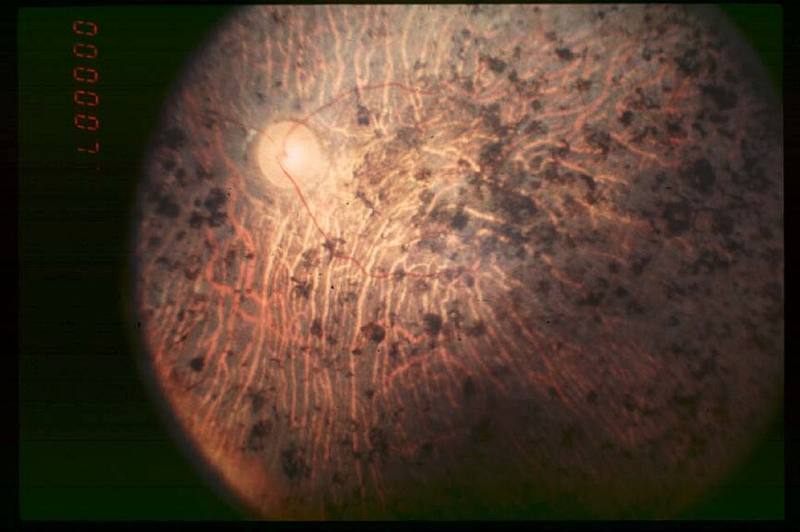
Who these approaches target:
- Advanced retinitis pigmentosa (RP), after photoreceptors are lost, when gene replacement is no longer possible [S3]. Optogenetics is described as independent of the causative mutation [S4].
- Geographic atrophy (GA) due to AMD with severe central vision loss: the PRIMA trial enrolled eyes with visual acuity of at least 1.2 logMAR [S9].
How it works:
| Approach | Mechanism | Stage |
|---|---|---|
| Optogenetics, ganglion-cell target | AAV vector delivers an opsin to retinal ganglion cells [S1] | Phase 1 in humans [S2] |
| Optogenetics, bipolar-cell target | Inner retinal target with more natural signal processing, limited by vector tropism and promoter specificity [S1] | Mostly preclinical [S1] [S3] |
| Epiretinal implant (Argus II) | Camera on glasses, electrode array on the retina [S8] | Long-term data available [S8] [S7] |
| Subretinal photovoltaic implant (PRIMA) | Implant powered by near-infrared light from glasses [S9] | Single-arm trial [S9] |
| Suprachoroidal implants | Electrode array behind the retina [S7] | Small studies [S7] |
Confirm it
What a specialist centre needs to confirm before referral to a trial:
- A diagnosis of advanced outer retinal degeneration, such as end-stage RP with bare or no light perception, as in the Argus II trial [S8].
- Surviving inner retina, because optogenetics depends on remaining retinal cells [S1].
- Trial eligibility; each programme sets its own criteria [S2] [S9].
Manage it
Before acting on this section, check the national and local guidelines, product information and regulatory approvals that apply where you practise. See the medical disclaimer.
Specialist management (vision restoration centres and trials only)
- Optogenetics. In the PIONEER phase 1 trial (2026), 10 people with advanced RP received one intravitreal injection of an AAV vector encoding ChrimsonR [S2]. Light sensitivity increased in 7 of 10, and 6 had a clinically meaningful increase [S2]. There were 34 ocular adverse events in 9 participants, including one transient central retinal artery occlusion straight after injection [S2]. It remains investigational [S2] [S3].
- Epiretinal implant. In the Argus II trial, 24 of 30 patients still had a functioning implant at 5 years, and performance was better with the device on than off [S8].
- Subretinal implant for GA. In the PRIMA trial (2026), 26 of 32 participants assessed at 12 months (81%) had a clinically meaningful gain in visual acuity of at least 0.2 logMAR [S9]. There were 26 serious adverse events in 19 participants, mostly within 2 months of surgery [S9].
Regulatory status
- In the European Union there is no specific regulation of optogenetics; combined gene-therapy and device studies must meet both medicinal-product and device rules [S10].
- Approval status in each country is not covered here: check the regulator's own register.
Refer when
| Situation | Urgency |
|---|---|
| A patient with advanced RP or GA asks about vision restoration | Routine referral to an inherited retinal disease or trial centre; timing per your local service or specialist advice |
| Sudden vision loss or pain after an intravitreal injection or implant surgery | Immediate, same-day review by the treating centre [G1] |
Pitfalls
- Equating light-sensitivity gains with useful reading vision: the phase 1 trial measured light sensitivity [S2].
- Trusting device-on versus device-off comparisons: they carry a high risk of bias [S5].
- Ignoring the device burden: goggles or glasses are required [S2] [S9].
- Assuming the vector is the only risk: immune responses to viral vectors and microbial opsins are a translational barrier [S3].
Evidence notes
| Source | Date | Design | Comment |
|---|---|---|---|
| [S1] | 2023 | Systematic review | History and challenges of optogenetics |
| [S2] | 2026 | Phase 1, open-label, 10 participants | Primary outcome was safety; the "clinically meaningful" threshold was not prespecified [S2] |
| [S3] | 2026 | Narrative review | Lists light sensitivity, immune responses and the lack of standard endpoints as barriers |
| [S4] | 2025 | Narrative review | Optogenetic tools and target cells |
| [S5] | 2021 | Systematic review | All implant studies judged at high risk of bias [S5] |
| [S6] | 2024 | Systematic review and meta-analysis of harms | 59 articles, 11 devices [S6] |
| [S7] | 2025 | Systematic review | 13 studies with at least 1 year of follow-up [S7] |
| [S8] | 2016 | Single-arm trial, 30 participants | 5-year Argus II data [S8] |
| [S9] | 2026 | Single-arm, baseline-controlled trial, 38 participants | No control group [S9] |
| [S10] | 2025 | Legal review | EU only |
- Certainty is low: no randomised trial of optogenetics or retinal implants was found in this shortlist [S5] [S7].
- Not covered by these sources: regulatory status, costs and long-term durability of optogenetics.
Related articles
References
See the numbered source list below. Each marker [S#] links to its PubMed and DOI record.
Sources
- [S1] Stefanov A, Flannery JG A Systematic Review of Optogenetic Vision Restoration: History, Challenges, and New Inventions from Bench to Bedside. Cold Spring Harbor perspectives in medicine. (2023). PubMed 36376079 · doi:10.1101/cshperspect.a041304
- [S2] Sahel JA, Futterknecht S, Audo I, Martel JN, Ling S, Pagot C, et al. Optogenetic Therapy for Restoring Aspects of Visual Function. The New England journal of medicine. (2026). PubMed 42842903 · doi:10.1056/nejmoa2602215
- [S3] Nakada N Optogenetic vision restoration: translational barriers and emerging therapeutic strategies. Gene therapy. (2026). PubMed 42687007 · doi:10.1038/s41434-026-00640-2
- [S4] Podoliak E, Guzman G, Busskamp V Optogenetic tools and their applications for therapeutic intervention in end-stage inherited retinal diseases. Molecular aspects of medicine. (2025). PubMed 40882487 · doi:10.1016/j.mam.2025.101388
- [S5] Hallum LE, Dakin SC Retinal Implantation of Electronic Vision Prostheses to Treat Retinitis Pigmentosa: A Systematic Review. Translational vision science & technology. (2021). PubMed 34383874 · doi:10.1167/tvst.10.10.8
- [S6] Hallum LE, Cloherty SL Harms associated with retinal implantation of a stimulating electrode array to treat outer-retinal degeneration: a systematic review and meta-analysis of safety. Progress in biomedical engineering (Bristol, England). (2024). PubMed 39655855 · doi:10.1088/2516-1091/ad811e
- [S7] Alqahtani HB, Votruba M, Regini J Do retinal implants provide long-term efficacy, safety and improve quality of life? A systematic review. Therapeutic advances in ophthalmology. (2025). PubMed 41221122 · doi:10.1177/25158414251385884
- [S8] da Cruz L, Dorn JD, Humayun MS, Dagnelie G, Handa J, Barale PO, et al. Five-Year Safety and Performance Results from the Argus II Retinal Prosthesis System Clinical Trial. Ophthalmology. (2016). PubMed 27453256 · doi:10.1016/j.ophtha.2016.06.049
- [S9] Holz FG, Le Mer Y, Muqit MMK, Hattenbach LO, Cusumano A, Grisanti S, et al. Subretinal Photovoltaic Implant to Restore Vision in Geographic Atrophy Due to AMD. The New England journal of medicine. (2026). PubMed 41124203 · doi:10.1056/nejmoa2501396
- [S10] Freise J Regulatory aspects of optogenetic research and therapy for retinitis pigmentosa under EU law. Frontiers in medical technology. (2025). PubMed 40417352 · doi:10.3389/fmedt.2025.1548927
Guidelines
- [G1] NHS Scotland (Community Eyecare Guidelines, eyes.nhs.scot). 7.4 Endophthalmitis, Post-Operative, (Exogenous Endophthalmitis) (2026). https://www.eyes.nhs.scot/eyecare-guidelines/section-7-uvea/74-endophthalmitis-post-operative-exogenous-endophthalmitis/