Educational content only. Not personalised medical advice. Clinical decisions remain the responsibility of the treating clinician.
Orbital and Preseptal Cellulitis
Preseptal (periorbital) and orbital cellulitis are infections of the tissues in front of and behind the orbital septum; they can be hard to tell apart clinically, and preseptal infection can progress to orbital infection [S4]. Orbital cellulitis can cause vision loss, meningitis and death [S4] [S10]. It is an ocular emergency requiring admission, intravenous antibiotics and sometimes surgery [S10].
Key points - Spread from the ethmoid sinuses is the most likely cause at any age; trauma, orbital foreign bodies and dental infection or procedures are other causes [S10]. - CT is the imaging modality of choice for orbital infection; MRI is used when CT is non-diagnostic [S5] [S8]. - Preseptal and postseptal cellulitis can generally be managed without surgery; orbital abscess and cavernous sinus thrombosis are managed surgically [S1]. - Evidence for adjunctive corticosteroids is very low certainty and conflicting [S3] [S4] [S7].
Evidence last checked: 2026-10-17 (PubMed abstracts).
Red flags
- Reduced vision, proptosis, ophthalmoplegia or chemosis: signs of postseptal (orbital) involvement [S10].
- Signs of orbital compartment syndrome: assess and manage this first [S8].
- Optic neuropathy: present in 15 (44.11%) of 34 patients with orbital abscess in a South Indian case series [S6].
- Suspected intracranial spread (cavernous sinus thrombosis, abscess, meningitis): needs neurosurgical input [S8].
- Neonates and people with diabetes: both appeared among patients with orbital abscess in the same series [S6].
Recognise it
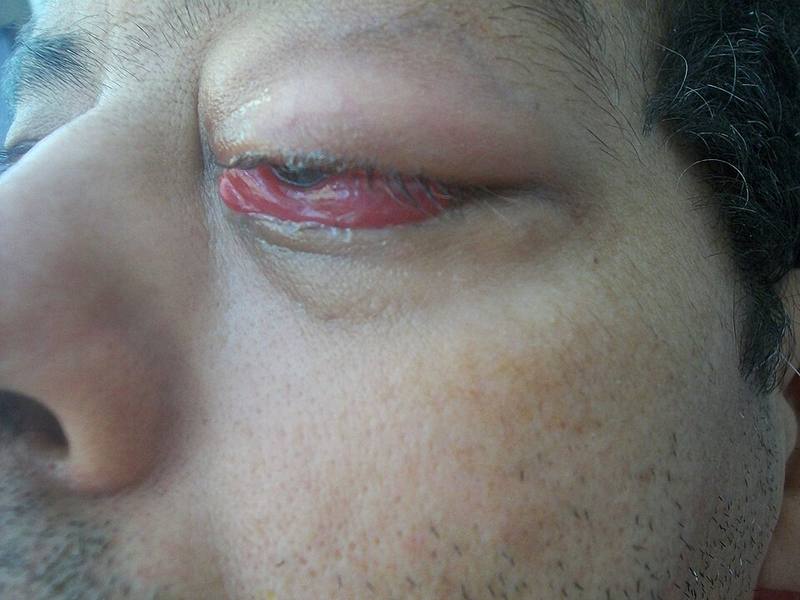
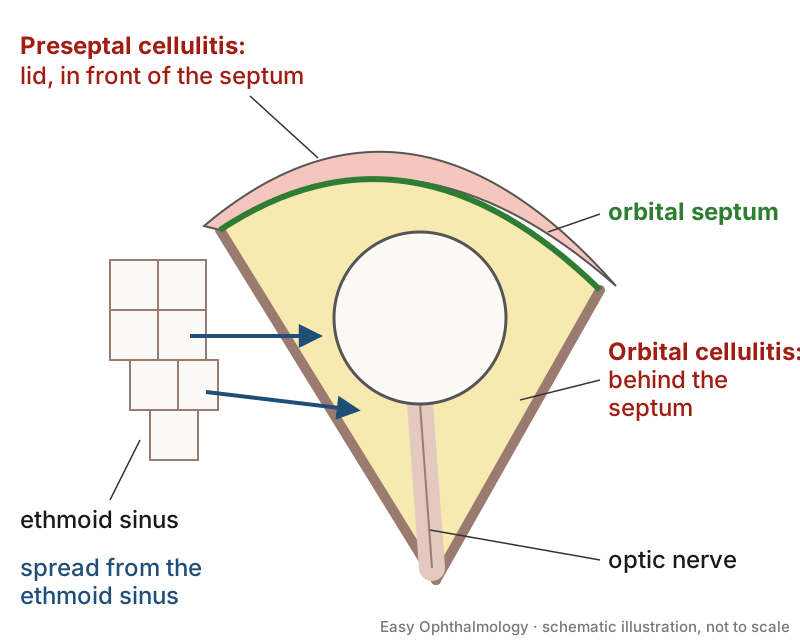
- Signs. Diffuse lid oedema with or without erythema, chemosis, proptosis and ophthalmoplegia [S10].
- Who. More common in children and young adults [S10] [S8]. In a South Indian series the median age with orbital abscess was 20.63 years, 3 patients (8.82%) were neonates, and sinusitis (29.41%) and diabetes (14.7%) were the commonest predisposing factors [S6].
- Why it threatens sight. Inflammatory swelling inside the bony orbit can create a compartment syndrome compressing vessels and the optic nerve [S4]. Vision can be lost through orbital abscess, cavernous sinus thrombosis, optic neuritis, central retinal artery occlusion and exposure keratopathy [S10].
- Organisms. In children, mainly Staphylococcus aureus or Streptococcus species; people older than 15 years more often have polymicrobial infection [S10]. In paediatric surgical cultures, Streptococcus anginosus group, group A streptococcus, pneumococcus and S. aureus predominate; MRSA had a median prevalence of 3% (IQR 0% to 13%) among culture-positive cases [S5].
Confirm it
- Clinical first. Orbital cellulitis is primarily a clinical diagnosis, followed by a focused eye examination after excluding orbital compartment syndrome [S8].
- CT. CT of the brain and orbits with and without contrast is critical to look for abscess or intracranial extension [S8]; CT remains the modality of choice in children [S5].
- MRI. Use when CT is non-diagnostic [S8].
- Ultrasound. Point-of-care ultrasound may help separate preseptal from orbital cellulitis but cannot exclude intracranial extension [S8]. A systematic review found only low-quality studies: of 46 participants in cohort studies, findings were interpretable in 18 (39%), and sensitivity and specificity could not be calculated [S9].
- Blood markers. Studies of inflammatory markers for severity and need for surgery give inconsistent results [S5].
- Cultures. Swab and blood cultures are often negative [S2].
Manage it
Before acting on this section, check the national and local guidelines, product information and regulatory approvals that apply where you practise. See the medical disclaimer.
Tier A (primary care / no specialist)
- Recognise orbital signs (reduced vision, proptosis, painful or restricted eye movement, chemosis) and refer for admission; orbital cellulitis needs intravenous antibiotics [S10].
- Give the first dose of broad-spectrum antibiotic early if your protocol allows, then transfer [S8]. Antibiotic choice and doses are not covered by these sources beyond the regimens below: follow local formularies.
- Preseptal cellulitis without orbital signs can generally be managed without surgery [S1], but needs close follow-up because it can progress [S4].
Tier B (general eye clinic)
- Admit, start intravenous broad-spectrum antibiotics and examine vision, pupils, motility and proptosis [S8] [S10].
- In a UK multicentre prospective study (98 patients with sinus-related cellulitis), intravenous ceftriaxone with metronidazole from admission was associated with the shortest inpatient stay (3.8 days) compared with ceftriaxone alone (5.8 days) or co-amoxiclav (4.5 days), and with fewer patients needing surgery [S2]. This is observational, not randomised.
- Early intranasal decongestants and steroids were associated with less surgery in the same study [S2].
- Arrange CT where available, and involve ENT when the sinuses are the source: drainage of pus and sinus ventilation are imperative in sinogenic disease [S10].
Tier C (specialist centre)
- Surgery. Orbital abscess and cavernous sinus thrombosis are managed surgically [S1]. Subperiosteal abscess in children is not an absolute indication for immediate surgery; medical treatment can succeed depending on age, abscess location and volume, clinical course and imaging [S1].
- In the UK study, 12 of 72 children (16.7%) and 5 of 26 adults (19.2%) needed surgery [S2]. In the South Indian series all 34 patients with orbital abscess had drainage, and vision improved or stabilised in all but 3 (8.82%) [S6].
- Corticosteroids. A Cochrane review found one trial of 21 participants: very low certainty evidence, no clear difference in hospital stay, antibiotic duration, vision at 12 weeks or need for surgery, and insufficient evidence to draw conclusions [S4]. In that trial steroids were started after an initial antibiotic response at 1.5 mg/kg for three days, then 1 mg/kg for three days, then tapered, as reported in [S4]. A separate meta-analysis (2022) reported shorter hospital stay with steroids, with very high heterogeneity (I2 = 96.9%), and no significant difference in surgical drainage [S3]. Reviews call steroid use controversial and note that hospital stay is an imperfect outcome [S7] [S8].
- Involve neurosurgery for intracranial extension [S8].
Refer when
| Situation | Urgency |
|---|---|
| Any orbital sign: reduced vision, proptosis, ophthalmoplegia, chemosis [S10] | Immediate, same-day admission for intravenous antibiotics [S10] |
| Signs of orbital compartment syndrome or optic neuropathy [S8] | Immediate to an eye service able to decompress |
| Suspected intracranial spread (cavernous sinus thrombosis, abscess, meningitis) [S8] | Immediate, with neurosurgery [S8] |
| Abscess on CT, or no improvement on intravenous antibiotics | Urgent, within hours, to orbit or ENT surgeon |
| Preseptal cellulitis managed as outpatient that is not improving | Same-day review [G1] |
Pitfalls
- Treating as "simple preseptal" without checking vision, pupils and motility: the two are hard to tell apart clinically [S4].
- Relying on ultrasound to exclude intracranial disease [S8] [S9].
- Using blood markers to decide on surgery: results are inconsistent [S5].
- Forgetting the sinuses: sinogenic disease needs drainage and ventilation [S10].
- Over-reading steroid evidence in either direction [S3] [S4].
Evidence notes
| Source | Date | Design |
|---|---|---|
| [S1] | 2018 | Systematic review, paediatric (71 studies) |
| [S2] | 2020 | Multicentre prospective observational study, UK |
| [S3] | 2022 | Meta-analysis, steroids |
| [S4] | 2021 | Cochrane systematic review, one small RCT |
| [S5] | 2021 | Systematic review, paediatric (63 studies, mostly poor quality) |
| [S6] | 2022 | Retrospective case series, South India |
| [S7] | 2023 | Narrative review, paediatric steroids |
| [S8] | 2023 | Narrative review, emergency medicine |
| [S9] | 2023 | Diagnostic accuracy systematic review |
| [S10] | 2023 | Narrative review, India |
- No RCT informs antibiotic choice; the regimen data come from one observational study [S2].
- The steroid meta-analysis [S3] and the Cochrane review [S4] conflict; the Cochrane review applied stricter inclusion (randomised trials only).
- Most paediatric evidence has high risk of bias [S5].
- Not covered by these sources: antibiotic doses and duration, oral step-down criteria, fungal (mucormycosis) orbital infection, and management of cavernous sinus thrombosis.
Related articles
- Idiopathic Orbital Inflammation and IgG4-Related Orbital Disease
- Orbital compartment syndrome and retrobulbar haemorrhage
References
See the numbered source list below. Each marker [S#] links to its PubMed and DOI record.
Sources
- [S1] Wong SJ, Levi J Management of pediatric orbital cellulitis: A systematic review. International journal of pediatric otorhinolaryngology. (2018). PubMed 29859573 · doi:10.1016/j.ijporl.2018.05.006
- [S2] Mahalingam S, Hone R, Lloyd G, Grounds R, Shamil E, Wong G, et al. The management of periorbital cellulitis secondary to sinonasal infection: a multicenter prospective study in the United Kingdom. International forum of allergy & rhinology. (2020). PubMed 32282127 · doi:10.1002/alr.22535
- [S3] Kim BY, Bae JH Role of systemic corticosteroids in orbital cellulitis: a meta-analysis and literature review. Brazilian journal of otorhinolaryngology. (2022). PubMed 33722520 · doi:10.1016/j.bjorl.2021.02.003
- [S4] Kornelsen E, Mahant S, Parkin P, Ren LY, Reginald YA, Shah SS, et al. Corticosteroids for periorbital and orbital cellulitis. The Cochrane database of systematic reviews. (2021). PubMed 33908631 · doi:10.1002/14651858.cd013535.pub2
- [S5] Burek AG, Melamed S, Liljestrom T, Qi J, Kelly TG, Suelzer E, et al. Evaluation and Medical Management of the Pediatric Patient With Orbital Cellulitis/Abscess: A Systematic Review. Journal of hospital medicine. (2021). PubMed 34730499 · doi:10.12788/jhm.3707
- [S6] Alam MS, Backiavathy V, Noronha V, Mukherjee B Orbital abscess: 20 years' experience at a tertiary eye care center. Orbit (Amsterdam, Netherlands). (2022). PubMed 35195044 · doi:10.1080/01676830.2021.2013901
- [S7] Lu JE, Yoon MK The Role of Steroids for Pediatric Orbital Cellulitis - Review of the Controversy. Seminars in ophthalmology. (2023). PubMed 36683269 · doi:10.1080/08820538.2023.2168487
- [S8] Pelletier J, Koyfman A, Long B High risk and low prevalence diseases: Orbital cellulitis. The American journal of emergency medicine. (2023). PubMed 36893591 · doi:10.1016/j.ajem.2023.02.024
- [S9] Anwar MR, Mahant S, Agbaje-Ojo T, Mahood Q, Borkhoff CM, Parkin PC, et al. Diagnostic test accuracy of ultrasound for orbital cellulitis: A systematic review. PloS one. (2023). PubMed 37410730 · doi:10.1371/journal.pone.0288011
- [S10] Yadalla D, Jayagayathri R, Padmanaban K, Ramasamy R, Rammohan R, Nisar SP, et al. Bacterial orbital cellulitis - A review. Indian journal of ophthalmology. (2023). PubMed 37417106 · doi:10.4103/ijo.ijo_3283_22
Guidelines
- [G1] NHS Scotland (Community Eyecare Guidelines, eyes.nhs.scot). 2.1 Cellulitis, Preseptal (2026). https://www.eyes.nhs.scot/eyecare-guidelines/section-2-orbitlacrimal-system/21-cellulitis-preseptal/