Educational content only. Not personalised medical advice. Clinical decisions remain the responsibility of the treating clinician.
Vision screening in children
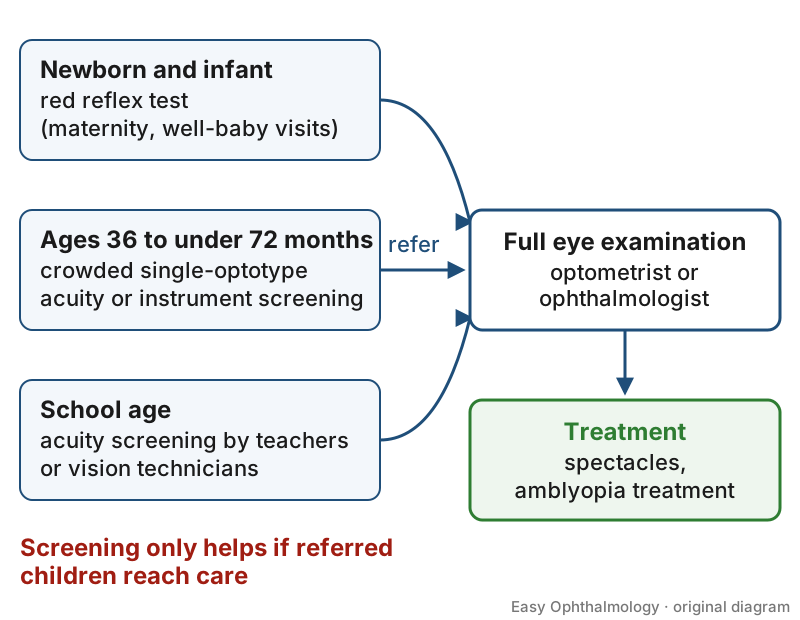
Vision screening in children aims to detect amblyopia, strabismus, significant refractive error and their risk factors early, when treatment works [S1] [S3]. Among children younger than 6 years, 1% to 6% have amblyopia or its risk factors [S3]. Programmes span newborn red reflex testing, preschool acuity or instrument screening, and school screening by teachers or technicians; each step only helps if referred children reach care [S9] [S12].
Key points - The USPSTF recommends vision screening at least once in all children aged 3 to 5 years (grade B); evidence is insufficient for children under 3 years [S3]. - Red reflex testing after birth increases early referral and surgery for congenital cataract [S9], but a normal red reflex does not exclude eye disease [S8]. - Best-practice preschool methods are crowded single-optotype monocular acuity or validated instrument screening [S1]; photoscreeners showed good accuracy for amblyopia risk factors [S6]. - Teachers can screen school children with pooled sensitivity 76.8% and specificity 93.6% [S11]; trained vision technicians were more accurate and cheaper per case found in north India [S10]. - Screening with free spectacles increases spectacle wear compared with a prescription only (Cochrane, high-certainty evidence) [S5]; median referral compliance after school screening is only 43.1% [S12].
Evidence last checked: 2026-10-17 (PubMed abstracts).
Red flags
- Abnormal red reflex in an infant: most likely reflects underlying ocular pathology [S8].
- Screening that stops at a referral slip: referral compliance ranged from 12.0% to 79.7% [S12]. A programme without a working pathway to care finds children but does not treat them.
- False reassurance: the red reflex test without dilation had a sensitivity of 7.5% for any ocular pathology [S8]; photoscreening detected only 0.46 of strabismus cases in the one eligible community study [S4].
Recognise it: targets and timing
- Newborns and infants: nine international guidelines recommend universal newborn eye screening with red reflex testing [S9].
- Early childhood: a Canadian guideline supports detecting amblyopia before 36 months and no later than 48 months, with at least one comprehensive eye examination by an optometrist or ophthalmologist before age 5 years, in addition to primary care screening [S7].
- Ages 36 to under 72 months: screen annually (best practice) or at least once (minimum standard) [S1].
- School age: screening targets correctable visual acuity deficits from refractive error [S5].
- Screening rates vary by ethnicity and family income [S3].
Confirm it: tests and their accuracy
- Red reflex (Brückner) test: specificity 97.5%, but sensitivity only 7.5% for any pathology and 17.5% for pathology needing intervention, when done without dilation [S8].
- Preschool acuity: monocular testing with single HOTV letters or LEA Symbols surrounded by crowding bars at 1.5 m [S1].
- Instrument screening: Retinomax or SureSight are best practice; Plusoptix is acceptable [S1]. Pooled sensitivity was 87.7% (Spot) and 89.4% (Plusoptix) [S6].
- Combining tests gave positive likelihood ratios above 10 in most studies [S2]. Inability to cooperate may limit some tests under 3 years [S2].
- Low-prevalence populations: where vision abnormalities affect under 10%, false-positive rates were usually over 75% [S2].
- Teacher screening: sensitivity was higher in younger children (89.29%) than in adolescents (45.45%); a 6/12 cut-off gave more consistent performance [S11].
- Strabismus: evidence on community tests is very limited [S4]; the reference test is the cover-uncover test by trained professionals [S4].
Manage it: running a programme
Before acting on this section, check the national and local guidelines, product information and regulatory approvals that apply where you practise. See the medical disclaimer.
Tier A (primary care / community / school)
- Perform red reflex testing in maternity wards and at well-baby visits [S9] [S7].
- Train teachers to test acuity in schools; continuous training is essential [S11]. Involving all classroom teachers maximises detection, while selected teachers are more feasible [S11].
- Refer children who fail, and children who should be examined rather than screened, to an optometrist or ophthalmologist [S1].
Tier B (eye clinic / outreach team)
- Where available, vision technicians gave sensitivity 93.3% and specificity 98.7%, versus 36.0% and 96.1% for all class teachers, at the lowest cost per child with true vision deficit ($2.82) [S10].
- Bring care to the school: on-site provision of prescriptions gave referral compliance of 51.8-96.0%; clear referral pathways also helped (25.0-65.7%), but education alone did not (21.3-24.5%) [S12].
- Provide spectacles free where possible; ready-made spectacles performed as well as custom-made ones for spectacle wear in lower-income settings [S5].
Tier C (specialist centre)
- Receive referrals for confirmed amblyopia, strabismus, abnormal red reflex and other pathology [S7]. Treatment of amblyopia in children aged 3 to 5 years gives moderate, likely lifelong, improvements in acuity [S3].
Refer when
| Situation | Urgency |
|---|---|
| Abnormal or absent red reflex in a newborn or infant | Urgent to an eye specialist; timing per your local service or specialist advice [EIC expert opinion] [S8] [S9] |
| Child fails acuity or instrument screening | Routine, for full eye examination; timing per your local service or specialist advice [EIC expert opinion] [S1] |
| Suspected squint at screening | Routine, within a month, for cover test by a trained professional [EIC expert opinion] [S4] |
Pitfalls
- Treating a normal red reflex as a normal eye [S8].
- Measuring success by numbers screened rather than children treated [S12].
- Relying on health education to improve spectacle wear: it had little effect [S5].
- Expecting teachers to perform as well with adolescents as with younger children [S11].
- Over-referral in low-prevalence populations [S2].
Evidence notes
| Source | Date | Design |
|---|---|---|
| [S1] | 2015 | Expert panel recommendations (US) |
| [S2] | 2017 | Systematic review for USPSTF, 40 studies |
| [S3] | 2017 | USPSTF recommendation statement (guideline) |
| [S4] | 2017 | Cochrane diagnostic test accuracy review, 1 study |
| [S5] | 2018 | Cochrane systematic review, 7 RCTs (China, India, Tanzania) |
| [S6] | 2019 | Diagnostic accuracy meta-analysis, 21 publications |
| [S7] | 2019 | National clinical practice guideline (Canada) |
| [S8] | 2021 | Diagnostic accuracy meta-analysis, 5 studies, 8713 infants |
| [S9] | 2022 | Systematic review and review of guidelines |
| [S10] | 2024 | Cluster-randomised accuracy and cost study (India) |
| [S11] | 2026 | Diagnostic accuracy meta-analysis, 19 articles |
| [S12] | 2026 | Systematic review, 30 articles |
- No RCT has compared screening with no screening, in preschool [S2] or school-age children [S5].
- Conflict on teacher screening: pooled sensitivity was 76.8% in the meta-analysis [S11], but all class teachers reached only 36.0% in the north Indian trial [S10].
- The red reflex accuracy estimates come from undilated testing [S8]; the newborn screening evidence for cataract was low certainty [S9].
- Not covered by these sources: screening for retinoblastoma specifically, optimal school screening intervals, and screening of children with neurodevelopmental disability.
Related articles
- Amblyopia: patching, atropine and binocular treatment
- School eye health programmes
- Refractive error in children and spectacle provision
References
See the numbered source list below. Each marker [S#] links to its PubMed and DOI record.
Sources
- [S1] Cotter SA, Cyert LA, Miller JM, Quinn GE, National Expert Panel to the National Center for Children’s Vision and Eye Health Vision screening for children 36 to <72 months: recommended practices. Optometry and vision science : official publication of the American Academy of Optometry. (2015). PubMed 25562476 · doi:10.1097/opx.0000000000000429
- [S2] Jonas DE, Amick HR, Wallace IF, Feltner C, Vander Schaaf EB, Brown CL, et al. Vision Screening in Children Aged 6 Months to 5 Years: Evidence Report and Systematic Review for the US Preventive Services Task Force. JAMA. (2017). PubMed 28873167 · doi:10.1001/jama.2017.9900
- [S3] US Preventive Services Task Force, Grossman DC, Curry SJ, Owens DK, Barry MJ, Davidson KW, et al. Vision Screening in Children Aged 6 Months to 5 Years: US Preventive Services Task Force Recommendation Statement. JAMA. (2017). PubMed 28873168 · doi:10.1001/jama.2017.11260
- [S4] Hull S, Tailor V, Balduzzi S, Rahi J, Schmucker C, Virgili G, et al. Tests for detecting strabismus in children aged 1 to 6 years in the community. The Cochrane database of systematic reviews. (2017). PubMed 29105728 · doi:10.1002/14651858.cd011221.pub2
- [S5] Evans JR, Morjaria P, Powell C Vision screening for correctable visual acuity deficits in school-age children and adolescents. The Cochrane database of systematic reviews. (2018). PubMed 29446439 · doi:10.1002/14651858.cd005023.pub3
- [S6] Zhang X, Wang J, Li Y, Jiang B Diagnostic test accuracy of Spot and Plusoptix photoscreeners in detecting amblyogenic risk factors in children: a systemic review and meta-analysis. Ophthalmic & physiological optics : the journal of the British College of Ophthalmic Opticians (Optometrists). (2019). PubMed 31236980 · doi:10.1111/opo.12628
- [S7] Joint Clinical Practice Guideline Expert Committee of the Canadian Association of Optometrists and the Canadian Ophthalmological Society, Delpero WT, Robinson BE, Gardiner JA, Nasmith L, Rowan-Legg A, et al. Evidence-based clinical practice guidelines for the periodic eye examination in children aged 0-5 years in Canada. Canadian journal of ophthalmology. Journal canadien d'ophtalmologie. (2019). PubMed 31767160 · doi:10.1016/j.jcjo.2019.09.003
- [S8] Subhi Y, Schmidt DC, Al-Bakri M, Bach-Holm D, Kessel L Diagnostic Test Accuracy of the Red Reflex Test for Ocular Pathology in Infants: A Meta-analysis. JAMA ophthalmology. (2021). PubMed 33180103 · doi:10.1001/jamaophthalmol.2020.4854
- [S9] Malik AN, Evans JR, Gupta S, Mariotti S, Gordon I, Bowman R, et al. Universal newborn eye screening: a systematic review of the literature and review of international guidelines. Journal of global health. (2022). PubMed 36269293 · doi:10.7189/jogh.12.12003
- [S10] Sabherwal S, Adhisesha Reddy P, Siddiqui Z, Sood I, Singh BP, Ganesh S, et al. Visual Acuity Screening in North Indian Schools: Testing Accuracy and Cost of Alternate Screening Models. Ophthalmic epidemiology. (2024). PubMed 36880784 · doi:10.1080/09286586.2023.2187069
- [S11] Cunha M, Nunes AF, Miguel M, Ferreira D, Lanca C Diagnostic Accuracy of Teacher-Administered School Vision Screening: A Systematic Review and Meta-Analysis. Ophthalmic & physiological optics : the journal of the British College of Ophthalmic Opticians (Optometrists). (2026). PubMed 42557529 · doi:10.1007/s44402-026-00145-w
- [S12] Cui J, Zhuo S, Qin Y, Wang J, Chen R, Huang W, et al. Compliance with post-school vision screening referral: a systematic review. BMJ open ophthalmology. (2026). PubMed 42838618 · doi:10.1136/bmjophth-2026-002876