Educational content only. Not personalised medical advice. Clinical decisions remain the responsibility of the treating clinician.
Posterior capsule opacification
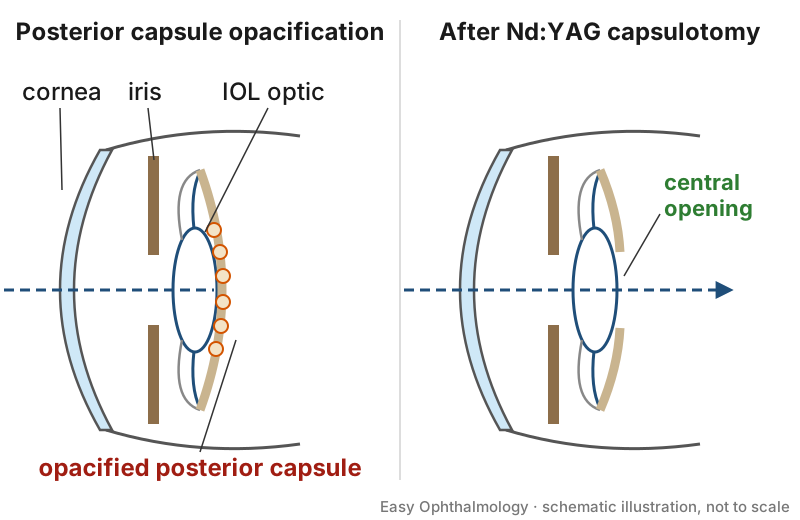
Posterior capsule opacification (PCO) is clouding of the posterior lens capsule after cataract surgery and the most common postoperative complication of modern surgery with a posterior chamber IOL [S6]. It causes reduced acuity, cloudy vision and loss of contrast, and is treated with Nd:YAG laser capsulotomy, which is unavailable in large parts of the developing world [S1] [S6].
Key points - Sharp-edged IOL optics reduce PCO and Nd:YAG capsulotomy; at five years the Cochrane estimate was RR 0.21, or 331 fewer capsulotomies per 1000 eyes [S6]. - Edge design matters in MSICS too: an Indian RCT found better BCVA at 12 and 18 months with low-cost square-edged IOLs [S9]. - Hydrophobic IOLs had lower capsulotomy rates than hydrophilic IOLs (OR 0.38) [S2]. - Nd:YAG capsulotomy may increase the risk of pseudophakic retinal detachment (RR 1.57) [S7]. - A single dose of brimonidine 0.2% one hour before laser, as reported in [S8] [S11], prevented significant IOP rises in small RCTs.
Evidence last checked: 2026-10-17 (PubMed abstracts).
Red flags
- Flashes, floaters or a field shadow after Nd:YAG capsulotomy: possible retinal detachment; the association was stronger in Asian populations (RR 4.54) and after extracapsular extraction (RR 2.97) [S7].
- Sudden vision drop or pain after capsulotomy: possible IOP spike [S8] [S11].
- Gradual blur months or years after surgery is expected PCO, but other causes such as macular oedema should be excluded [S6].
Recognise it
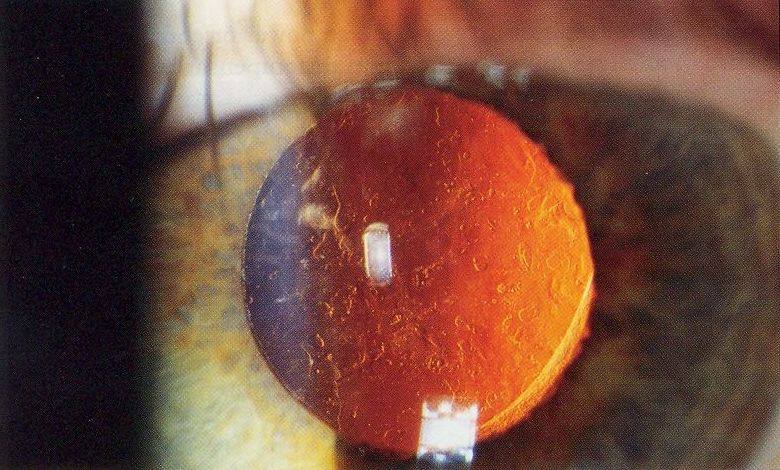
- Main symptoms: decreased acuity, cloudy or blurred vision and reduced contrast sensitivity [S6].
- After premium (multifocal, EDOF, toric and accommodative) IOLs, Nd:YAG capsulotomy incidence was 0.5% at 6 months, 3.7% at 12 months and 18.1% at 24 months [S10].
- Patients at higher PCO risk include those with high myopia, younger age, diabetes or grade III to V nuclear hardness [S10].
Confirm it
- In trials PCO was assessed under slit-lamp illumination by an independent observer [S9] or quantified with scores such as AQUA and EPCO [S6].
Manage it
Before acting on this section, check the national and local guidelines, product information and regulatory approvals that apply where you practise. See the medical disclaimer.
Tier A (primary care / no specialist)
- Refer patients whose vision deteriorates gradually months after cataract surgery to an eye clinic; PCO is common and treatable [S6].
- After laser capsulotomy, tell patients to return the same day if flashes, floaters or a shadow appear [S7].
Tier B (general eye clinic)
- Prevent it at surgery. - Choose sharp (square) posterior optic edge IOLs: preferred in both Cochrane reviews [S1] [S6] and effective in MSICS [S9]. - Prefer hydrophobic to hydrophilic acrylic material where available [S2]. A network meta-analysis found the lowest capsulotomy risk with one hydrophobic acrylic brand (hazard ratio 7.54 for hydrophilic acrylic vs that brand) [S4]. - Anterior capsule polishing was associated with lower PCO (OR 0.42) in one RCT and four cohort studies [S3]. - Anti-inflammatory regimen choice did not influence PCO [S1]. - For premium IOLs, avoid silicone, plate-loop or four-haptic, round-edge and accommodative designs in high-risk patients [S10].
- Treat it. Nd:YAG laser capsulotomy is the standard treatment [S6] [S8].
- Prevent IOP spikes. Betaxolol 0.5% or brimonidine 0.2% as a single topical dose 1 hour before laser (as reported in [S8]) prevented clinically significant rises in 38 eyes. Dexmedetomidine 0.008% was inferior to brimonidine 0.2%, with more spikes above 10 mmHg (9% vs 2%) [S11].
Tier C (specialist centre)
- Capsular tension rings were associated with fewer capsulotomies (OR 0.241) in a meta-analysis of 8 studies, with very high heterogeneity for PCO scores [S5].
- Retinal detachment after capsulotomy: examine the peripheral retina in symptomatic patients, especially in high-risk groups [S7].
Refer when
| Situation | Urgency |
|---|---|
| Flashes, floaters or a field shadow after Nd:YAG capsulotomy | Same-day to an eye service able to examine the retina [S7] |
| Eye pain, headache or blurring within hours of capsulotomy | Same-day for IOP check [S11] |
| Gradual visual decline after cataract surgery, suspected PCO | Routine to a clinic with a YAG laser; timing per your local service or specialist advice |
Pitfalls
- Using round-edged IOLs when sharp-edged ones are affordable [S6] [S9].
- Expecting the anti-inflammatory regimen to prevent PCO [S1].
- Forgetting the retinal detachment risk after capsulotomy, particularly after extracapsular surgery [S7].
- Implanting high-PCO-risk premium IOL designs in young, myopic or diabetic patients [S10].
Evidence notes
| Source | Date | Design |
|---|---|---|
| [S1] | 2010 | Cochrane systematic review, 66 RCTs |
| [S2] | 2017 | Meta-analysis of 11 RCTs and cohort studies |
| [S3] | 2019 | Meta-analysis, 1 RCT and 4 cohort studies |
| [S4] | 2019 | Network meta-analysis of RCTs |
| [S5] | 2021 | Meta-analysis of 8 studies |
| [S6] | 2021 | Cochrane systematic review, 10 RCTs |
| [S7] | 2022 | Meta-analysis of 11 studies |
| [S8] | 2022 | Double-masked RCT, 38 eyes |
| [S9] | 2023 | RCT, 104 eyes, MSICS, India |
| [S10] | 2026 | Systematic review and meta-analysis, 129 studies |
| [S11] | 2026 | Double-masked RCT, 111 eyes |
- [S1] found no clear difference between optic materials, whereas [S2] and [S4] favour hydrophobic acrylic: the newer analyses include different studies and designs.
- [S4] compared one manufacturer's IOL family with others; the abstract does not state funding, so the Editor-in-Chief should check for industry support.
- The one-year Cochrane estimate for capsulotomy was imprecise (Peto OR 0.30, CI 0.05 to 1.74); longer follow-up was more precise [S6].
- Not covered by these sources: Nd:YAG laser energy settings and technique, surgical capsulotomy where no laser is available, and paediatric PCO.
Related articles
References
See the numbered source list below. Each marker [S#] links to its PubMed and DOI record.
Sources
- [S1] Findl O, Buehl W, Bauer P, Sycha T Interventions for preventing posterior capsule opacification. The Cochrane database of systematic reviews. (2010). PubMed 20166069 · doi:10.1002/14651858.cd003738.pub3
- [S2] Zhao Y, Yang K, Li J, Huang Y, Zhu S Comparison of hydrophobic and hydrophilic intraocular lens in preventing posterior capsule opacification after cataract surgery: An updated meta-analysis. Medicine. (2017). PubMed 29095259 · doi:10.1097/md.0000000000008301
- [S3] Han MY, Yu AH, Yuan J, Cai XJ, Ren JB Effect of anterior capsule polish on visual function: A meta-analysis. PloS one. (2019). PubMed 30620750 · doi:10.1371/journal.pone.0210205
- [S4] Thom H, Ender F, Samavedam S, Perez Vivez C, Gupta S, Dhariwal M, et al. Effect of AcrySof versus other intraocular lens properties on the risk of Nd:YAG capsulotomy after cataract surgery: A systematic literature review and network meta-analysis. PloS one. (2019). PubMed 31425548 · doi:10.1371/journal.pone.0220498
- [S5] Zhang K, Dong Y, Zhao M, Nie L, Ding X, Zhu C The effect of capsule tension ring on posterior capsule opacification: A meta-analysis. PloS one. (2021). PubMed 33720958 · doi:10.1371/journal.pone.0246316
- [S6] Maedel S, Evans JR, Harrer-Seely A, Findl O Intraocular lens optic edge design for the prevention of posterior capsule opacification after cataract surgery. The Cochrane database of systematic reviews. (2021). PubMed 34398965 · doi:10.1002/14651858.cd012516.pub2
- [S7] Liu H, Liu X, Chen Y, Wang D, Li Y, Chen H, et al. Effect of Nd:YAG laser capsulotomy on the risk for retinal detachment after cataract surgery: systematic review and meta-analysis. Journal of cataract and refractive surgery. (2022). PubMed 34538778 · doi:10.1097/j.jcrs.0000000000000755
- [S8] Elmi Sadr N, Saber E, Paknazar F The prophylactic effect of betaxolol 0.5% versus brimonidine 0.2% on IOP elevation after Nd:YAG laser posterior capsulotomy. Clinical & experimental optometry. (2022). PubMed 34753412 · doi:10.1080/08164622.2021.1989265
- [S9] Joshi RS, Rasal AV Posterior capsular opacification and Nd:YAG capsulotomy rates in patients implanted with square-edged and non-square-edged intraocular lenses in manual small-incision cataract surgery: A randomized controlled study. Indian journal of ophthalmology. (2023). PubMed 37602611 · doi:10.4103/ijo.ijo_359_23
- [S10] Wang H, Li Y, Wong MOM, Chan CKM, Yuen HKL, Liu Z Incidence and associated factors of Nd:YAG posterior capsulotomy after premium IOL implantation surgery: a systematic review and meta-analysis. International journal of surgery (London, England). (2026). PubMed 41556197 · doi:10.1097/js9.0000000000003855
- [S11] Zakeri P, Akhavanakbari G, Ojaghi H, Amani F The Prophylactic Effect of Dexmedetomidine 0.008% Versus Brimonidine 0.2% on IOP Elevation After Nd: YAG Laser Capsulotomy. Pharmacology research & perspectives. (2026). PubMed 42192576 · doi:10.1002/prp2.70227