Educational content only. Not personalised medical advice. Clinical decisions remain the responsibility of the treating clinician.
Pharmacological treatment of presbyopia
Eye drops for presbyopia are mainly miotics such as pilocarpine, which temporarily improve near vision through a pinhole effect; lens-softening drugs have not reached practice [S6]. Phase 3 trials show that about a third of users gain 3 or more lines of near acuity for some hours after a dose, at the cost of headache, blurred vision and reduced night-driving performance [S2] [S4] [S8]. Reading spectacles remain the reference treatment, and these drops are short-acting alternatives.
Key points - Pilocarpine 1.25% and 0.4% have FDA approval for presbyopia [S6]. - Pooled RCTs: 33% of pilocarpine users vs 12% with vehicle gained 3 or more lines of near acuity at 3 hours after the dose [S8]. - The effect is transient; in GEMINI 1 the 3-line response fell from 30.7% at hour 3 to 18.4% at hour 6 [S2]. - Pilocarpine increased headache, blurred vision and eye pain, mostly mild and transient [S8], and night-driving performance was worse than with placebo [S4]. - Evidence is short term (weeks), from trials largely in white US populations [S2] [S5]; long-term safety data are lacking [S8] [S11].
Evidence last checked: 2026-10-17 (PubMed abstracts).
Red flags
- Night driving. Overall night-driving performance was inferior with pilocarpine 1.25% compared with placebo [S4]. Advise caution.
- Visual symptoms after starting drops. Pilocarpine increased blurred vision and visual impairment [S11]. Any new flashes, floaters or field loss needs a dilated retinal examination.
- Unexplained near-vision loss. Drops are for age-related presbyopia; trials required good corrected distance acuity, for example 20/20-2 or better in [S5]. Poor distance or near acuity outside this pattern needs examination first.
Recognise it
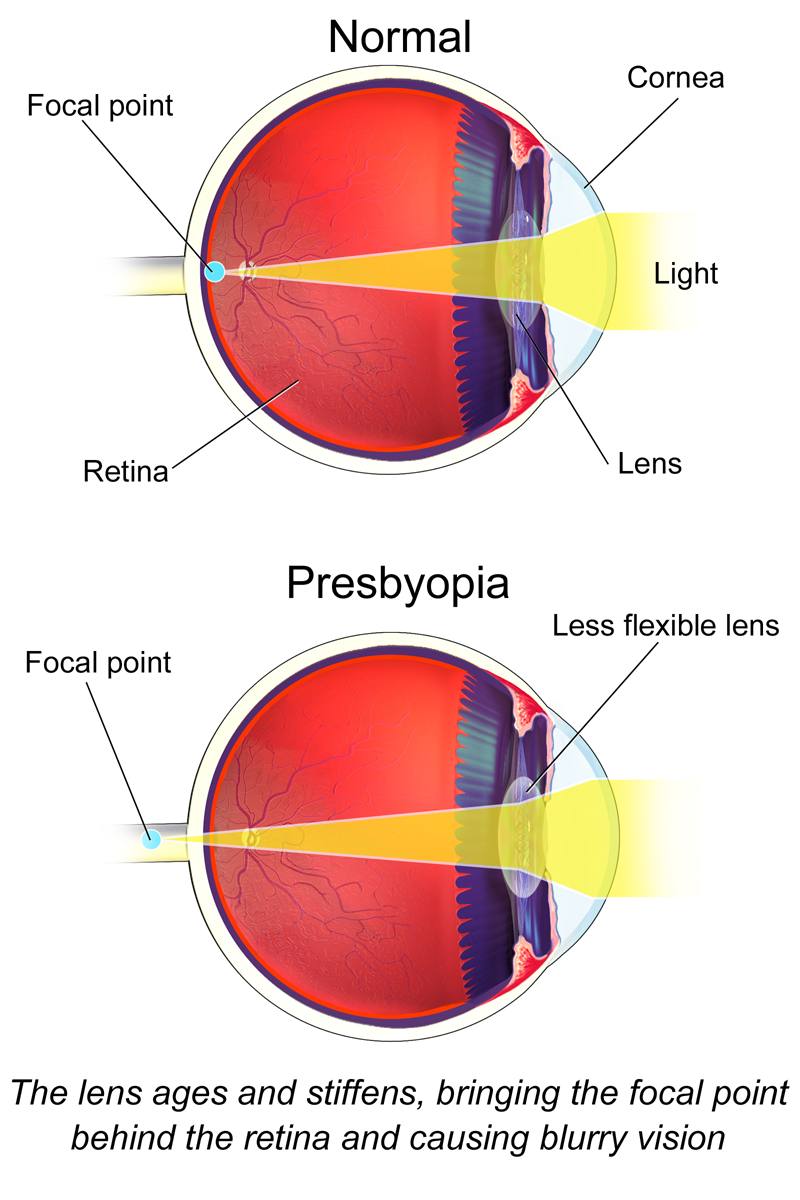
- Trial participants were aged 40 to 55 years [S2] [S3] or 45 to 64 years [S5], with distance-corrected near acuity of about 20/40 to 20/100 [S3] or 20/50 to 20/160 [S5].
- The NEAR trials excluded people with prior refractive surgery or intraocular lenses and those with small dark-adapted pupils (<3.5 mm) [S5].
Confirm it
- Trials measured distance-corrected near visual acuity under mesopic lighting, with response defined as a gain of 3 or more lines without loss of distance acuity [S3] [S5].
Manage it
Before acting on this section, check the national and local guidelines, product information and regulatory approvals that apply where you practise. See the medical disclaimer.
Tier A (primary care / no specialist)
- Reading spectacles are the standard low-cost correction; these sources do not compare drops with spectacles. The drops in these trials are prescription medicines and are not first-line in primary care.
Tier B (general eye clinic)
Doses below are as reported in the trials, not a prescription; follow local formularies and regulatory status.
- Pilocarpine 1.25% once daily (GEMINI 1, 30 days): 30.7% vs 8.1% gained 3 or more lines at hour 3; onset at 15 minutes, as reported in [S2].
- Pilocarpine 1.25% twice daily, 6 hours apart (Virgo, 14 days): 27.3% more responders than vehicle at hour 9; headache 8.8% vs 3.4%; minimal systemic accumulation, as reported in [S3].
- Pilocarpine 0.4% twice daily (NEAR-1 and NEAR-2, 2 weeks): 40.1% vs 19.1% responders at 1 hour, with mostly mild, transient adverse events, as reported in [S5].
- Indian data. In a multicentre RCT of pilocarpine 1.25% in 234 adults aged 45 to 55, 31% vs 4% gained three lines at day 30 with no adverse drug reactions observed [S9].
- Counselling. Expect miosis (mean pupil reduction 1.38 mm) [S8], headache (+6.9%), blurred vision (+3.1%) and eye pain (+2.4%) [S8], and reduced night-driving performance [S4].
Tier C (specialist centre)
- Combinations. Pilocarpine 1% plus bromfenac 0.09% gave more patients N6 near vision at 8 weeks than pilocarpine alone (78.6% vs 44.1%), with fewer adverse events, in a single Indian RCT [S10]. Adding low-dose diclofenac did not add to 0.4% pilocarpine in a phase 2b trial [S7].
- Aceclidine. A 2026 meta-analysis of 5 trials (883 participants) found more 3-line responders than placebo (RR 6.28) and more treatment-emergent adverse events (RR 2.23) [S12].
- Lens softeners. Lipoic acid choline ester (UNR844) improved near acuity over 91 days in a small RCT [S1], but further development of lens softeners has been suspended [S6].
Refer when
| Situation | Urgency |
|---|---|
| New flashes, floaters or a shadow in the vision after starting miotic drops | Same-day |
| Eye pain or reduced vision that persists after the drop effect should have worn off | Urgent; timing per your local service or specialist advice |
| Near-vision complaint with reduced distance acuity | Routine, for full examination [S5]; timing per your local service or specialist advice |
Pitfalls
- Overselling: most users do not reach a 3-line gain, and the effect fades within hours [S2] [S8].
- Forgetting to warn about night driving [S4].
- Extrapolating from short trials: most were 2 to 4 weeks [S3] [S5] [S8].
- Treating Phase 2 or single-centre results as established [S1] [S10].
Evidence notes
| Source | Date | Design |
|---|---|---|
| [S1] | 2021 | RCT, 75 subjects, safety and preliminary efficacy |
| [S2] | 2022 | Phase 3 RCT, 323 participants (GEMINI 1) |
| [S3] | 2023 | Phase 3 RCT, 230 participants (Virgo) |
| [S4] | 2024 | Phase 3b crossover RCT, 43 adults, night driving |
| [S5] | 2024 | Two phase 3 RCTs pooled, 613 participants (NEAR) |
| [S6] | 2024 | Narrative systematic review |
| [S7] | 2024 | Phase 2b RCT, 166 participants |
| [S8] | 2025 | Meta-analysis, 4 RCTs, 1531 participants |
| [S9] | 2025 | Multicentre RCT, India, 234 participants |
| [S10] | 2026 | RCT, India, pilocarpine with bromfenac |
| [S11] | 2026 | Meta-analysis, 5 RCTs |
| [S12] | 2026 | Meta-analysis, 5 aceclidine trials |
- Several pivotal trials are industry-sponsored formulations [S2] [S5]; participants were predominantly white (90.4% in [S2], 80.8% in [S5]).
- Safety conflicts: the Indian 1.25% trial observed no adverse drug reactions [S9], while pooled data show more adverse events with pilocarpine [S8] [S11]. The 2026 meta-analysis rated safety evidence as very low to moderate certainty [S11].
- The bromfenac combination trial does not report its sample size in the abstract [S10].
- Not covered by these sources: retinal detachment risk, long-term use, cost and availability in low-income countries, and comparison with reading spectacles.
Related articles
References
See the numbered source list below. Each marker [S#] links to its PubMed and DOI record.
Sources
- [S1] Korenfeld MS, Robertson SM, Stein JM, Evans DG, Rauchman SH, Sall KN, et al. Topical lipoic acid choline ester eye drop for improvement of near visual acuity in subjects with presbyopia: a safety and preliminary efficacy trial. Eye (London, England). (2021). PubMed 33514891 · doi:10.1038/s41433-020-01391-z
- [S2] Waring GO, Price FW, Wirta D, McCabe C, Moshirfar M, Guo Q, et al. Safety and Efficacy of AGN-190584 in Individuals With Presbyopia: The GEMINI 1 Phase 3 Randomized Clinical Trial. JAMA ophthalmology. (2022). PubMed 35238902 · doi:10.1001/jamaophthalmol.2022.0059
- [S3] Kannarr S, El-Harazi SM, Moshirfar M, Lievens C, Kim JL, Peace JH, et al. Safety and Efficacy of Twice-Daily Pilocarpine HCl in Presbyopia: The Virgo Phase 3, Randomized, Double-Masked, Controlled Study. American journal of ophthalmology. (2023). PubMed 37149245 · doi:10.1016/j.ajo.2023.05.008
- [S4] Waring GO, Brujic M, McGee S, Micheletti JM, Zhao C, Schachter S, et al. Impact of presbyopia treatment pilocarpine hydrochloride 1.25% on night-driving performance. Clinical & experimental optometry. (2024). PubMed 38044272 · doi:10.1080/08164622.2023.2279189
- [S5] Holland E, Karpecki P, Fingeret M, Schaeffer J, Gupta P, Fram N, et al. Efficacy and Safety of CSF-1 (0.4% Pilocarpine Hydrochloride) in Presbyopia: Pooled Results of the NEAR Phase 3 Randomized, Clinical Trials. Clinical therapeutics. (2024). PubMed 38216351 · doi:10.1016/j.clinthera.2023.12.005
- [S6] Grzybowski A, Kapitanovaite L, Zemaitiene R An updated systematic review of pharmacological treatments for presbyopia. Advances in ophthalmology practice and research. (2024). PubMed 39512930 · doi:10.1016/j.aopr.2024.09.001
- [S7] Farid M, Rowen SL, Moshirfar M, Cunningham D, Gaddie IB, Smits G, et al. Combination Low-Dose Pilocarpine/Diclofenac Sodium and Pilocarpine Alone for Presbyopia: Results of a Randomized Phase 2b Clinical Trial. Clinical ophthalmology (Auckland, N.Z.). (2024). PubMed 39606177 · doi:10.2147/opth.s476658
- [S8] Lima GN, Amaral DC, Ivanov YA, Silva LD, Ribeiro Dos Santos L, Sampaio CAF, et al. Short-Term Efficacy and Safety of Pilocarpine Ophthalmic Solution for Presbyopia: A Systematic Review and Meta-Analysis. American journal of ophthalmology. (2025). PubMed 40835063 · doi:10.1016/j.ajo.2025.08.033
- [S9] Singh P, Garasiya T, Ajila V, Sengupta S, Datta A, Nivean M Efficacy and safety of pilocarpine hydrochloride ophthalmic solution USP 1.25% w/v versus placebo ophthalmic solution for the treatment of presbyopia - A multicentric clinical trial. Indian journal of ophthalmology. (2025). PubMed 40880143 · doi:10.4103/ijo.ijo_680_25
- [S10] Jain A, Sen S, Imchen MT, Gangwar A, Yadav M, Dubey P Enhancing presbyopia treatment: A comparative study of 1% Pilocarpine monotherapy versus combination with 0.09% Bromfenac. Indian journal of ophthalmology. (2026). PubMed 41884911 · doi:10.4103/ijo.ijo_1354_25
- [S11] Chen H, Wu K, Deng J, Yu Y, Liu Q, Zhou X, et al. Efficacy and safety of pilocarpine for the treatment of presbyopia: a systematic review and meta‑analysis of randomized controlled trials. Scientific reports. (2026). PubMed 42472713 · doi:10.1038/s41598-026-61814-x
- [S12] Ibrahim T, Burhan M, Bin Shafiq S, Razzak MJ, Khan AA, Shahid ZUA, et al. Efficacy and Safety of Aceclidine in Presbyopia, a Systematic Review and Meta -Analysis. Seminars in ophthalmology. (2026). PubMed 42574210 · doi:10.1080/08820538.2026.2716333