Educational content only. Not personalised medical advice. Clinical decisions remain the responsibility of the treating clinician.
Primary Angle-Closure Disease: Suspects to Glaucoma
Primary angle-closure disease runs from primary angle-closure suspect (PACS, narrow angle only) through primary angle closure (PAC: synechiae or raised IOP) to primary angle-closure glaucoma (PACG) [S1] [S5]. Most suspects identified by screening do not progress, so prophylactic iridotomy has a modest benefit [S1] [S10], whereas for established PAC and PACG early lens extraction controls pressure better than iridotomy [S3] [S6].
Key points - Over an average 6.2 years, 14.2% of suspects progressed, mostly to PAC; acute angle closure (0.5%) and PACG (0.9%) were rare [S10]. - Laser peripheral iridotomy (LPI) reduces progression to PAC in suspects (HR 0.53 at 6 years, 0.31 at 14 years in China; 0.55 at 5 years in Singapore) [S1] [S5] [S9], but widespread prophylactic LPI of community-screened suspects was not recommended by the Zhongshan trial authors [S1]. - In chronic PACG and PAC, clear lens extraction gave drop-free good IOP control far more often than LPI (66% vs 18% at 36 months) [S6], with moderate-certainty Cochrane evidence favouring lens extraction [S3]. - Adding goniosynechialysis, viscogonioplasty or trabeculectomy to phacoemulsification showed no added benefit in low-certainty evidence [S3]; laser iridoplasty for chronic angle closure is not supported [S2].
Evidence last checked: 2026-10-17 (PubMed abstracts).
Red flags
- Raised IOP or peripheral anterior synechiae in a narrow-angle eye: this is PAC, not a suspect [S5] [S9].
- Persistent angle closure after LPI, seen in 33.1% of treated eyes at 5 years, especially with a thick iris and narrow angle [S12].
- Higher baseline IOP and older age predicted progression in suspects [S5] [S9].
- Optic disc or field damage with a closed angle (PACG): lens extraction reduced visual field progression compared with LPI [S3].
Recognise it: who is at risk
- Trial participants with PACS were mostly aged 50 to 70, female (74.7% to 83%) and Chinese [S1] [S5] [S7] [S10].
- In Africa, the pooled prevalence of PACG was 0.98%, against 5.07% for primary open-angle glaucoma [S11].
- Suspects in trials were defined by appositional angle closure on gonioscopy (for example 2 or more quadrants) [S5].
Confirm it
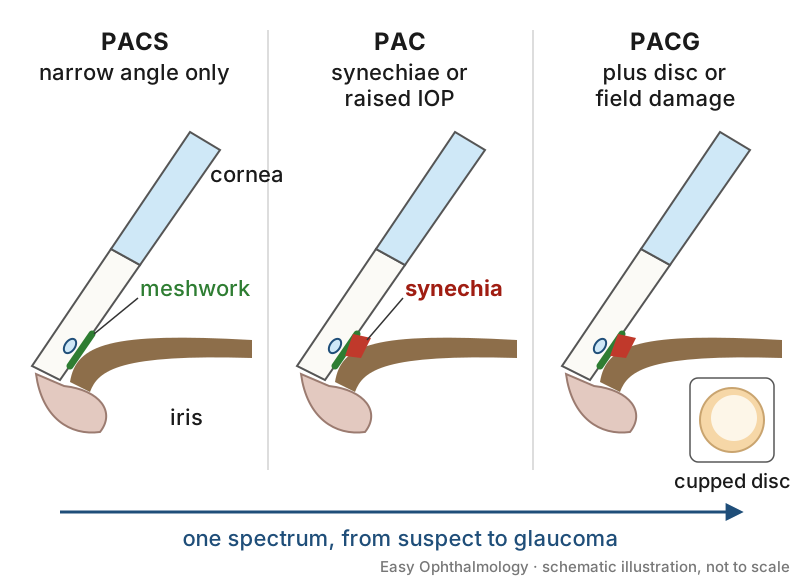
- Gonioscopy defines the stage; trial end points were synechiae, IOP above 21 or 24 mmHg, or acute angle closure [S5] [S9].
- Dilation of PACS eyes raised IOP by a mean of about 1.5 mmHg, and acute angle closure after dilation was very rare (1.04 per 1000 dilations in untreated eyes) [S4]. Routine LPI before dilation was not recommended [S4].
- Anterior segment OCT measures of a thick iris (IT750) in a narrow angle predicted persistent closure after LPI [S12].
Manage it: stage by stage
Before acting on this section, check the national and local guidelines, product information and regulatory approvals that apply where you practise. See the medical disclaimer.
Tier A (primary care / no specialist)
- Refer adults with suspected narrow angles, raised IOP or disc damage for gonioscopy.
- Dilation of narrow-angle suspects carries a very low acute closure risk in trial data [S4]; local protocols decide whether to dilate before an eye assessment.
Tier B (general eye clinic)
- PACS (suspects). Prophylactic LPI reduced PAC (NNT 15 in pooled data, 22 in the Singapore trial) [S10] [S5]. A Cochrane review found little to no difference in IOP or visual acuity at 1 and 5 years, wider angles and fewer synechiae at 5 years, and no clear reduction in acute angle closure (low certainty) [S8]. In a population with low event rates, LPI for everyone screened was judged of limited benefit [S1]. Decide case by case, weighing IOP, age and access to follow-up [S5] [S9] [S10].
- Safety of LPI. LPI did not cause clinically meaningful cataract progression over 72 months (21.2% vs 19.4%) [S7]. Minor adverse events such as pain, redness and discomfort were more common after iridotomy [S8].
- After LPI. Re-examine the angle: about one third remain closed at 5 years [S12]. Angle widening occurs within 2 years and then stays stable [S12].
Tier C (specialist centre)
- PAC and PACG with clear lens. In EAGLE, 90% met a good-response criterion after clear lens extraction vs 67% after LPI at 36 months; non-Chinese ethnicity, higher baseline IOP and prior glaucoma drops predicted worse response [S6]. Cochrane found less visual field progression (OR 0.35) and fewer medications with phacoemulsification than LPI, with little difference in quality of life or acuity at 12 months [S3]. The decision should be shared with the patient [S3].
- PACG with visually significant cataract. Phacoemulsification alone; adding viscogonioplasty or goniosynechialysis gave no extra benefit, and adding trabeculectomy may cause more complications (low or very low certainty) [S3].
- Laser iridoplasty for chronic angle closure may be no more effective than comparators and is not supported by trials to date [S2].
Refer when
| Situation | Urgency |
|---|---|
| Narrow angle with IOP above normal or synechiae (PAC) | Within a week to a glaucoma service [G2] |
| PACG with disc or field damage | Urgent for lens extraction assessment; timing per your local service or specialist advice |
| Suspect (narrow angle only, normal IOP and disc) | Routine, for gonioscopy and a shared LPI decision; timing per your local service or specialist advice |
| Symptoms of an acute attack | Immediate: see acute primary angle closure [G1] |
Pitfalls
- Assuming LPI ends the problem; one third stay closed [S12].
- Offering LPI to all screened suspects regardless of risk [S1] [S10].
- Using LPI rather than lens extraction as first treatment for PACG [S3] [S6].
- Adding iridoplasty or extra angle procedures without evidence [S2] [S3].
Evidence notes
| Source | Date | Design |
|---|---|---|
| [S1] | 2019 | RCT (fellow-eye), 889 people, China, 72 months |
| [S2] | 2021 | Cochrane review, 4 RCTs, 276 eyes |
| [S3] | 2021 | Cochrane review, 8 RCTs, 513 eligible eyes |
| [S4] | 2022 | Analysis within the Zhongshan RCT |
| [S5] | 2022 | Multicentre RCT (fellow-eye), 480 people, Singapore |
| [S6] | 2023 | Secondary analysis of the EAGLE RCT, 369 patients |
| [S7] | 2023 | Analysis within the Zhongshan RCT, 72 months |
| [S8] | 2023 | Cochrane review, 4 trials, 3086 eyes |
| [S9] | 2023 | 14-year extension of the Zhongshan RCT |
| [S10] | 2025 | Meta-analysis, 2 RCTs and 3 observational studies |
| [S11] | 2025 | Bayesian meta-analysis, 9 African studies |
| [S12] | 2026 | Subanalysis of the Singapore RCT |
- PACS trials were almost entirely in Chinese populations, and loss to follow-up at 14 years was large (390 and 388 eyes) [S9]. No PACS trial reported visual field progression [S8].
- The PACS meta-analysis notes the lack of demonstrated clinical efficacy of LPI and calls for balanced decisions [S10]; this conflicts in emphasis with the relative risk reductions in individual trials [S1] [S5].
- Cochrane could not pool lens extraction trials; conclusions are short to medium term [S3].
- Not covered by these sources: screening strategies, plateau iris, cost-effectiveness, LPI technique and settings, and timing of surgery.
Related articles
- Acute Primary Angle Closure
- Gonioscopy and anterior-segment imaging of the angle
- Primary Open-Angle Glaucoma: Diagnosis and Treatment Targets
References
See the numbered source list below. Each marker [S#] links to its PubMed and DOI record.
Sources
- [S1] He M, Jiang Y, Huang S, Chang DS, Munoz B, Aung T, et al. Laser peripheral iridotomy for the prevention of angle closure: a single-centre, randomised controlled trial. Lancet (London, England). (2019). PubMed 30878226 · doi:10.1016/s0140-6736(18)32607-2
- [S2] Bayliss JM, Ng WS, Waugh N, Azuara-Blanco A Laser peripheral iridoplasty for chronic angle closure. The Cochrane database of systematic reviews. (2021). PubMed 33755197 · doi:10.1002/14651858.cd006746.pub4
- [S3] Ong AY, Ng SM, Vedula SS, Friedman DS Lens extraction for chronic angle-closure glaucoma. The Cochrane database of systematic reviews. (2021). PubMed 33759192 · doi:10.1002/14651858.cd005555.pub3
- [S4] Wang L, Huang W, Han X, Liao C, Jin L, He M The Impact of Pharmacological Dilation on Intraocular Pressure in Primary Angle Closure Suspects. American journal of ophthalmology. (2022). PubMed 34197780 · doi:10.1016/j.ajo.2021.06.018
- [S5] Baskaran M, Kumar RS, Friedman DS, Lu QS, Wong HT, Chew PTK, et al. The Singapore Asymptomatic Narrow Angles Laser Iridotomy Study: Five-Year Results of a Randomized Controlled Trial. Ophthalmology. (2022). PubMed 34453952 · doi:10.1016/j.ophtha.2021.08.017
- [S6] Mitchell WG, Azuara-Blanco A, Foster PJ, Halawa O, Burr J, Ramsay CR, et al. Predictors of long-term intraocular pressure control after lens extraction in primary angle closure glaucoma: results from the EAGLE trial. The British journal of ophthalmology. (2023). PubMed 35387778 · doi:10.1136/bjophthalmol-2021-319765
- [S7] Chang DS, Jiang Y, Kim JA, Huang S, Munoz B, Aung T, et al. Cataract progression after Nd:YAG laser iridotomy in primary angle-closure suspect eyes. The British journal of ophthalmology. (2023). PubMed 35501120 · doi:10.1136/bjophthalmol-2021-320929
- [S8] Rouse B, Le JT, Gazzard G Iridotomy to slow progression of visual field loss in angle-closure glaucoma. The Cochrane database of systematic reviews. (2023). PubMed 36621864 · doi:10.1002/14651858.cd012270.pub3
- [S9] Yuan Y, Wang W, Xiong R, Zhang J, Li C, Yang S, et al. Fourteen-Year Outcome of Angle-Closure Prevention with Laser Iridotomy in the Zhongshan Angle-Closure Prevention Study: Extended Follow-up of a Randomized Controlled Trial. Ophthalmology. (2023). PubMed 37030454 · doi:10.1016/j.ophtha.2023.03.024
- [S10] Ji PX, Pickel L, Balas M, Mathew DJ Progression of primary angle closure suspects: a systematic review and meta-analysis. Eye (London, England). (2025). PubMed 39905214 · doi:10.1038/s41433-025-03655-y
- [S11] Asiamah R, Kyei S, Owusu G, Agyiri PE Prevalence of glaucoma in Africa: A systematic review and Bayesian meta-analysis. PloS one. (2025). PubMed 40811710 · doi:10.1371/journal.pone.0330567
- [S12] Servillo A, Tun TA, Yoo C, Kumar RS, Baskaran M, Nongpiur ME, et al. Long-term Persistent Angle Closure and Anatomic Changes after Laser Iridotomy in Suspected Primary Angle-Closure. Ophthalmology. (2026). PubMed 41205830 · doi:10.1016/j.ophtha.2025.10.027
Guidelines
- [G1] NHS Scotland Community Eyecare Guidelines. 6.4 Glaucoma, Acute Angle Closure (n.d.). https://www.eyes.nhs.scot/eyecare-guidelines/section-6-glaucoma/64-glaucoma-acute-angle-closure/
- [G2] NHS Scotland Community Eyecare Guidelines. 6.3 Glaucoma, Primary Angle Closure (n.d.). https://www.eyes.nhs.scot/eyecare-guidelines/section-6-glaucoma/63-glaucoma-primary-angle-closure/