Educational content only. Not personalised medical advice. Clinical decisions remain the responsibility of the treating clinician.
Integrating eye care into primary health care
Primary eye care (PEC) is a core part of comprehensive eye care and universal eye health coverage; in most of the developing world it is delivered by primary health workers, and in developed nations by personnel such as optometrists [S4]. Integrating eye health into primary health care is widely endorsed, but the evidence that it works at the primary level remains weak [S2] [S8].
Key points - In 2021 the World Health Assembly endorsed a 40-percentage-point increase in effective refractive error coverage by 2030, which requires refractive services in community and primary care [S9]. - In India, more than 300 vision centres linked to mentor hospitals provide PEC in remote rural areas [S4], within a pyramidal model of primary, secondary and tertiary care [S1]. - In Southern and Eastern Africa, eye health was prioritised nationally but failed to cascade to lower levels, eye care data were inadequate and government funding was limited [S8]. - Asynchronous tele-ophthalmology between community optometrists and hospitals cut false-positive urgent referrals by 59% in a UK cluster RCT [S11]. - A menu of 22 eye health indicators, 7 of them core, was agreed for monitoring eye health within universal health coverage [S6].
Evidence last checked: 2026-10-18 (PubMed abstracts).
Red flags: signs that need urgent action
- In a person: a red eye with danger signs. Most red eyes are benign and treatable in primary care, but some emergent conditions present this way and need immediate referral to an ophthalmologist [S3].
- In a person: conjunctivitis during a respiratory epidemic, which may be an early sign of infection; use extra protective equipment [S5].
- In a child: reduced vision. The main causes in Africa (uncorrected refractive error, amblyopia, cataract and corneal opacities) are avoidable with timely diagnosis [S10].
- In a system: no referral link from primary to specialist eye care [S2].
- In a system: no data. Inadequate eye care documentation prevents planning [S8].
Recognise it: what primary eye care covers
- Refractive and optical care: delivered through school-based, pharmacy and outreach models in the community, and vision centre, health centre and door-to-door models in primary care [S9].
- Health promotion: health education, counselling, vision and eye screening, training, and diabetic retinopathy screening [S12].
- Community roles: health promotion and education; drug and supplement distribution and immunisation campaigns; surveillance, screening and detection; and referral and pathway navigation [S7].
- Barriers for children: lack of availability, accessibility and affordability, plus incorrect health beliefs and poor knowledge [S10].
- Barriers in rural India: uptake of services was lowest among lower socio-economic groups, women and rural populations [S1].
Confirm it: is integration working?
- Use the agreed indicators, which were judged feasible, actionable, reliable and internationally comparable [S6].
- Evaluate delivery approaches: few studies have evaluated refractive service delivery models [S9].
- Check whether integration reaches the lower levels of the system, not only national policy [S8].
- Monitor compliance and follow-up after health promotion, which are recognised gaps [S12].
Manage it: what to do at each resource tier
Before acting on this section, check the national and local guidelines, product information and regulatory approvals that apply where you practise. See the medical disclaimer.
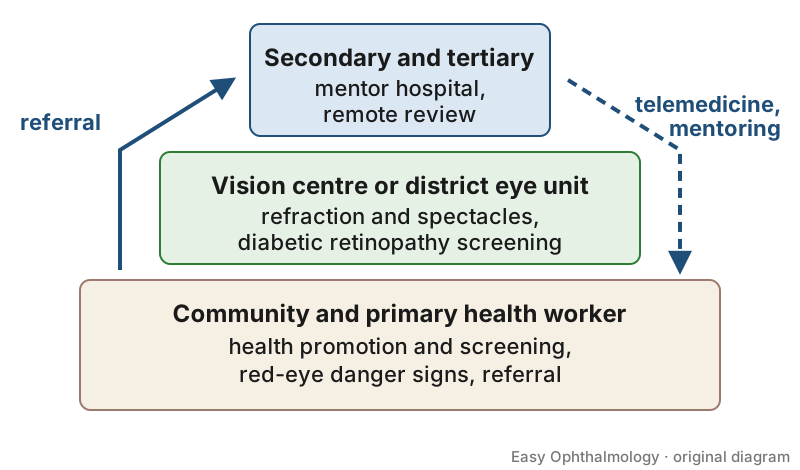
Tier A (community and primary health worker)
- Engage community actors, but do not assume this alone builds trust; volunteer programmes struggle to sustain motivation when resources are limited [S7].
- Deliver eye health promotion in schools, clinics, workplaces and community events [S12].
- Recognise red-eye danger signs and refer [S3].
- During epidemics, keep distance, use gloves, masks and shields, and sterilise instruments, as recommended by Indian consensus guidelines [S5].
Tier B (vision centre or district eye unit)
- Provide refraction and spectacles close to where people live [S4] [S9].
- Plan human resources, supply chains, financial sustainability, quality and monitoring [S4].
- Add screening for diabetes and diabetic retinopathy to increase community participation [S1].
- Use telemedicine for emergent cases that cannot be managed at the primary level [S5].
Tier C (secondary and tertiary centre and planners)
- Act as mentor hospitals that link vision centres to secondary and tertiary care [S1] [S4].
- Offer remote review of primary-level referrals; in the HERMES trial a decision was given within 48 hours and time to consultation improved [S11].
- Integrate eye care into all health system building blocks, especially financing, leadership and governance [S2] [S8].
- Train general health cadres and communities, while monitoring quality [S8].
Refer when
| Situation | Urgency |
|---|---|
| Red eye with danger signs (pain, reduced vision, photophobia or corneal opacity) | Immediate, same-day, to an ophthalmologist [S3]; specific danger signs |
| Eye injury or sudden loss of vision | Same-day to an eye unit |
| Child with reduced vision | Urgent to a child eye service; timing per your local service or specialist advice |
| Reduced vision not corrected by spectacles in an adult | Routine to an eye clinic; timing per your local service or specialist advice |
Pitfalls
- Treating integration as a national policy statement without implementation at lower levels [S8].
- Training general cadres without checking quality of care [S8].
- Relying on volunteers without resources to sustain them [S7].
- Expecting AI triage tools to work everywhere; one model could not process images from 48.5% of participants [S11].
- Missing emergent causes of red eye [S3].
Evidence notes
| Source | Date | Design |
|---|---|---|
| [S1] | 2012 | Programme description, India |
| [S2] | 2013 | Scoping review, sub-Saharan Africa |
| [S3] | 2015 | Narrative review |
| [S4] | 2020 | Programme description, more than 300 vision centres, India |
| [S5] | 2020 | Expert consensus guideline (COVID-19), India |
| [S6] | 2022 | Expert prioritisation (72 experts) |
| [S7] | 2023 | Scoping review, 73 studies, LMICs |
| [S8] | 2023 | Scoping review, 30 articles, Southern and Eastern Africa |
| [S9] | 2024 | Cochrane scoping review, WHO-led |
| [S10] | 2024 | Systematic review, Africa |
| [S11] | 2025 | Cluster RCT with diagnostic accuracy study, UK |
| [S12] | 2025 | Systematic review, 80 studies |
- Thin evidence: most sources are programme descriptions, scoping reviews and expert opinion; the only RCT is from a high-income setting [S11].
- Evidence for integration is weak for service delivery, equipment and supplies, financing, leadership and governance [S2].
- No explicit definition of integration was found in the ECSA-HC review [S8].
- Not covered by these sources: a standard list of primary eye care conditions and treatments, essential medicines and equipment lists, and red-eye danger signs in detail.
Related articles
References
See the numbered source list below. Each marker [S#] links to its PubMed and DOI record.
Sources
- [S1] Rao GN, Khanna RC, Athota SM, Rajshekar V, Rani PK Integrated model of primary and secondary eye care for underserved rural areas: the L V Prasad Eye Institute experience. Indian journal of ophthalmology. (2012). PubMed 22944748 · doi:10.4103/0301-4738.100533
- [S2] du Toit R, Faal HB, Etya'ale D, Wiafe B, Mason I, Graham R, et al. Evidence for integrating eye health into primary health care in Africa: a health systems strengthening approach. BMC health services research. (2013). PubMed 23506686 · doi:10.1186/1472-6963-13-102
- [S3] Dunlop AL, Wells JR Approach to Red Eye for Primary Care Practitioners. Primary care. (2015). PubMed 26319338 · doi:10.1016/j.pop.2015.05.002
- [S4] Khanna RC, Sabherwal S, Sil A, Gowth M, Dole K, Kuyyadiyil S, et al. Primary eye care in India - The vision center model. Indian journal of ophthalmology. (2020). PubMed 31957722 · doi:10.4103/ijo.ijo_118_19
- [S5] Vashist P, Senjam SS, Gupta V, Manna S, Agrawal S, Gupta N, et al. Community eye-health and vision center guidelines during COVID-19 pandemic in India. Indian journal of ophthalmology. (2020). PubMed 32587155 · doi:10.4103/ijo.ijo_1527_20
- [S6] McCormick I, Mactaggart I, Resnikoff S, Muirhead D, Murthy GV, Silva JC, et al. Eye health indicators for universal health coverage: results of a global expert prioritisation process. The British journal of ophthalmology. (2022). PubMed 33712481 · doi:10.1136/bjophthalmol-2020-318481
- [S7] Lee L, Moo E, Angelopoulos T, Yashadhana A Integrated people-centered eye care: A scoping review on engaging communities in eye care in low- and middle-income settings. PloS one. (2023). PubMed 36656849 · doi:10.1371/journal.pone.0278969
- [S8] Ogundo CLA, Bascaran C, Habtamu E, Buchan J, Mwangi N Eye Health Integration in Southern and Eastern Africa: A Scoping Review. Middle East African journal of ophthalmology. (2023). PubMed 38435102 · doi:10.4103/meajo.meajo_320_21
- [S9] Umaefulam V, Safi S, Lingham G, Gordon I, Mueller A, Krishnam NS, et al. Approaches for delivery of refractive and optical care services in community and primary care settings. The Cochrane database of systematic reviews. (2024). PubMed 38808577 · doi:10.1002/14651858.cd016043
- [S10] Alrasheed SH, Mohamed ZD, Alluwimi MS Childhood visual impairment causes and barriers to accessing eye care: A suggested approach for Africa. African journal of primary health care & family medicine. (2024). PubMed 39099279 · doi:10.4102/phcfm.v16i1.4556
- [S11] Sharma A, Hussain R, Learoyd AE, Aristidou A, Soomro T, Blandford A, et al. Tele-ophthalmology-enabled and artificial intelligence-ready referral pathway for community optometry referrals of retinal disease: HERMES cluster randomised trial with a diagnostic accuracy study. Health technology assessment (Winchester, England). (2025). PubMed 41424155 · doi:10.3310/qndf3325
- [S12] Masemola HC, Nkambule SJ, Baloyi O, Xulu-Kasaba ZN Eye health promotion in multi-sectoral settings: A systematic review of intervention types and effectiveness. F1000Research. (2025). PubMed 41585456 · doi:10.12688/f1000research.168998.1