Educational content only. Not personalised medical advice. Clinical decisions remain the responsibility of the treating clinician.
Primary Open-Angle Glaucoma: Diagnosis and Treatment Targets
Glaucoma is the leading cause of global irreversible blindness, with primary open-angle glaucoma (POAG) most prevalent in Africa [S3]. Lowering intraocular pressure (IOP) preserves the visual field, as shown by the first placebo-controlled trial [S4], and first-line selective laser trabeculoplasty (SLT) or, in advanced disease, primary trabeculectomy can outperform drops [S6] [S7] [S11].
Key points - Global glaucoma numbers were projected to rise to 111.8 million in 2040, disproportionately in Asia and Africa [S3]; POAG incidence is highest in low sociodemographic index regions and in Africa [S8]. - Latanoprost halved the risk of visual field deterioration over 24 months compared with placebo (HR 0.44) [S4]. - Prostaglandin analogues lowered IOP most among first-line drops, but within-class differences were small [S5]. - First-line SLT gave better long-term disease control than drops, with fewer trabeculectomies and cataract operations over 6 years [S6] and slower visual field loss [S11]. - In advanced glaucoma, primary trabeculectomy gave lower IOP and less field loss than drops at 5 years, with similar safety [S7].
Evidence last checked: 2026-10-17 (PubMed abstracts).
Red flags
- Optic disc haemorrhage: associated with progression of POAG (OR 4.51) and normal-tension glaucoma (OR 5.15) [S12].
- Rapid field loss: among ocular hypertensive eyes that developed field loss, 21% lost 1.0 dB per year or more and 5.4% lost 2.0 dB per year or more [S9].
- Advanced disease at diagnosis: medication was associated with more field progression than surgery in more severe glaucoma [S1] [S7].
Recognise it: who is at risk
- Risk factors for incident POAG: family history (OR 2.49), myopia (OR 2.08), elevated IOP (OR 1.13 per unit), older age and male sex [S8].
- People of African ancestry were more likely to have POAG than people of European ancestry (OR 2.80), and urban residents more than rural (OR 1.58) [S3].
- Incidence rises from 5.51 per 10 000 person-years at 40 to 44 years to 64.36 at 75 to 79 years [S8].
- Screening: the US Preventive Services Task Force found the evidence insufficient to assess the benefits and harms of screening asymptomatic adults in primary care (I statement) [S2]. This applies to a US primary care setting; high-prevalence settings may differ [S3] [S8].
Confirm it
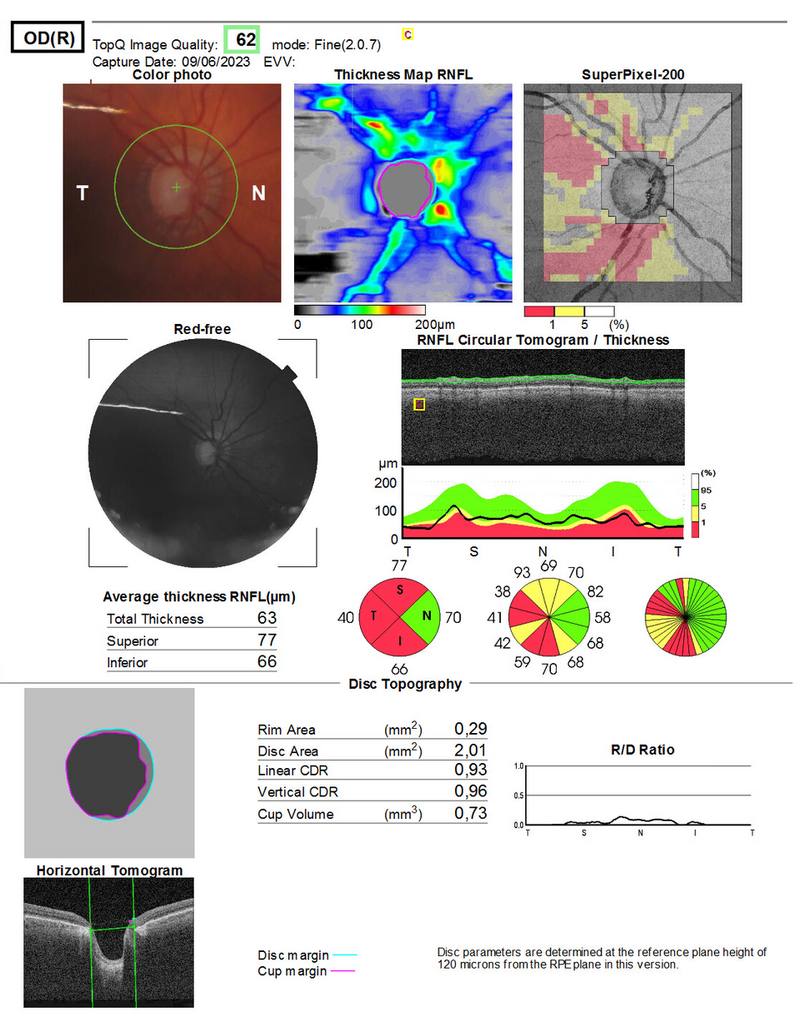
- Diagnosis and monitoring in trials relied on visual fields, stereoscopic disc photographs, and disc imaging (HRT rim area, OCT nerve fibre layer) [S9] [S10].
- Visual field mean deviation deteriorated faster (-0.59 dB per year) than structural measures in UKGTS, partly explained by the structural floor effect [S10].
- Each mmHg of IOP accelerated functional and structural progression to a similar degree [S10].
Manage it: treatment and targets
Before acting on this section, check the national and local guidelines, product information and regulatory approvals that apply where you practise. See the medical disclaimer.
Tier A (primary care / no specialist)
- Refer people with a family history of glaucoma, suspicious discs or raised IOP to an eye service.
- Support adherence for patients already on drops; drop choice is a specialist decision. Dosing is not covered beyond the trial regimens below; follow local formularies.
Tier B (general eye clinic)
- Start lowering IOP. In UKGTS, latanoprost 0.005% once daily to both eyes (as reported in [S4]) lowered IOP by 3.8 mmHg vs 0.9 mmHg with placebo at 24 months and prolonged visual field preservation [S4].
- Choose a drug. In a network meta-analysis of 114 RCTs, 3-month IOP reduction was greatest with bimatoprost (5.61 mmHg), latanoprost (4.85) and travoprost (4.83), and smaller with timolol (3.70), brimonidine (3.59) and dorzolamide (2.49) [S5]. Adverse effects, patient preference and cost should guide choice [S5].
- Offer SLT first where available. In LiGHT, 69.8% of SLT-treated eyes stayed at or below target IOP without further treatment at 6 years, progression was less frequent (19.6% vs 26.8%) and no serious laser-related adverse events occurred [S6]. The visual field rate was -0.26 vs -0.37 dB per year [S11].
- Monitor the rate of field loss. Some ocular hypertensive patients lost vision rapidly despite trial follow-up, so high-risk patients need careful follow-up [S9]. Monitor more closely after a disc haemorrhage [S12].
Tier C (specialist centre)
- Advanced glaucoma at presentation. In TAGS, mitomycin C-augmented trabeculectomy gave mean IOP 12.07 vs 14.76 mmHg and better field mean deviation at 5 years, with similar quality of life and safety events (52.2% vs 57.9%) [S7].
- Earlier trials of initial surgery. A Cochrane review of 4 older trials (888 participants) found no significant difference in field progression in mild disease at 5 years, lower IOP but more eye symptoms with trabeculectomy, and more treatment failure with medication in the longer term; medications and surgery have changed since [S1].
- Treatment targets. Individual target IOP values are not specified in these abstracts; LiGHT used a protocol-defined target [S6].
Refer when
| Situation | Urgency |
|---|---|
| Advanced field loss or very high IOP at first diagnosis | Urgent, within days, to a glaucoma service [S7] [G1] |
| Disc haemorrhage or documented rapid field loss on treatment | Urgent for treatment escalation [S9] [S12]; timing per your local service or specialist advice |
| Suspected POAG (suspicious disc, raised IOP, family history) | Routine; timing per your local service or specialist advice |
Pitfalls
- Equating a normal IOP reading with no glaucoma; disc haemorrhage predicts progression in normal-tension disease too [S12].
- Defaulting to drops when SLT is available and acceptable [S6] [S11].
- Starting drops alone in advanced disease without discussing surgery [S7].
- Judging stability on structure alone in advanced disease, given the floor effect [S10].
Evidence notes
| Source | Date | Design |
|---|---|---|
| [S1] | 2012 | Cochrane review, 4 RCTs |
| [S2] | 2013 | USPSTF recommendation statement |
| [S3] | 2014 | Meta-analysis of 50 population-based studies |
| [S4] | 2015 | Triple-masked placebo-controlled RCT, 516 patients, UK |
| [S5] | 2016 | Network meta-analysis, 114 RCTs |
| [S6] | 2023 | Multicentre RCT (LiGHT), 6-year results |
| [S7] | 2024 | Multicentre RCT (TAGS), 453 adults, UK |
| [S8] | 2024 | Meta-analysis of 50 prospective incidence studies |
| [S9] | 2025 | Prespecified analysis of OHTS RCT data |
| [S10] | 2025 | Secondary analysis of UKGTS |
| [S11] | 2026 | Post hoc analysis of LiGHT |
| [S12] | 2026 | Meta-analysis of 22 cohort studies |
- UKGTS was stopped early and its primary outcome changed after an interim analysis; it was funded partly by Pfizer [S4].
- LiGHT, TAGS and UKGTS were run in the UK [S4] [S6] [S7]; their applicability to African and Asian services is not tested in these abstracts.
- The disc haemorrhage evidence is observational [S12].
- Not covered by these sources: methods for setting target IOP, central corneal thickness, cost and drop availability in low-resource settings, and screening programmes outside the US.
Related articles
- Glaucoma Medications: Choices, Adherence and Side Effects
- Selective Laser Trabeculoplasty as First-Line Treatment
- Visual field testing and interpretation
- Optic disc assessment in glaucoma
References
See the numbered source list below. Each marker [S#] links to its PubMed and DOI record.
Sources
- [S1] Burr J, Azuara-Blanco A, Avenell A, Tuulonen A Medical versus surgical interventions for open angle glaucoma. The Cochrane database of systematic reviews. (2012). PubMed 22972069 · doi:10.1002/14651858.cd004399.pub3
- [S2] Moyer VA, U.S. Preventive Services Task Force Screening for glaucoma: U.S. Preventive Services Task Force Recommendation Statement. Annals of internal medicine. (2013). PubMed 24325017 · doi:10.7326/0003-4819-159-6-201309170-00686
- [S3] Tham YC, Li X, Wong TY, Quigley HA, Aung T, Cheng CY Global prevalence of glaucoma and projections of glaucoma burden through 2040: a systematic review and meta-analysis. Ophthalmology. (2014). PubMed 24974815 · doi:10.1016/j.ophtha.2014.05.013
- [S4] Garway-Heath DF, Crabb DP, Bunce C, Lascaratos G, Amalfitano F, Anand N, et al. Latanoprost for open-angle glaucoma (UKGTS): a randomised, multicentre, placebo-controlled trial. Lancet (London, England). (2015). PubMed 25533656 · doi:10.1016/s0140-6736(14)62111-5
- [S5] Li T, Lindsley K, Rouse B, Hong H, Shi Q, Friedman DS, et al. Comparative Effectiveness of First-Line Medications for Primary Open-Angle Glaucoma: A Systematic Review and Network Meta-analysis. Ophthalmology. (2016). PubMed 26526633 · doi:10.1016/j.ophtha.2015.09.005
- [S6] Gazzard G, Konstantakopoulou E, Garway-Heath D, Adeleke M, Vickerstaff V, Ambler G, et al. Laser in Glaucoma and Ocular Hypertension (LiGHT) Trial: Six-Year Results of Primary Selective Laser Trabeculoplasty versus Eye Drops for the Treatment of Glaucoma and Ocular Hypertension. Ophthalmology. (2023). PubMed 36122660 · doi:10.1016/j.ophtha.2022.09.009
- [S7] King AJ, Hudson J, Azuara-Blanco A, Burr J, Kernohan A, Homer T, et al. Evaluating Primary Treatment for People with Advanced Glaucoma: Five-Year Results of the Treatment of Advanced Glaucoma Study. Ophthalmology. (2024). PubMed 38199528 · doi:10.1016/j.ophtha.2024.01.007
- [S8] Shan S, Wu J, Cao J, Feng Y, Zhou J, Luo Z, et al. Global incidence and risk factors for glaucoma: A systematic review and meta-analysis of prospective studies. Journal of global health. (2024). PubMed 39513294 · doi:10.7189/jogh.14.04252
- [S9] Gordon MO, Heuer DK, Higginbotham EJ, Parrish RK, Liu L, Brandt JD, et al. Visual Field Progression in the Ocular Hypertension Treatment Study. American journal of ophthalmology. (2025). PubMed 39647569 · doi:10.1016/j.ajo.2024.11.017
- [S10] Montesano G, Rabiolo A, Ometto G, Crabb DP, Garway-Heath DF Relationship Between Intraocular Pressure and the True Rate of Functional and Structural Progression in the United Kingdom Glaucoma Treatment Study. Investigative ophthalmology & visual science. (2025). PubMed 39808119 · doi:10.1167/iovs.66.1.32
- [S11] Montesano G, Crabb DP, Garway-Heath DF, Wright DM, Konstantakopoulou E, Nathwani N, et al. Six-Year Rate of Visual Field Progression in the Laser in Glaucoma and Ocular Hypertension Trial. Ophthalmology. (2026). PubMed 41043781 · doi:10.1016/j.ophtha.2025.09.023
- [S12] Tan CQL, Tan CJ, Tai BC, Chan NS, Lun WK, Tham YC, et al. Longitudinal Association Between Disc Hemorrhage and Primary Open-Angle Glaucoma Progression: A Systematic Review and Meta-Analysis. Ophthalmic epidemiology. (2026). PubMed 41626848 · doi:10.1080/09286586.2025.2568395
Guidelines
- [G1] NHS Scotland (Community Eyecare Guidelines, eyes.nhs.scot). 6.2 Glaucoma, Primary Open Angle (n.d.). https://www.eyes.nhs.scot/eyecare-guidelines/section-6-glaucoma/62-glaucoma-primary-open-angle/