Educational content only. Not personalised medical advice. Clinical decisions remain the responsibility of the treating clinician.
Retinopathy of prematurity
Retinopathy of prematurity (ROP) is a vision-threatening vasoproliferative disease of preterm infants [S3] [S2] and a leading cause of potentially avertable childhood blindness [S4]. Its rising prevalence in low- and middle-income countries, the "third epidemic", has increased the need to screen at-risk infants [S7]. Timely screening and treatment with laser or intravitreal anti-VEGF drugs are the core of care [S12].
Key points - Risk rises steeply with prematurity: each week less of gestational age carried a median 1.4 times the odds of ROP, and each 100 g less of birth weight 1.8 times [S9]. - Laser photocoagulation and intravitreal anti-VEGF injection are the standard treatments [S12]; anti-VEGF was not inferior to laser for retreatment in a network meta-analysis and gave a better refractive profile [S12]. - Anti-VEGF monotherapy does not reduce retinal detachment overall and may increase recurrence needing retreatment in zone II disease (Cochrane, low-quality evidence) [S2]. - Telemedicine, weight-gain algorithms and artificial intelligence can support screening in settings with few specialists, but AI is not yet sufficient as a sole diagnostic tool [S7] [S8] [S11].
Evidence last checked: 2026-10-17 (PubMed abstracts).
Red flags
- Treatment-requiring (type 1) ROP: zone I any stage with plus disease, zone I stage 3 with or without plus disease, or zone II stage 2 or 3 with plus disease [S2].
- Aggressive posterior ROP was included in treatment trials as requiring treatment [S10].
- Recurrence after anti-VEGF: recurrence risk was higher in eyes that received bevacizumab in eye-level analyses [S2], and lower doses were associated with shorter times to retreatment [S12]. Infants treated with anti-VEGF need continued follow-up.
- The most immature infants: at 23 weeks' gestation the risk of any, severe and treatment-requiring ROP was 66.5%, 40.3% and 39.4% [S9].
Recognise it: who is at risk
- Across 18 population-based studies (342,005 infants), the overall risk of ROP in preterm infants was 18.8% [S9].
- Gestational age and birth weight are the basis of national screening guidelines [S9]. Higher risk was also found with neonatal sepsis and bronchopulmonary dysplasia [S9].
- In regions with higher neonatal mortality, infants with ROP had the highest mean gestational age [S9]: more mature babies develop ROP in these settings, so screening criteria from high-income countries may miss them.
- Exact screening eligibility thresholds are not given in these abstracts: follow your national guideline.
Confirm it
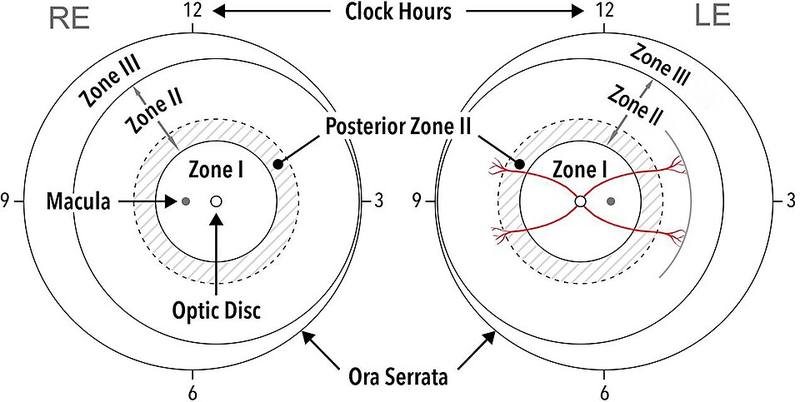
- The recommended screening method is binocular indirect ophthalmoscopy, which needs frequent examinations and a heavy workload [S8].
- Weight-gain algorithms (WINROP, G-ROP, CHOP ROP, ROPScore, CO-ROP) had adequate sensitivity to rule out type 1 or severe ROP in a meta-analysis of 61 studies; only algorithms with sensitivity close to 100% should be used to reduce examinations safely [S8]. WINROP had a pooled sensitivity of 0.89 [S8], too low for that purpose.
- Telemedicine: low-income countries use available internet and communications technology for ROP screening; programmes need national support to maintain infrastructure [S7].
- Artificial intelligence on wide-field retinal images reported sensitivity of 71%-100% and specificity of 74-99%, comparable to ophthalmologists, but should be an adjunct rather than the sole diagnostic tool [S11].
Manage it
Before acting on this section, check the national and local guidelines, product information and regulatory approvals that apply where you practise. See the medical disclaimer.
Tier A (primary care / no specialist)
- Neonatal units: identify every infant meeting national screening criteria and make sure the examination happens [S9].
- Oxygen: in extremely preterm infants (under 28 weeks), restricted (SpO2 85%-89%) vs liberal (91%-95%) targets did not change ROP rates, but restricted targets increased mortality before discharge and necrotising enterocolitis (moderate to low quality) [S1].
Tier B (general eye clinic or screening service)
- Screen with indirect ophthalmoscopy or validated imaging and telemedicine where an ROP specialist is not on site [S7] [S8].
- After laser, arrange periodic cycloplegic refraction and early optical correction: laser was associated with myopia (OR 8.08) and astigmatism (OR 3.19) [S4].
Tier C (specialist centre)
- Laser vs ranibizumab. In RAINBOW (225 infants under 1500 g, 26 countries), treatment success was 80% with ranibizumab 0.2 mg, 75% with 0.1 mg and 66% with laser (doses as reported in [S5]); superiority of 0.2 mg narrowly missed significance (p=0.051), with fewer unfavourable structural outcomes and similar adverse events at 24 weeks [S5].
- Laser vs aflibercept. In FIREFLEYE (118 infants), aflibercept 0.4 mg (as reported in [S10]) gave 85.5% vs 82.1% success but did not meet noninferiority criteria; rescue treatment was needed in 4.8% vs 11.1% of eyes [S10].
- Cochrane review. Bevacizumab or ranibizumab monotherapy did not reduce retinal detachment or overall recurrence, reduced recurrence in zone I but increased it in zone II, and lowered very high myopia at 30 months; evidence was very low to low quality and long-term systemic effects are unknown [S2].
- Choice of agent and dose. A network meta-analysis of 68 studies (6445 infants) found no agent inferior to laser for retreatment; half doses retained efficacy but were associated with shorter times to retreatment [S12]. Exact bevacizumab doses are not stated in these abstracts: follow local protocols.
- Neurodevelopment. A meta-analysis of 8 studies did not find increased severe neurodevelopmental impairment after bevacizumab (OR 1.39, 95% CI 0.98-1.97), with a minor difference in motor scores; evidence quality was low [S6].
- Propranolol prophylaxis might reduce progression to stage 3 and the need for laser or anti-VEGF, but adverse events at 2 mg/kg/day (as reported in [S3]) raise concerns, and there is insufficient evidence for routine use [S3].
Refer when
| Situation | Urgency |
|---|---|
| Type 1 ROP or aggressive posterior ROP found at screening | Urgent, at the latest, to a treating centre; timing per your local service or specialist advice [S2] [S10] |
| Preterm infant meeting screening criteria and not yet examined, or due for transfer or discharge | Urgent, arrange screening; timing per your local service or specialist advice |
| Infant treated with anti-VEGF who misses follow-up | Urgent; timing per your local service or specialist advice [S2] [S12] |
| Child treated for ROP, for refraction | Routine, periodic cycloplegic refraction [S4] |
Pitfalls
- Using high-income screening thresholds where more mature infants develop ROP [S9].
- Relying on an algorithm without near-100% sensitivity to skip examinations [S8].
- Using AI as the only diagnostic step [S11].
- Losing anti-VEGF-treated infants to follow-up despite recurrence risk [S2] [S12].
- Forgetting refraction after laser [S4].
Evidence notes
| Source | Date | Design |
|---|---|---|
| [S1] | 2015 | Systematic review and meta-analysis of 5 RCTs |
| [S2] | 2018 | Cochrane systematic review, 6 trials, 383 infants |
| [S3] | 2018 | Cochrane systematic review, 3 RCTs, 366 infants |
| [S4] | 2019 | Meta-analysis of 8 case-control studies |
| [S5] | 2019 | Open-label multicentre RCT, 225 infants |
| [S6] | 2021 | Meta-analysis of 8 comparative studies |
| [S7] | 2021 | Systematic review |
| [S8] | 2021 | Diagnostic accuracy meta-analysis, 61 studies |
| [S9] | 2022 | Systematic review of 18 population-based studies |
| [S10] | 2022 | Phase 3 RCT, 118 infants |
| [S11] | 2023 | Systematic review, 27 studies |
| [S12] | 2024 | Network meta-analysis, 15 RCTs and 53 non-randomised studies |
- Conflict: RAINBOW and FIREFLEYE suggest anti-VEGF performs at least as well as laser [S5] [S10] [S12], while the Cochrane review found no reduction in retinal detachment and warned of higher recurrence in zone II [S2]; the Cochrane review predates both trials.
- Funding: RAINBOW was funded by Novartis [S5].
- The network meta-analysis relied largely on non-randomised studies [S12].
- The UK 2022 screening guideline was in the search results but had no abstract, so it could not be cited.
- Not covered by these sources: national screening thresholds and examination intervals, ROP staging details (ICROP), vitrectomy for stage 4 and 5, and pain relief during screening.
Related articles
References
See the numbered source list below. Each marker [S#] links to its PubMed and DOI record.
Sources
- [S1] Manja V, Lakshminrusimha S, Cook DJ Oxygen saturation target range for extremely preterm infants: a systematic review and meta-analysis. JAMA pediatrics. (2015). PubMed 25664703 · doi:10.1001/jamapediatrics.2014.3307
- [S2] Sankar MJ, Sankar J, Chandra P Anti-vascular endothelial growth factor (VEGF) drugs for treatment of retinopathy of prematurity. The Cochrane database of systematic reviews. (2018). PubMed 29308602 · doi:10.1002/14651858.cd009734.pub3
- [S3] Kaempfen S, Neumann RP, Jost K, Schulzke SM Beta-blockers for prevention and treatment of retinopathy of prematurity in preterm infants. The Cochrane database of systematic reviews. (2018). PubMed 29499081 · doi:10.1002/14651858.cd011893.pub2
- [S4] Liang J Systematic review and meta-analysis of the negative outcomes of retinopathy of prematurity treated with laser photocoagulation. European journal of ophthalmology. (2019). PubMed 30022693 · doi:10.1177/1120672118770557
- [S5] Stahl A, Lepore D, Fielder A, Fleck B, Reynolds JD, Chiang MF, et al. Ranibizumab versus laser therapy for the treatment of very low birthweight infants with retinopathy of prematurity (RAINBOW): an open-label randomised controlled trial. Lancet (London, England). (2019). PubMed 31522845 · doi:10.1016/s0140-6736(19)31344-3
- [S6] Tsai CY, Yeh PT, Tsao PN, Chung YE, Chang YS, Lai TT Neurodevelopmental Outcomes after Bevacizumab Treatment for Retinopathy of Prematurity: A Meta-analysis. Ophthalmology. (2021). PubMed 33212122 · doi:10.1016/j.ophtha.2020.11.012
- [S7] Al-Khaled T, Valikodath NG, Patel SN, Cole E, Chervinko M, Douglas CE, et al. Addressing the Third Epidemic of Retinopathy of Prematurity Through Telemedicine and Technology: A Systematic Review. Journal of pediatric ophthalmology and strabismus. (2021). PubMed 34288773 · doi:10.3928/01913913-20210223-01
- [S8] Athikarisamy S, Desai S, Patole S, Rao S, Simmer K, Lam GC The Use of Postnatal Weight Gain Algorithms to Predict Severe or Type 1 Retinopathy of Prematurity: A Systematic Review and Meta-analysis. JAMA network open. (2021). PubMed 34812847 · doi:10.1001/jamanetworkopen.2021.35879
- [S9] Yu CW, Popovic MM, Dhoot AS, Arjmand P, Muni RH, Tehrani NN, et al. Demographic Risk Factors of Retinopathy of Prematurity: A Systematic Review of Population-Based Studies. Neonatology. (2022). PubMed 35124682 · doi:10.1159/000519635
- [S10] Stahl A, Sukgen EA, Wu WC, Lepore D, Nakanishi H, Mazela J, et al. Effect of Intravitreal Aflibercept vs Laser Photocoagulation on Treatment Success of Retinopathy of Prematurity: The FIREFLEYE Randomized Clinical Trial. JAMA. (2022). PubMed 35881122 · doi:10.1001/jama.2022.10564
- [S11] Ramanathan A, Athikarisamy SE, Lam GC Artificial intelligence for the diagnosis of retinopathy of prematurity: A systematic review of current algorithms. Eye (London, England). (2023). PubMed 36577806 · doi:10.1038/s41433-022-02366-y
- [S12] Ortiz-Seller A, Martorell P, Barranco H, Pascual-Camps I, Morcillo E, Ortiz JL Comparison of different agents and doses of anti-vascular endothelial growth factors (aflibercept, bevacizumab, conbercept, ranibizumab) versus laser for retinopathy of prematurity: A network meta-analysis. Survey of ophthalmology. (2024). PubMed 38432359 · doi:10.1016/j.survophthal.2024.02.005