Educational content only. Not personalised medical advice. Clinical decisions remain the responsibility of the treating clinician.
Trabeculectomy
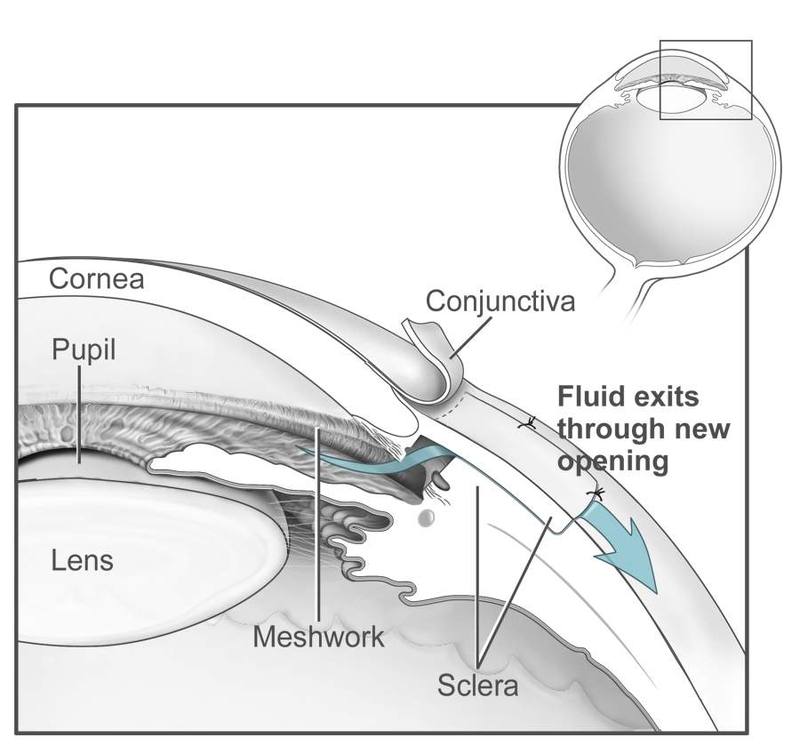
Trabeculectomy lowers intraocular pressure (IOP) by creating a filtering bleb, and antimetabolites such as mitomycin C (MMC) and 5-fluorouracil (5-FU) reduce failure from scarring [S3] [S4]. In advanced glaucoma, primary MMC-augmented trabeculectomy gave lower IOP and less field loss than drops at 5 years [S12], and it remains a benchmark against which newer devices are compared [S10] [S11].
Key points - In the TAGS trial of advanced glaucoma, trabeculectomy gave mean IOP 12.07 vs 14.76 mmHg with medication at 5 years and less field loss, with similar safety [S12]. - MMC may give lower IOP than 5-FU at one year (mean difference -3.05 mmHg; low-quality evidence) [S4]; postoperative 5-FU injections reduced failure in high-risk eyes (NNT 4.1) [S3]. - Trabeculectomy with MMC achieved higher 2-year success than the PreserFlo MicroShunt (64.4% vs 50.6%) but more hypotony (51.1% vs 30.9%) [S11]. - Trabeculectomy with MMC and tube surgery gave similar IOP and failure at 5 years, with fewer medications after trabeculectomy [S8]. - Outcomes of trabeculectomy appear poorer in people of African Caribbean descent than in people of European descent [S9].
Evidence last checked: 2026-10-17 (PubMed abstracts).
Red flags
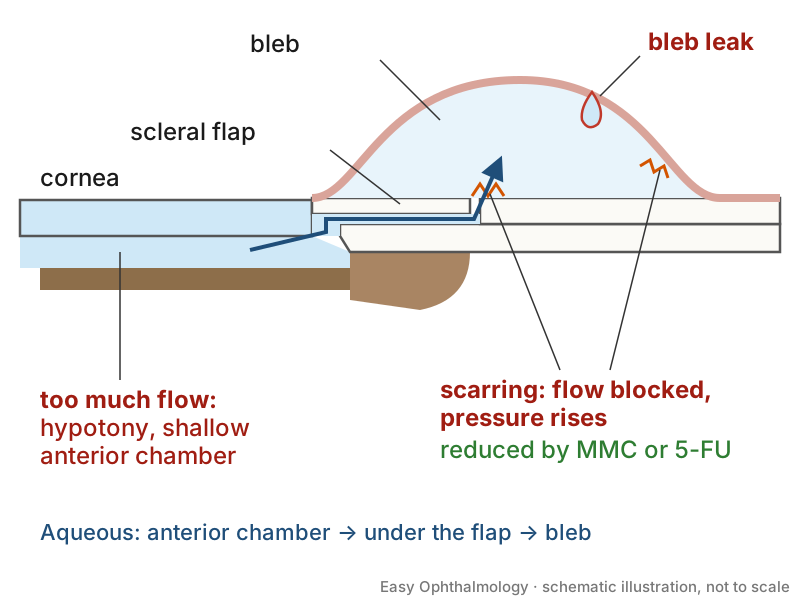
- Hypotony: occurred in 51.1% of trabeculectomy eyes by 2 years in one RCT [S11] and was more frequent with MMC than with an Ologen implant [S6].
- Late bleb leak: there is no evidence comparing most treatments; conjunctival advancement outperformed amniotic membrane in the one trial [S2].
- Endophthalmitis, wound leak, shallow anterior chamber: reported as rare events in antimetabolite trials [S5].
- Encapsulated bleb with rising IOP: in one small trial needling was not better than medical treatment [S1].
Recognise it: who needs trabeculectomy
- Advanced open-angle glaucoma at presentation [S12].
- Eyes at high risk of failure gained clear benefit from antimetabolites [S3] [S4].
- In people of African Caribbean descent, consider that aqueous shunts did not show poorer outcomes than in people of European descent [S9].
Confirm it: assessing the result
- Trials defined success by IOP thresholds with or without medication at 1 to 5 years [S8] [S11].
- Typical mean IOP after trabeculectomy was 10.7 to 13.0 mmHg at 2 to 5 years in recent RCTs [S8] [S11] [S12].
Manage it
Before acting on this section, check the national and local guidelines, product information and regulatory approvals that apply where you practise. See the medical disclaimer.
Tier A (primary care / no specialist)
- Tier A does not perform or manage trabeculectomy. After surgery, a patient with pain, redness, discharge or reduced vision needs the eye unit the same day [G1].
Tier B (general eye clinic)
- Recognise early complications (hypotony, leak, shallow anterior chamber) and refer to the surgeon [S5] [S11].
- Keep medication burden in mind: after trabeculectomy mean medications fell from 2.9 to 0.4 at 2 years [S11].
Tier C (specialist centre)
- Antimetabolite choice. MMC may be more effective than 5-FU, with less epitheliopathy and hyphaema, in 11 trials across the US, Europe, Asia and Africa [S4]. Regular-dose postoperative 5-FU reduced failure in high-risk (RR 0.44) and primary (RR 0.21) surgery; low-dose postoperative 5-FU did not [S3].
- MMC concentration. Trabeculectomy with 0.2 mg/mL MMC had higher complete success than with 0.4 mg/mL (as reported in [S6]). Ologen gave slightly less IOP reduction than MMC up to 12 months, with less hypotony [S6].
- Anti-VEGF instead of MMC is not supported: IOP was 1.86 mmHg higher with anti-VEGF, on low-quality evidence [S5].
- Conjunctival flap. Fornix-based and limbal-based flaps gave similar IOP at 12 and 24 months (moderate certainty) and similar medication use (high certainty) [S7].
- Device-modified trabeculectomy. Ex-PRESS may give slightly lower IOP at 1 year (low certainty); PreserFlo gave higher IOP than trabeculectomy but less hypotony or shallow chamber (RR 0.44) [S10].
- Bleb problems. Needling an encapsulated bleb was not better than medical treatment in one small trial [S1]. Conjunctival advancement is the standard comparator for late leaks [S2].
Refer when
| Situation | Urgency |
|---|---|
| Pain, redness, discharge or vision loss after trabeculectomy (possible infection) | Immediate, same-day [G1] |
| Very low IOP, shallow chamber or wound leak after surgery | Within hours to the operating surgeon [S5] [S11] [EIC expert opinion] |
| Advanced glaucoma at diagnosis, to discuss primary surgery | Urgent to a glaucoma surgeon [S12]; timing per your local service or specialist advice |
Pitfalls
- Replacing MMC with anti-VEGF agents without evidence [S5].
- Using low-dose postoperative 5-FU and expecting benefit [S3].
- Needling encapsulated blebs routinely [S1].
- Ignoring higher failure in African Caribbean patients when choosing the operation [S9].
Evidence notes
| Source | Date | Design |
|---|---|---|
| [S1] | 2012 | Cochrane review, 1 RCT, 25 eyes |
| [S2] | 2012 | Cochrane review, 1 RCT, 30 eyes |
| [S3] | 2014 | Cochrane review, 12 RCTs |
| [S4] | 2015 | Cochrane review, 11 RCTs |
| [S5] | 2016 | Cochrane review, 5 RCTs |
| [S6] | 2019 | Meta-analysis, 11 studies |
| [S7] | 2021 | Cochrane review, 6 RCTs |
| [S8] | 2022 | RCT (PTVT), 5-year results |
| [S9] | 2022 | Systematic review, 76 studies |
| [S10] | 2023 | Cochrane review, 8 studies |
| [S11] | 2024 | Multicentre RCT, MicroShunt vs trabeculectomy; commercial disclosures noted |
| [S12] | 2024 | Multicentre RCT (TAGS), 453 adults, UK |
- Most antimetabolite trials were small and at unclear or high risk of bias; 83% of 5-FU trial participants were white [S3] [S4].
- The bleb complication reviews each rest on a single small trial [S1] [S2].
- Not covered by these sources: surgical technique details, MMC exposure time, postoperative steroid regimens, blebitis management and training of surgeons in low-resource settings.
Related articles
- Glaucoma Drainage Devices
- Minimally Invasive Glaucoma Surgery (MIGS)
- Primary Open-Angle Glaucoma: Diagnosis and Treatment Targets
References
See the numbered source list below. Each marker [S#] links to its PubMed and DOI record.
Sources
- [S1] Feyi-Waboso A, Ejere HO Needling for encapsulated trabeculectomy filtering blebs. The Cochrane database of systematic reviews. (2012). PubMed 22895936 · doi:10.1002/14651858.cd003658.pub3
- [S2] Bochmann F, Azuara-Blanco A Interventions for late trabeculectomy bleb leak. The Cochrane database of systematic reviews. (2012). PubMed 22972097 · doi:10.1002/14651858.cd006769.pub2
- [S3] Green E, Wilkins M, Bunce C, Wormald R 5-Fluorouracil for glaucoma surgery. The Cochrane database of systematic reviews. (2014). PubMed 24554410 · doi:10.1002/14651858.cd001132.pub2
- [S4] Cabourne E, Clarke JC, Schlottmann PG, Evans JR Mitomycin C versus 5-Fluorouracil for wound healing in glaucoma surgery. The Cochrane database of systematic reviews. (2015). PubMed 26545176 · doi:10.1002/14651858.cd006259.pub2
- [S5] Cheng JW, Cheng SW, Wei RL, Lu GC Anti-vascular endothelial growth factor for control of wound healing in glaucoma surgery. The Cochrane database of systematic reviews. (2016). PubMed 26769010 · doi:10.1002/14651858.cd009782.pub2
- [S6] Song DS, Qian J, Chen ZJ Ologen implant versus mitomycin-C for trabeculectomy: A meta-analysis. Medicine. (2019). PubMed 31232951 · doi:10.1097/md.0000000000016094
- [S7] Theventhiran AB, Kim G, Yao W Fornix-based versus limbal-based conjunctival trabeculectomy flaps for glaucoma. The Cochrane database of systematic reviews. (2021). PubMed 34437715 · doi:10.1002/14651858.cd009380.pub3
- [S8] Gedde SJ, Feuer WJ, Lim KS, Barton K, Goyal S, Ahmed II, et al. Treatment Outcomes in the Primary Tube Versus Trabeculectomy Study after 5 Years of Follow-up. Ophthalmology. (2022). PubMed 35835337 · doi:10.1016/j.ophtha.2022.07.003
- [S9] Nagar AM, Maghsoudlou P, Wormald R, Barton K, Hysi P, Lim KS Differences in the Surgical Outcomes of Glaucoma Surgery in Patients of African Caribbean Descent. Current eye research. (2022). PubMed 36214781 · doi:10.1080/02713683.2022.2126859
- [S10] Park J, Rittiphairoj T, Wang X, E JY, Bicket AK Device-modified trabeculectomy for glaucoma. The Cochrane database of systematic reviews. (2023). PubMed 36912740 · doi:10.1002/14651858.cd010472.pub3
- [S11] Panarelli JF, Moster MR, Garcia-Feijoo J, Flowers BE, Baker ND, Barnebey HS, et al. Ab-Externo MicroShunt versus Trabeculectomy in Primary Open-Angle Glaucoma: Two-Year Results from a Randomized, Multicenter Study. Ophthalmology. (2024). PubMed 37769852 · doi:10.1016/j.ophtha.2023.09.023
- [S12] King AJ, Hudson J, Azuara-Blanco A, Burr J, Kernohan A, Homer T, et al. Evaluating Primary Treatment for People with Advanced Glaucoma: Five-Year Results of the Treatment of Advanced Glaucoma Study. Ophthalmology. (2024). PubMed 38199528 · doi:10.1016/j.ophtha.2024.01.007
Guidelines
- [G1] NHS Scotland (Community Eyecare Guidelines, eyes.nhs.scot). 7.4 Endophthalmitis, Post-Operative, (Exogenous Endophthalmitis) (2026). https://www.eyes.nhs.scot/eyecare-guidelines/section-7-uvea/74-endophthalmitis-post-operative-exogenous-endophthalmitis/