Educational content only. Not personalised medical advice. Clinical decisions remain the responsibility of the treating clinician.
Trachoma: SAFE strategy and elimination
Trachoma is the world's leading infectious cause of blindness, caused by ocular strains of Chlamydia trachomatis [S6] [S12]. WHO's SAFE strategy combines Surgery for trichiasis, Antibiotics, Facial cleanliness and Environmental improvement [S2] [S6]. Mass azithromycin reduces active trachoma and infection in communities [S6], but trichiasis recurrence and persistent hyperendemic areas remain major obstacles [S9] [S11].
Key points - A single dose of mass oral azithromycin reduced ocular infection at 12 months (RR 0.36; moderate-certainty evidence) [S6]. - Full-thickness incision of the tarsal plate with rotation of the lash-bearing lid margin is the most effective trichiasis operation, and trained ophthalmic assistants can perform it [S2]. - Post-operative trichiasis is common: pooled prevalence 19% [S11]; reported incidence in Africa ranged from 2% to 69% [S7]. - Clean faces and sanitation are associated with less trachoma in observational data [S1], but two cluster RCTs found no added benefit from WASH or enhanced F and E measures [S10] [S12]. - In districts with baseline TF above 30%, annual mass treatment did not reach TF <5% even after 5 to 7 years [S9].
Evidence last checked: 2026-10-17 (PubMed abstracts).
Red flags: signs that need urgent action
- In a person: trachomatous trichiasis (TT), where eyelashes scratch the globe, which can lead to corneal opacity, visual impairment and blindness [S11].
- In a person: recurrence after TT surgery; post-operative TT is more likely in older adults and after surgery for major trichiasis [S11].
- In a programme: TF stuck above 5% after years of annual mass treatment in hyperendemic districts [S9].
- In a programme: rising infection after stopping mass treatment. Ocular chlamydia gradually increases after cessation while TF often declines, so TF can miss recrudescence [S8].
- In a programme: high surgical failure rates, which jeopardise elimination [S7].
Recognise it: who is at risk
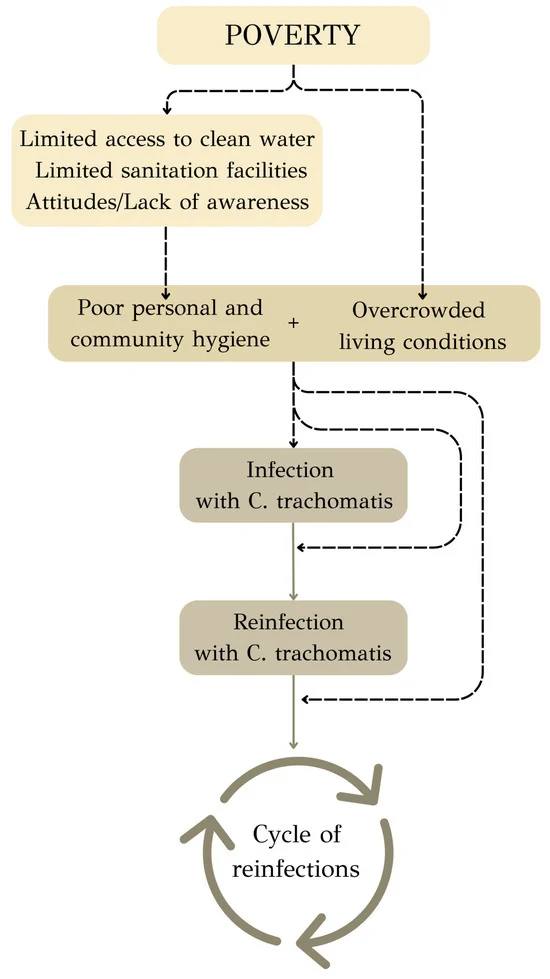
- Active trachoma is graded as trachomatous inflammation-follicular (TF) or trachomatous inflammation-intense (TI) [S1].
- Children carry most infection; programme surveys sample children aged 1 to 9 years [S8] [S12].
- Poor facial cleanliness: ocular discharge, nasal discharge and an unclean face are associated with TF/TI [S1].
- Lack of sanitation is associated with more TF/TI and more infection [S1].
- Geography: over 50% of the global trachoma burden remains in Ethiopia [S12].
Confirm it
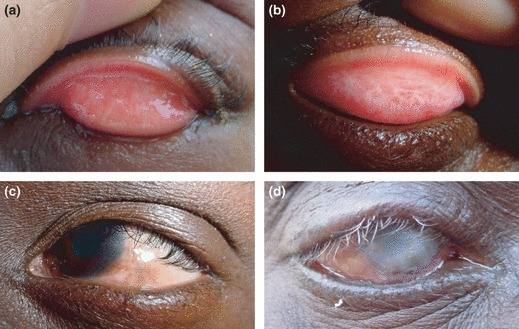
- Clinical grading of TF/TI is used for programme decisions; TF <5.0% is used to judge elimination as a public health problem [S9].
- Ocular chlamydia testing (conjunctival swabs, PCR) may detect recrudescence better than TF after mass treatment stops [S8] [S10] [S12].
- Trichiasis is any lash touching the globe; the Cochrane review used this as its definition of post-operative trichiasis [S2].
Manage it: running SAFE at each resource tier
Before acting on this section, check the national and local guidelines, product information and regulatory approvals that apply where you practise. See the medical disclaimer.
Tier A (primary care / no specialist)
- F and E: promote face washing with soap, towel use and latrine use [S1] [S10].
- A: support mass drug administration campaigns; azithromycin was well tolerated, with mainly mild nausea, diarrhoea and headache [S12]. The main adverse effects of azithromycin (about 10%) were abdominal pain, vomiting and nausea [S6].
- Follow the national programme for dosing; in the Stronger SAFE trial each height-based oral azithromycin dose was equivalent to 20 mg/kg, as reported in [S12].
- Find TT cases in the community and refer them for surgery [S2].
- Engage the community: tailored engagement and adapting SAFE to the setting aided adoption [S5].
Tier B (general eye clinic or outreach surgical team)
- S: perform full-thickness tarsal plate incision with rotation of the lash-bearing margin (bilamellar rotation was more effective than unilamellar, OR 0.29) [S2].
- Use a lid clamp, which reduced contour abnormalities and granulomas; absorbable sutures gave comparable results to silk [S2].
- Offer surgery in the community, which increased uptake with comparable outcomes [S2].
- Epilation was less effective than surgery for mild trichiasis but had comparable results for vision and corneal change [S2].
- Give single-dose oral azithromycin after surgery: lower post-operative TT than tetracycline ointment (OR 0.82) [S11]. Fluorometholone after surgery is not yet ready for programme use [S3].
- Follow up patients and provide health education after surgery [S11].
Tier C (national programme and specialist centre)
- Train surgeons periodically and audit outcomes [S7] [S11].
- Tailor mass treatment to baseline prevalence: one round sufficed at TF 5.0% to 9.9%, and annual treatment for 3 to 5 years at 10.0% to 29.9% [S9]. Quarterly treatment was more effective in hyperendemic districts [S9]; the Cochrane review found no strong evidence for varying annual mass treatment [S6].
- Double-dose azithromycin, fly control and enhanced hygiene added nothing over well-implemented standard SAFE in Ethiopia [S12].
- Monitor antimicrobial resistance: high-certainty evidence of roughly 5-fold increased resistance in S. pneumoniae, S. aureus and E. coli at 12 months [S6]; no resistance in C. trachomatis has been reported, but evidence is scarce [S4].
- Monitor infection after stopping treatment [S8]. Plan staffing, training and multisectoral collaboration [S5].
Refer when
| Situation | Urgency |
|---|---|
| Trichiasis with corneal opacity or reduced vision | Urgent to a TT surgeon; timing per your local service or specialist advice |
| Any trichiasis (lashes touching the globe) | Routine, at the next surgical outreach; timing per your local service or specialist advice |
| Recurrent trichiasis after surgery | Urgent to a few weeks, to an experienced TT surgeon; timing per your local service or specialist advice |
Pitfalls
- Using TF alone for post-treatment surveillance [S8].
- Assuming annual treatment for 3 to 5 years works in every district [S9].
- Neglecting surgical quality and follow-up [S7] [S11].
- Expecting WASH alone to prevent rebound after antibiotics stop [S10].
- Ignoring antimicrobial resistance in other organisms [S6].
Evidence notes
| Source | Date | Design |
|---|---|---|
| [S1] | 2014 | Systematic review and meta-analysis, 86 mostly observational studies |
| [S2] | 2015 | Cochrane systematic review, 13 RCTs |
| [S3] | 2019 | Phase 2 dose-ranging RCT, 154 participants |
| [S4] | 2019 | Systematic review, 19 studies |
| [S5] | 2019 | Systematic review of implementation, 10 papers |
| [S6] | 2019 | Cochrane systematic review, 26 trials |
| [S7] | 2020 | Systematic review, 22 studies in Africa |
| [S8] | 2021 | Systematic review, 21 studies |
| [S9] | 2021 | Systematic review, 13 cluster RCTs and 54 non-randomised studies |
| [S10] | 2022 | Cluster RCT (WUHA), 40 communities, Ethiopia |
| [S11] | 2023 | Systematic review and meta-analysis, 18 studies |
| [S12] | 2026 | Cluster RCT (Stronger SAFE), 68 clusters, Ethiopia |
- Conflict on F and E: observational meta-analysis supports them [S1], but WUHA (without concurrent antibiotics) and Stronger SAFE found no added effect [S10] [S12].
- Conflict on treatment frequency: [S9] favours more frequent treatment in hyperendemic districts; [S6] found no strong evidence to vary annual treatment.
- No trichiasis trial was designed to measure blindness prevention [S2].
- Fluorometholone needs a full-scale trial before programme use [S3].
- Not covered by these sources: the full WHO elimination dossier criteria, TT prevalence thresholds and the WHO simplified grading system.
Related articles
References
See the numbered source list below. Each marker [S#] links to its PubMed and DOI record.
Sources
- [S1] Stocks ME, Ogden S, Haddad D, Addiss DG, McGuire C, Freeman MC Effect of water, sanitation, and hygiene on the prevention of trachoma: a systematic review and meta-analysis. PLoS medicine. (2014). PubMed 24586120 · doi:10.1371/journal.pmed.1001605
- [S2] Burton M, Habtamu E, Ho D, Gower EW Interventions for trachoma trichiasis. The Cochrane database of systematic reviews. (2015). PubMed 26568232 · doi:10.1002/14651858.cd004008.pub3
- [S3] Kempen JH, Tekle-Haimanot R, Hunduma L, Alemayehu M, Pistilli M, Abashawl A, et al. Fluorometholone 0.1% as Ancillary Therapy for Trachomatous Trichiasis Surgery: Randomized Clinical Trial. American journal of ophthalmology. (2019). PubMed 30267699 · doi:10.1016/j.ajo.2018.09.017
- [S4] O'Brien KS, Emerson P, Hooper PJ, Reingold AL, Dennis EG, Keenan JD, et al. Antimicrobial resistance following mass azithromycin distribution for trachoma: a systematic review. The Lancet. Infectious diseases. (2019). PubMed 30292480 · doi:10.1016/s1473-3099(18)30444-4
- [S5] Maritim P, Zulu JM, Jacobs C, Chola M, Chongwe G, Zyambo J, et al. Factors shaping the implementation of the SAFE strategy for trachoma using the Consolidated Framework for Implementation Research: a systematic review. Global health action. (2019). PubMed 30773102 · doi:10.1080/16549716.2019.1570646
- [S6] Evans JR, Solomon AW, Kumar R, Perez Á, Singh BP, Srivastava RM, et al. Antibiotics for trachoma. The Cochrane database of systematic reviews. (2019). PubMed 31554017 · doi:10.1002/14651858.cd001860.pub4
- [S7] Mwangi G, Courtright P, Solomon AW Systematic review of the incidence of post-operative trichiasis in Africa. BMC ophthalmology. (2020). PubMed 33203380 · doi:10.1186/s12886-020-01564-0
- [S8] Mahmud H, Landskroner E, Amza A, Aragie S, Godwin WW, de Hostos Barth A, et al. Stopping azithromycin mass drug administration for trachoma: A systematic review. PLoS neglected tropical diseases. (2021). PubMed 34237074 · doi:10.1371/journal.pntd.0009491
- [S9] Xiong T, Yue Y, Li WX, Choonara I, Qazi S, Chen HJ, et al. Effectiveness of azithromycin mass drug administration on trachoma: a systematic review. Chinese medical journal. (2021). PubMed 34665571 · doi:10.1097/cm9.0000000000001717
- [S10] Aragie S, Wittberg DM, Tadesse W, Dagnew A, Hailu D, Chernet A, et al. Water, sanitation, and hygiene for control of trachoma in Ethiopia (WUHA): a two-arm, parallel-group, cluster-randomised trial. The Lancet. Global health. (2022). PubMed 34919861 · doi:10.1016/s2214-109x(21)00409-5
- [S11] Adimassu NF, Assem AS, Fekadu SA Postoperative trachomatous trichiasis: a systematic review and meta-analysis study. International health. (2023). PubMed 36852770 · doi:10.1093/inthealth/ihad014
- [S12] Last A, Shafi Abdurahman O, Greenland K, Robinson A, Sinba Etu E, Butcher R, et al. Double-dose azithromycin mass drug administration, facial cleanliness, and fly control measures for trachoma control in Oromia, Ethiopia (Stronger SAFE): a cluster-randomised controlled trial. The Lancet. Infectious diseases. (2026). PubMed 41895312 · doi:10.1016/s1473-3099(26)00024-1