Educational content only. Not personalised medical advice. Clinical decisions remain the responsibility of the treating clinician.
Vitreoretinal lymphoma
Vitreoretinal lymphoma (VRL) is a rare malignancy, usually a diffuse large B-cell lymphoma, that forms a subset of primary central nervous system lymphoma (PCNSL) [S1] [S11]. It commonly masquerades as posterior uveitis, so diagnosis is often delayed [S1] [S10]. Most patients eventually develop CNS lymphoma, which is the main cause of death [S1] [S8].
Key points - Suspect VRL in an older adult with "uveitis" showing vitreous cells in sheets or clumps and creamy-white outer retinal lesions [S7]. - Diagnostic vitrectomy should be performed, and systemic corticosteroids stopped at least 2 weeks before surgery, according to an international Delphi consensus [S7]. - An IL-10:IL-6 ratio greater than 1 had the highest pooled sensitivity (89.39%) among diagnostic tests [S10]. - Local treatment (intravitreal methotrexate or rituximab, or ocular radiotherapy) clears the eye but does not prevent CNS relapse [S8]. - Consider VRL in HIV-positive people presenting with intermediate or posterior uveitis [S5].
Evidence last checked: 2026-10-17 (PubMed abstracts).
Red flags
- "Uveitis" in an older person that does not behave as expected. VRL commonly masquerades as posterior uveitis and mostly affects elderly people [S1].
- Severe vitreous infiltration without macular oedema. This is the most likely presentation [S7].
- Steroid use before sampling. Systemic corticosteroids should be discontinued at least 2 weeks before diagnostic surgery [S7].
- Neurological symptoms. 65%-90% of patients with VRL develop CNS lymphoma [S1].
Recognise it
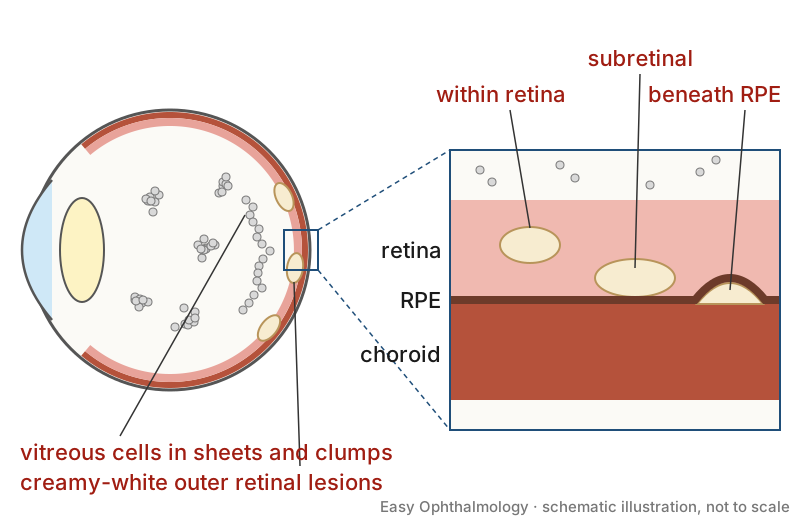
- Symptoms: floaters and painless loss of vision [S7].
- Signs: vitreous cells organised into sheets or clumps; multifocal creamy or white outer retinal lesions; "leopard-skin" retinal lesions and RPE atrophy [S7]. Lesions may lie beneath the RPE, in the subretinal space or within the retina [S11].
- In HIV-related VRL, patients are relatively young with very low CD4 counts, and vitritis with subretinal or sub-RPE infiltrates is typical [S5].
- Among people with VRL, 41% have non-ocular CNS involvement at diagnosis and 69% over the course of disease [S4].
Confirm it
- Sampling. Diagnostic vitrectomy is recommended [S7]. Vitreous cytology is the gold standard, supplemented by flow cytometry, genetic analyses and interleukin-10 measurement [S5]. Lymphoma cells are fragile and cannot always be identified, so close coordination with cytologists is needed [S8].
- Tests (sensitivity in a systematic review of 29 retrospective studies): IL-10:IL-6 ratio >1, 89.39%; vitreous flow cytometry, 88.00%; monoclonal IgH rearrangement by PCR, 85.10%; MYD88 L265P mutation, 70.00%; CD79B mutation, 35.09% [S10].
- Imaging. OCT and fundus autofluorescence are recommended [S7].
- Neuroimaging and CNS staging. Required because of frequent CNS involvement [S4]; the specific workup is not detailed in these abstracts.
Manage it
Before acting on this section, check the national and local guidelines, product information and regulatory approvals that apply where you practise. See the medical disclaimer.
Tier A (primary care / no specialist)
- Refer any older adult or HIV-positive person with persistent floaters, blurred vision or uveitis to an eye clinic [S5] [S7].
- Avoid starting systemic corticosteroids for presumed uveitis without an ophthalmic diagnosis, as steroids should be stopped before diagnostic surgery [S7].
Tier B (general eye clinic)
- Suspect VRL when "uveitis" shows the features above, especially without macular oedema [S7].
- Refer to a centre able to perform diagnostic vitrectomy with cytology and interleukin testing (see Refer when) [S7] [S8].
- In HIV-positive patients, ensure linkage to antiretroviral therapy, which is part of treatment [S5].
Tier C (specialist centre)
- Multispecialty care. Management involves a team coordinating intraocular chemotherapy, ocular irradiation, systemic chemotherapy and/or autologous stem cell transplantation [S3].
- Intravitreal chemotherapy. Methotrexate and rituximab are the most commonly injected drugs; several schedules exist but none has been tested in a randomised trial [S3]. Dosing is not covered here; follow local protocols.
- Systemic therapy. High-dose methotrexate-based chemotherapy, with or without local treatment, might reduce CNS relapse [S8]. Systemic chemotherapy alone gives high response rates but a high relapse rate [S1]. In a small series of 12 patients, bilateral radiotherapy (30-40 Gy, as reported in [S2]) followed by methotrexate-based chemotherapy produced complete response in all, and median survival had not been reached at 68 months [S2].
- Laterality. CNS progression did not differ between bilateral and unilateral VRL (pooled RR 1.12) [S9].
- Prognosis. Despite high ocular control with intravitreal agents, 65-85% of patients eventually die of CNS disease, and the role of adjuvant therapy is unknown [S6].
- Relapse. Intensive consolidation chemotherapy with stem cell transplantation can be considered; ibrutinib, lenalidomide and temozolomide are effective at relapse [S8].
Refer when
| Situation | Urgency |
|---|---|
| Suspected VRL (older adult or HIV-positive person with atypical or steroid-resistant uveitis) | Urgent to a uveitis or ocular oncology service; timing per your local service or specialist advice |
| Known or suspected VRL with new neurological symptoms | Same-day neurology or oncology assessment [EIC expert opinion] |
Pitfalls
- Treating presumed uveitis with corticosteroids before diagnostic sampling [S7].
- Taking a negative cytology result as excluding lymphoma [S8].
- Relying on MYD88 or CD79B mutation testing alone: sensitivity is lower than other tests [S10].
- Treating the eye only and forgetting CNS surveillance [S6] [S8].
Evidence notes
| Source | Date | Design |
|---|---|---|
| [S1] | 2011 | International symposium report (expert review) |
| [S2] | 2019 | Prospective multicentre series, 12 patients |
| [S3] | 2020 | Narrative review of intraocular chemotherapy |
| [S4] | 2020 | Systematic review of cohorts |
| [S5] | 2021 | Narrative review, HIV-related VRL |
| [S6] | 2021 | Systematic review of treatment outcomes |
| [S7] | 2021 | International Delphi consensus on diagnosis |
| [S8] | 2021 | Narrative review |
| [S9] | 2022 | Systematic review and meta-analysis, 25 small studies |
| [S10] | 2024 | Systematic review of 29 retrospective studies |
| [S11] | 2025 | National guideline (China) |
- Proportions of patients developing CNS disease vary between sources (65%-90% [S1]; 69% [S4]; 65-85% dying of CNS disease [S6]).
- No randomised trials of VRL treatment exist in these sources; treatment evidence is retrospective or from small cohorts [S3] [S8].
- The diagnostic systematic review reports sensitivity only, not specificity [S10].
- Not covered by these sources: drug doses for intravitreal or systemic therapy, CNS staging protocol, follow-up schedules, and validated referral timings.
Related articles
References
See the numbered source list below. Each marker [S#] links to its PubMed and DOI record.
Sources
- [S1] Chan CC, Rubenstein JL, Coupland SE, Davis JL, Harbour JW, Johnston PB, et al. Primary vitreoretinal lymphoma: a report from an International Primary Central Nervous System Lymphoma Collaborative Group symposium. The oncologist. (2011). PubMed 22045784 · doi:10.1634/theoncologist.2011-0210
- [S2] de la Fuente MI, Alderuccio JP, Reis IM, Omuro A, Markoe A, Echegaray JJ, et al. Bilateral radiation therapy followed by methotrexate-based chemotherapy for primary vitreoretinal lymphoma. American journal of hematology. (2019). PubMed 30663807 · doi:10.1002/ajh.25414
- [S3] Kvopka M, Lake SR, Smith JR Intraocular chemotherapy for vitreoretinal lymphoma: A review. Clinical & experimental ophthalmology. (2020). PubMed 31680408 · doi:10.1111/ceo.13668
- [S4] Farrall AL, Smith JR Eye involvement in primary central nervous system lymphoma. Survey of ophthalmology. (2020). PubMed 32057762 · doi:10.1016/j.survophthal.2020.02.001
- [S5] Steffen J, Coupland SE, Smith JR Primary Vitreoretinal Lymphoma in HIV Infection. Ocular immunology and inflammation. (2021). PubMed 32453669 · doi:10.1080/09273948.2020.1751856
- [S6] Raval V, Binkley E, Aronow ME, Valenzuela J, Peereboom DM, Singh AD Primary central nervous system lymphoma - ocular variant: an interdisciplinary review on management. Survey of ophthalmology. (2021). PubMed 33762182 · doi:10.1016/j.survophthal.2021.03.004
- [S7] Carbonell D, Mahajan S, Chee SP, Sobolewska B, Agrawal R, Bülow T, et al. Consensus Recommendations for the Diagnosis of Vitreoretinal Lymphoma. Ocular immunology and inflammation. (2021). PubMed 34009095 · doi:10.1080/09273948.2021.1878233
- [S8] Soussain C, Malaise D, Cassoux N Primary vitreoretinal lymphoma: a diagnostic and management challenge. Blood. (2021). PubMed 34036310 · doi:10.1182/blood.2020008235
- [S9] van Rooij JLM, Tokarska KA, Ten Dam-van Loon NH, Wessels PH, Seute T, Minnema MC, et al. Central Nervous System Progression in Primary Vitreoretinal Lymphoma with Bilateral and Unilateral Involvement: A Systematic Review and Meta-Analysis. Cancers. (2022). PubMed 35740632 · doi:10.3390/cancers14122967
- [S10] Huang RS, Mihalache A, Popovic MM, Cruz-Pimentel M, Pandya BU, Muni RH, et al. Diagnostic methods for primary vitreoretinal lymphoma: A systematic review. Survey of ophthalmology. (2024). PubMed 38163550 · doi:10.1016/j.survophthal.2023.12.001
- [S11] Zhang X, Peng X, Liang D, Chen Y, Zhang W, Zhang Y, et al. Clinical guidelines for the diagnosis and treatment of vitreoretinal lymphoma in Chinese patients (2024). Eye and vision (London, England). (2025). PubMed 40414948 · doi:10.1186/s40662-025-00434-4