Educational content only. Not personalised medical advice. Clinical decisions remain the responsibility of the treating clinician.
Acanthamoeba keratitis
Acanthamoeba keratitis (AK) is a rare parasitic corneal infection that can lead to permanent blindness if not diagnosed and treated promptly [S6]. It is linked to contact lens wear in Western countries, but in India most cases follow trauma or contaminated water exposure, and many present with a diffuse infiltrate that mimics herpes simplex or fungal keratitis [S2]. Early diagnosis and anti-amoebic treatment decide the outcome [S2] [S10].
Key points - Delayed diagnosis and corticosteroid use before diagnosis are key poor prognostic factors [S10]. - In vivo confocal microscopy (IVCM) is the most recommended tool for early detection; PCR is the alternative if IVCM is unavailable [S6]. - First-line treatment is a biguanide with or without a diamidine [S2] [S10]; in the ODAK phase 3 RCT, PHMB 0.08% alone was non-inferior to PHMB 0.02% plus propamidine 0.1%, with medical cure rates above 86% [S8]. - Contact lens wearers should avoid any water exposure of lenses and cases [S3]. - Keratoplasty is a salvage or rehabilitation option, not first-line [S5] [S10].
Evidence last checked: 2026-10-17 (PubMed abstracts).
Red flags
- "Keratitis" in a contact lens wearer that is not responding to antibacterial, antifungal or antiviral drops. Anti-amoebic drugs were often prescribed only after other treatments had failed, which may contribute to complications [S7].
- Water exposure with lenses: tap water rinsing, wet hands, showering or swimming in lenses [S3].
- Children using overnight orthokeratology lenses, which may increase the risk of microbial keratitis, especially Acanthamoeba [S4].
- Steroid drops started before the diagnosis is made [S10].
- Ring infiltrate, radial keratoneuritis or pain out of proportion, although in India these were seen in less than a third of cases [S2].
Recognise it
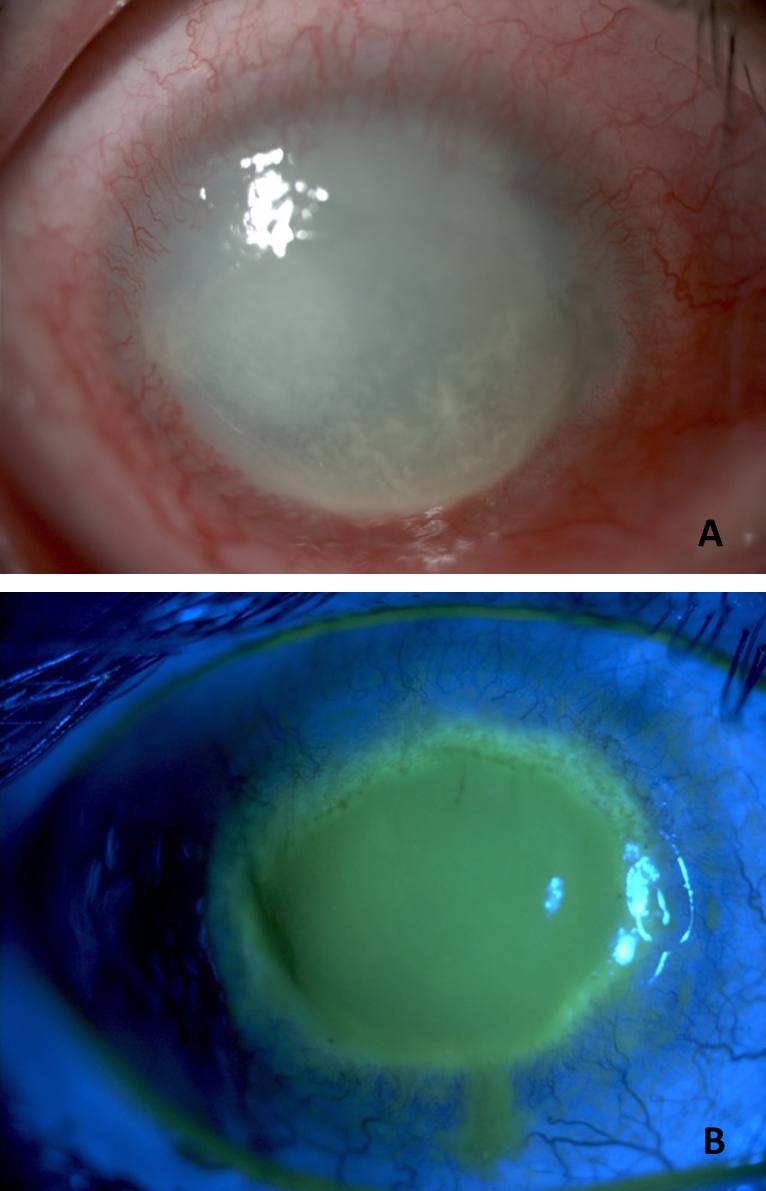
- Burden. Data from 20 countries gave an estimated 23,561 cases a year, highest in India [S6]. AK accounts for 2% of microbiology-proven keratitis in an Indian series [S2].
- Risk factors. Daily contact lens wear in Western countries [S2]; trauma and contaminated water in non-wearers [S2]. In historical case reports (1970 to 1995), contact lens wear was reported in 68.2% and trauma in 31.8% [S11].
- Appearance. Most Indian cases present with a diffuse infiltrate mimicking herpes simplex or fungal keratitis [S2]. AK features are non-specific and easily mistaken for other keratitis or coinfection [S12].
- Delay is common. In historical case reports, mean time from presentation to diagnosis was 7.3 weeks, and only 23.2% were diagnosed within 4 weeks [S11].
Confirm it
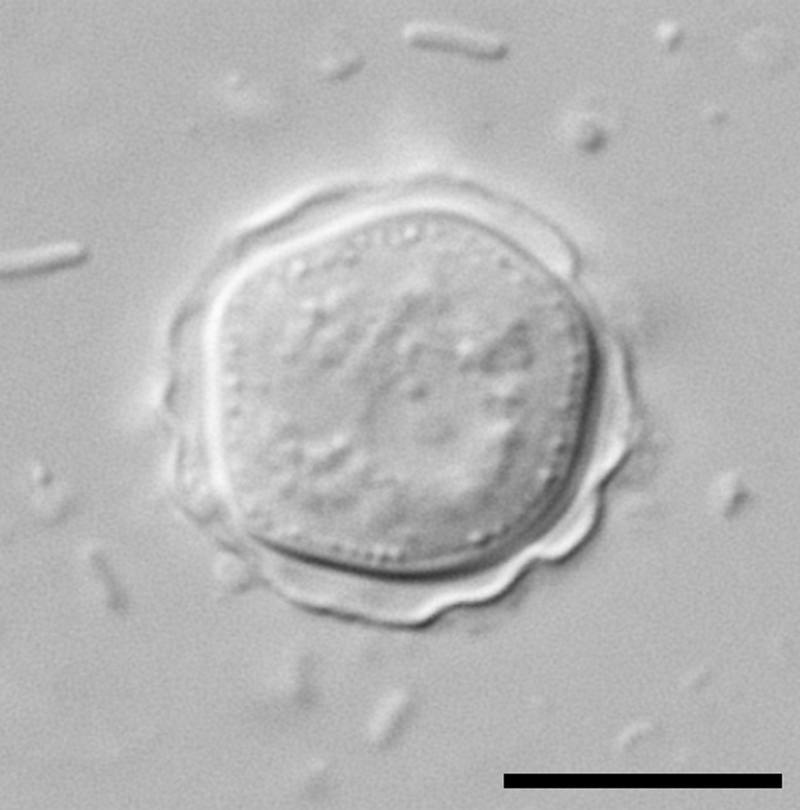
- Corneal scraping for microscopy and culture on non-nutrient agar with an Escherichia coli overlay confirms the diagnosis [S2].
- IVCM is the most recommended method for early detection [S6] and helps with deep infiltrates, although its value depends on operator experience [S2].
- PCR has shown sensitivity similar to or greater than culture with high specificity [S12], and is the alternative where IVCM is unavailable [S6].
Manage it
Before acting on this section, check the national and local guidelines, product information and regulatory approvals that apply where you practise. See the medical disclaimer.
Tier A (primary care / no specialist)
- Ask every patient with a red eye about contact lens wear, water exposure and trauma [S2] [S3].
- Do not start steroid drops on a suspected corneal infection; prior steroid use worsens prognosis [S10].
- Advise contact lens wearers to avoid handling lenses with wet hands, rinsing lenses or cases in tap water, showering in lenses and swimming without goggles [S3].
Tier B (general eye clinic)
- Scrape and culture where possible [S2]; refer suspected cases to a cornea service (see "Refer when").
- Medical treatment is successful if the disease is diagnosed early and management starts soon; surgery is rarely needed when definitive treatment begins within 3 weeks of symptom onset [S2].
Tier C (specialist centre)
- Anti-amoebic therapy. Biguanides with or without diamidines are primary treatment [S2]. A systematic review of 61 studies suggests therapeutic epithelial debridement followed by a biguanide, a diamidine and an antibacterial agent as a strong initial option [S10].
- ODAK trial (2024). In 135 patients at 6 European centres, the adjusted medical cure rate within 12 months was 86.6% with PHMB 0.02% plus propamidine 0.1% and 86.7% with PHMB 0.08%, as reported in [S8]. Treatment failed in 13.4% and 6.3% needed therapeutic keratoplasty; no serious drug-related adverse events occurred [S8]. The result applies with the trial's treatment protocol and similar disease severity [S8].
- Older evidence. A Cochrane review found only one RCT (56 eyes): chlorhexidine 0.02% and PHMB 0.02% gave similar resolution (86% vs 78%), but the trial was too small to detect differences [S1].
- Adjuncts. Topical voriconazole 1% or oral miltefosine may be considered [S10]; voriconazole, rose bengal photodynamic therapy, miltefosine and povidone-iodine showed potential benefit in observational studies and small trials only [S12].
- Steroids may play a role when indicated, following established protocols [S2]; this conflicts with their association with worse prognosis when used before diagnosis [S10].
- Keratoplasty. In a review of 359 eyes, clear grafts were seen in 73% after therapeutic penetrating keratoplasty, 84% after therapeutic DALK and 94% after optical keratoplasty; recurrence was 16.8%, 19% and 9.5% [S5]. Optical keratoplasty after 6 to 12 months of medical cure appears best; therapeutic DALK may suit early disease and penetrating keratoplasty later disease [S5] [S10]. The best timing remains uncertain [S12].
- Complications are uncommon overall: perforation 2.21%, evisceration or enucleation 1% and corneal transplantation 16.68% across 158 reports [S9].
Dosing schedules are not covered by these abstracts: follow local formularies.
Refer when
| Situation | Urgency |
|---|---|
| Suspected AK (contact lens wearer with keratitis, or keratitis failing standard treatment) | Same-day to a cornea service |
| Confirmed AK with worsening despite anti-amoebic therapy, thinning or scleritis | Emergency referral to a specialist centre [EIC expert opinion] |
Pitfalls
- Treating as herpes or fungal keratitis for weeks before considering AK [S2] [S7].
- Steroid drops before the diagnosis [S10].
- Relying on classic signs; they may be absent [S2].
- Assuming daily disposable lenses remove the risk: they have not consistently changed the overall rate of microbial keratitis [S4].
Evidence notes
| Source | Date | Design |
|---|---|---|
| [S1] | 2015 | Cochrane systematic review, 1 RCT |
| [S2] | 2017 | Expert perspective and review (India) |
| [S3] | 2019 | Literature review of water exposure |
| [S4] | 2021 | Consensus statement (think tank) |
| [S5] | 2022 | Literature review of 33 studies plus case series |
| [S6] | 2023 | Review of epidemiology and diagnosis |
| [S7] | 2023 | Scoping review |
| [S8] | 2024 | Phase 3 double-masked RCT (ODAK), 135 patients |
| [S9] | 2024 | Systematic assessment of 158 reports |
| [S10] | 2025 | Systematic review of 61 studies, mostly retrospective |
| [S11] | 2025 | Systematic review of 56 historical case reports |
| [S12] | 2026 | Scoping review |
- Only one high-quality RCT (ODAK) guides first-line drug choice [S8]; the Cochrane review found insufficient evidence [S1].
- Most surgical and adjunct evidence is observational [S5] [S10] [S12].
- Sources conflict on corticosteroids [S2] [S10].
- Complication data come from heterogeneous reports and remain poor [S9].
- Not covered by these sources: drug concentrations available outside Europe, duration of treatment, and pain management.
Related articles
References
See the numbered source list below. Each marker [S#] links to its PubMed and DOI record.
Sources
- [S1] Alkharashi M, Lindsley K, Law HA, Sikder S Medical interventions for acanthamoeba keratitis. The Cochrane database of systematic reviews. (2015). PubMed 25710134 · doi:10.1002/14651858.cd010792.pub2
- [S2] Garg P, Kalra P, Joseph J Non-contact lens related Acanthamoeba keratitis. Indian journal of ophthalmology. (2017). PubMed 29133630 · doi:10.4103/ijo.ijo_826_17
- [S3] Arshad M, Carnt N, Tan J, Ekkeshis I, Stapleton F Water Exposure and the Risk of Contact Lens-Related Disease. Cornea. (2019). PubMed 30789440 · doi:10.1097/ico.0000000000001898
- [S4] Szczotka-Flynn LB, Shovlin JP, Schnider CM, Caffery BE, Alfonso EC, Carnt NA, et al. American Academy of Optometry Microbial Keratitis Think Tank. Optometry and vision science : official publication of the American Academy of Optometry. (2021). PubMed 33771951 · doi:10.1097/opx.0000000000001664
- [S5] Di Zazzo A, Varacalli G, De Gregorio C, Coassin M, Bonini S Therapeutic Corneal Transplantation in Acanthamoeba Keratitis: Penetrating Versus Lamellar Keratoplasty. Cornea. (2022). PubMed 34690262 · doi:10.1097/ico.0000000000002880
- [S6] Zhang Y, Xu X, Wei Z, Cao K, Zhang Z, Liang Q The global epidemiology and clinical diagnosis of Acanthamoeba keratitis. Journal of infection and public health. (2023). PubMed 37030037 · doi:10.1016/j.jiph.2023.03.020
- [S7] Büchele MLC, Nunes BF, Filippin-Monteiro FB, Caumo KS Diagnosis and treatment of Acanthamoeba Keratitis: A scoping review demonstrating unfavorable outcomes. Contact lens & anterior eye : the journal of the British Contact Lens Association. (2023). PubMed 37117130 · doi:10.1016/j.clae.2023.101844
- [S8] Dart JKG, Papa V, Rama P, Knutsson KA, Ahmad S, Hau S, et al. The Orphan Drug for Acanthamoeba Keratitis (ODAK) Trial: PHMB 0.08% (Polihexanide) and Placebo versus PHMB 0.02% and Propamidine 0.1. Ophthalmology. (2024). PubMed 37802392 · doi:10.1016/j.ophtha.2023.09.031
- [S9] Posarelli M, Passaro ML, Avolio FC, Costagliola C, Semeraro F, Romano V The incidence of severe complications in acanthamoeba keratitis: Qualitative and quantitative systematic assessment. Survey of ophthalmology. (2024). PubMed 38885760 · doi:10.1016/j.survophthal.2024.06.001
- [S10] Marques-Couto P, Monteiro M, Ferreira AM, Pinheiro-Costa J, Vilares-Morgado R Acanthamoeba Keratitis Management and Prognostic Factors: A Systematic Review. Journal of clinical medicine. (2025). PubMed 40217976 · doi:10.3390/jcm14072528
- [S11] Papa V, Bodicoat DH, Duarte AA, Dart JKG, De Francesco M The Natural History of Acanthamoeba Keratitis: A Systematic Literature Review. Ophthalmology and therapy. (2025). PubMed 40323557 · doi:10.1007/s40123-025-01152-9
- [S12] Diaz AZ, Kassaye I, Keenan JD Acanthamoeba Keratitis: Recent Advances in Diagnosis and Management. Cornea. (2026). PubMed 42348670 · doi:10.1097/ico.0000000000004205