Educational content only. Not personalised medical advice. Clinical decisions remain the responsibility of the treating clinician.
Chemical eye injury
Ocular surface burns are caused by alkalis, acids or direct heat; they damage the limbal epithelial stem cells and can lead to delayed healing, stem cell failure and conjunctivalisation of the cornea [S10]. Outcomes after alkali burns were better when irrigation with tap water began immediately at the scene [S3].
Key points - Start irrigation immediately, with whatever clean fluid is available; tap water at the scene was associated with better outcomes [S3] [S7]. - Diphoterine may be superior to other rinsing solutions, but the studies are of poor quality, and rinsing should not wait for it [S7]. - Amniotic membrane transplantation (AMT) speeds epithelial healing in moderate burns but has shown no clear benefit in severe burns or for final vision [S10] [S11]. - Late limbal stem cell deficiency (LSCD) after a unilateral burn can be treated with autologous limbal transplantation; simple limbal epithelial transplantation (SLET) gave good outcomes [S9] [S12].
Evidence last checked: 2026-10-17 (PubMed abstracts).
Red flags
- Any chemical splash to the eye is an emergency for immediate irrigation, before history taking or referral; decontamination is imperative [S7].
- Alkali burns: alkali was the most common cause of total LSCD in an RCT of 100 eyes with total LSCD after burns [S12].
- Severe burns (Roper-Hall grade IV): in an RCT, corneal epithelial defects took a mean of 72.6 days to heal and mean final acuity was about 2.06 logMAR with or without AMT [S8].
- Limbal ischaemia, large epithelial defects and corneal haze are baseline features used to grade severity [S2].
Recognise it
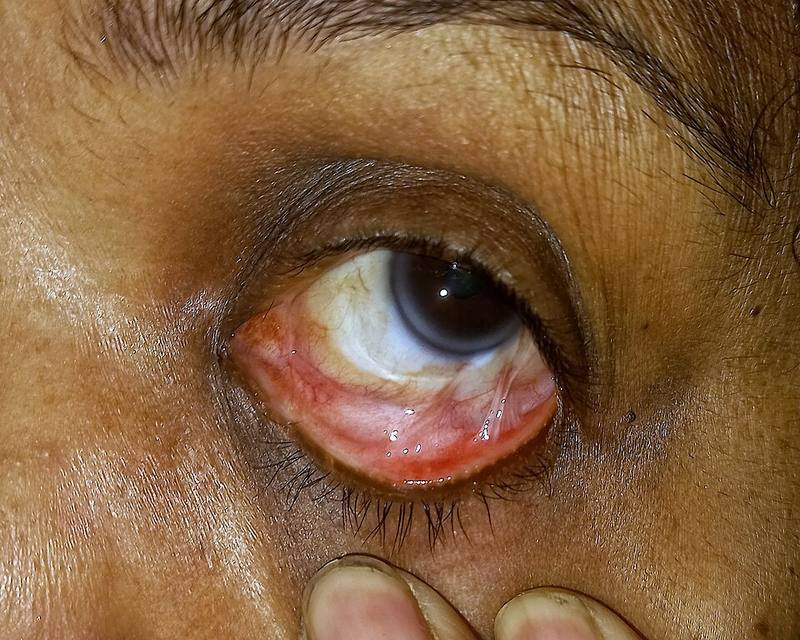
- History of a splash of an alkali or acid, or a thermal injury, to the eye [S10].
- The grade of injury predicts outcome. Moderate burns are graded II to III in both the Roper-Hall and Dua systems; the Dua system splits Roper-Hall grade IV into grades IV, V and VI and has better prognostic value in severe burns [S2].
- The late result of severe burns is LSCD: ocular burns were 88% of the indications for autologous limbal transplantation in a systematic review [S9].
Confirm it
- Grade the burn after irrigation by the size of the epithelial defect, corneal haze, limbal ischaemia and conjunctival involvement, and record visual acuity [S2].
- Measuring pH resolution is an outcome in decontamination studies [S7]. The sources do not give a target pH or a protocol for checking it; follow local protocols.
Manage it
Before acting on this section, check the national and local guidelines, product information and regulatory approvals that apply where you practise. See the medical disclaimer.
Tier A (primary care / no specialist)
- Irrigate at once. Begin irrigation immediately after the injury; tap water used at the scene after alkali burns gave significantly better outcomes [S3].
- Use the best fluid available, but do not delay. Normal saline, lactated Ringer's, saline with sodium bicarbonate, BSS Plus and Diphoterine all gave positive outcomes in hospital settings [S3]. If Diphoterine is not available, use a different rinsing solution [S7].
- Irrigate for longer rather than shorter. Prolonged irrigation was associated with shorter hospital treatment and less time off work [S3]. The sources do not state a volume or duration.
- Refer every chemical injury to an eye clinic after irrigation, the same day [EIC expert opinion].
Tier B (general eye clinic)
- Continue irrigation as needed, then grade the injury [S2].
- Medical therapy. In one RCT, conventional treatment for grade IV burns consisted of preservative-free lubricating gel and drops, chloramphenicol, betamethasone, homatropine, oral vitamin C and doxycycline, as reported in [S8]. Doses and durations are not given in the abstract; follow local formularies.
- In another RCT, control eyes also received mechanical release of early adhesions as needed [S1].
Tier C (specialist centre)
- Amniotic membrane transplantation (acute phase). AMT is performed in the first 7 days and secures a membrane over the entire ocular surface [S10]. In moderate burns, RCTs showed faster epithelial healing with AMT [S1] [S11]. In severe burns, AMT did not speed healing or improve vision in two RCTs [S8] [S10]. A Cochrane review rated the evidence for moderate burns as uncertain (very low to low certainty) [S10].
- Autologous serum and plasma drops (adjuncts). In an RCT of 45 eyes, umbilical cord serum drops and AMT both shortened epithelialisation compared with medical therapy alone (22.9 and 22.0 vs 56.7 days), with better early pain control and corneal clarity for the serum drops, avoiding surgery in an inflamed eye [S5]. A small RCT (20 eyes) found faster healing with autologous platelet-rich plasma drops in grade III injuries only [S4].
- Late LSCD. In a systematic review of 22 case series (1023 eyes), autologous limbal transplantation had 69% anatomical and 60% functional success; SLET (78%) and conjunctival-limbal autograft (81%) did better than cultivated limbal transplantation (CLET, 61.4%) [S9]. In an RCT of 100 eyes, SLET and CLET gave similar stable surfaces at 1 year (88% vs 86%), with better vision after SLET [S12].
Refer when
| Situation | Urgency |
|---|---|
| Any chemical injury to the eye, after immediate irrigation | Same-day eye assessment [EIC expert opinion] |
| Limbal ischaemia, large epithelial defect or corneal haze (moderate or severe burn) | Immediate referral to a cornea service |
| Epithelial defect not healing on medical therapy | Urgent, within days, for consideration of AMT or serum drops [S5] [S11] |
| Chronic surface failure or LSCD after a burn | Routine, within weeks, to a cornea service for limbal transplantation [S9] |
Pitfalls
- Delaying irrigation to find a special solution or to complete the history [S3] [S7].
- Stopping irrigation too early; longer irrigation was associated with better recovery [S3].
- Expecting AMT to rescue a severe burn; RCTs found no benefit in grade IV burns [S8] [S10].
- Under-grading severe injuries with Roper-Hall alone when the Dua system gives finer prognostic information [S2].
Evidence notes
| Source | Date | Design |
|---|---|---|
| [S1] | 2011 | RCT, 100 patients, moderate and severe burns |
| [S2] | 2011 | Prognostic comparison within an RCT, 100 patients |
| [S3] | 2012 | Systematic review, 4 studies, 302 patients |
| [S4] | 2012 | RCT, 20 eyes |
| [S5] | 2016 | RCT, 45 eyes |
| [S6] | 2017 | Systematic review (Diphoterine) |
| [S7] | 2018 | Systematic review, 13 studies (Diphoterine) |
| [S8] | 2019 | RCT, 60 eyes, grade IV burns |
| [S9] | 2020 | Systematic review of 22 case series |
| [S10] | 2022 | Cochrane systematic review, 2 RCTs |
| [S11] | 2025 | Systematic review (American Academy of Ophthalmology) |
| [S12] | 2024 | RCT, 100 eyes |
- Irrigation evidence is weak: 4 heterogeneous studies with significant differences between comparison groups [S3].
- Diphoterine: one review calls it safe and highly effective [S6]; the other finds poor methodology and a high risk of bias and concludes it is probably superior [S7]. Treat superiority as uncertain.
- AMT trials had high risk of performance and detection bias, imprecision and no a priori sample-size calculations [S10] [S11].
- Not covered by these sources: irrigation volume or duration, target pH, topical drug doses, intraocular pressure management and the timing of lid and fornix procedures.
Related articles
References
See the numbered source list below. Each marker [S#] links to its PubMed and DOI record.
Sources
- [S1] Tandon R, Gupta N, Kalaivani M, Sharma N, Titiyal JS, Vajpayee RB Amniotic membrane transplantation as an adjunct to medical therapy in acute ocular burns. The British journal of ophthalmology. (2011). PubMed 20675729 · doi:10.1136/bjo.2009.173716
- [S2] Gupta N, Kalaivani M, Tandon R Comparison of prognostic value of Roper Hall and Dua classification systems in acute ocular burns. The British journal of ophthalmology. (2011). PubMed 20805137 · doi:10.1136/bjo.2009.173724
- [S3] Chau JP, Lee DT, Lo SH A systematic review of methods of eye irrigation for adults and children with ocular chemical burns. Worldviews on evidence-based nursing. (2012). PubMed 21649853 · doi:10.1111/j.1741-6787.2011.00220.x
- [S4] Panda A, Jain M, Vanathi M, Velpandian T, Khokhar S, Dada T Topical autologous platelet-rich plasma eyedrops for acute corneal chemical injury. Cornea. (2012). PubMed 22759830 · doi:10.1097/ico.0b013e3182114661
- [S5] Sharma N, Singh D, Maharana PK, Kriplani A, Velpandian T, Pandey RM, et al. Comparison of Amniotic Membrane Transplantation and Umbilical Cord Serum in Acute Ocular Chemical Burns: A Randomized Controlled Trial. American journal of ophthalmology. (2016). PubMed 27210276 · doi:10.1016/j.ajo.2016.05.010
- [S6] Lynn DD, Zukin LM, Dellavalle R The safety and efficacy of Diphoterine for ocular and cutaneous burns in humans. Cutaneous and ocular toxicology. (2017). PubMed 27486965 · doi:10.1080/15569527.2016.1217423
- [S7] Alexander KS, Wasiak J, Cleland H Chemical burns: Diphoterine untangled. Burns : journal of the International Society for Burn Injuries. (2018). PubMed 29029860 · doi:10.1016/j.burns.2017.09.017
- [S8] Eslani M, Baradaran-Rafii A, Cheung AY, Kurji KH, Hasani H, Djalilian AR, et al. Amniotic Membrane Transplantation in Acute Severe Ocular Chemical Injury: A Randomized Clinical Trial. American journal of ophthalmology. (2019). PubMed 30419194 · doi:10.1016/j.ajo.2018.11.001
- [S9] Shanbhag SS, Nikpoor N, Rao Donthineni P, Singh V, Chodosh J, Basu S Autologous limbal stem cell transplantation: a systematic review of clinical outcomes with different surgical techniques. The British journal of ophthalmology. (2020). PubMed 31118185 · doi:10.1136/bjophthalmol-2019-314081
- [S10] Clare G, Bunce C, Tuft S Amniotic membrane transplantation for acute ocular burns. The Cochrane database of systematic reviews. (2022). PubMed 36047788 · doi:10.1002/14651858.cd009379.pub3
- [S11] Veldman PB, Greiner MA, Cortina MS, Kuo AN, Li JY, Miller DD, et al. Efficacy of Amniotic Membrane Grafting for the Treatment of Chemical and Thermal Ocular Surface Injuries: A Report by the American Academy of Ophthalmology. Ophthalmology. (2025). PubMed 39387749 · doi:10.1016/j.ophtha.2024.08.021
- [S12] Sharma N, Venugopal R, Mohanty S, Priyadarshini K, Nagpal R, Singhal D, et al. Simple limbal epithelial transplantation versus cultivated limbal epithelial transplantation in ocular burns. The ocular surface. (2024). PubMed 39442877 · doi:10.1016/j.jtos.2024.10.007