Educational content only. Not personalised medical advice. Clinical decisions remain the responsibility of the treating clinician.
Neurotrophic keratopathy
Neurotrophic keratopathy (NK) is a degenerative corneal disease caused by damage to corneal sensory nerves, leading to epithelial breakdown, impaired healing, ulceration and, if untreated, keratolysis and perforation [S5] [S8] [S10]. Causes include herpetic infection, trauma, diabetes, drug toxicity, contact lens overuse and ocular or neurosurgical surgery [S8] [S9]. It is chronic and can progress even after periods of apparent stability [S10].
Key points - Check corneal sensation early in any non-healing epithelial defect [S10]. - First-line care at every stage: preservative-free lubricants, punctal occlusion, blood-derived drops, and removal of toxic or preserved medications [S10]. - Cenegermin (recombinant human nerve growth factor) improved healing over vehicle in RCTs, on low-certainty evidence overall [S1] [S8]. - Tarsorrhaphy may be needed in refractory or rapidly progressing cases [S10]. - A descemetocele needs urgent intervention because perforation is imminent [S3].
Evidence last checked: 2026-10-17 (PubMed abstracts).
Red flags
- Persistent epithelial defect with reduced corneal sensation [S1] [S10].
- Stromal thinning, melting or descemetocele: imminent risk of perforation, needing urgent intervention [S3].
- Rapid progression despite lubrication: timely tarsorrhaphy may be necessary [S10].
- History of herpes zoster ophthalmicus, especially with recurrences, which increase NK risk [S9].
- Toxic or preservative-containing drops that may be worsening the surface [S10].
Recognise it
- Definition. Dysfunction of corneal innervation with loss of corneal sensation, leading to epithelial breakdown and ultimately keratolysis if untreated [S10].
- Causes. Infection, inflammation, chemical or mechanical trauma, diabetes, drug toxicity, contact lens overuse and surgery [S8]; herpetic disease including HZO is frequent [S9]; intracranial tumours [S4].
- Course. Uncommon, though prevalence is likely higher than previously estimated [S5] [S10]. It can cause ulceration, corneal opacification and perforation [S5].
Confirm it
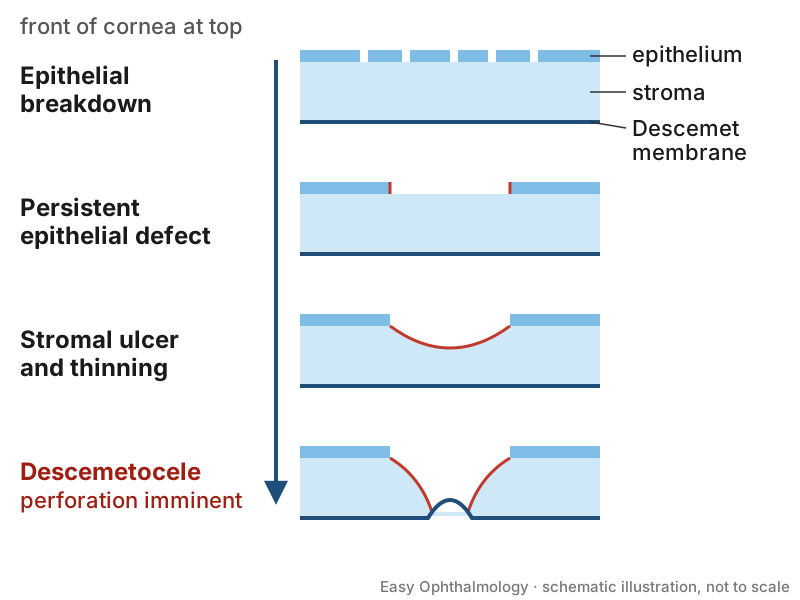
- Test corneal sensation early; the Neurotrophic Keratitis Study Group classification stresses this and separates epithelial and stromal disease [S10].
- Identify the root cause, which is needed for the best chance of treatment success [S9].
- Stage the disease to guide treatment [S4] [S10].
Manage it
Before acting on this section, check the national and local guidelines, product information and regulatory approvals that apply where you practise. See the medical disclaimer.
Tier A (primary care / no specialist)
- Refer any non-healing corneal defect (see "Refer when").
- Stop unnecessary toxic or preserved drops where possible, with eye-team advice [S10].
Tier B (general eye clinic)
- Supportive care at all stages: preservative-free tears, gels and ointments; punctal occlusion; and removal of toxic or preservative-containing medications [S10].
- Blood-derived drops: autologous serum, umbilical cord serum or platelet-rich plasma [S10].
- Topical insulin. A systematic review of 13 studies (268 patients) reported improved corneal healing without adverse effects using 0.5 to 2 U/ml, typically four times daily, as reported in [S6]. Its accessibility and low cost make it a possible alternative or adjunct to serum or amniotic membrane [S6]. Evidence is mainly observational.
- Tarsorrhaphy for refractory or rapidly progressing disease [S10].
- HZO prevention. Vaccination and suppressive valacyclovir are recommended to reduce HZO recurrences and NK risk, in an expert review [S9].
Tier C (specialist centre)
- Cenegermin. In the NGF0214 RCT (48 patients), cenegermin 20 µg/ml 6 times daily for 8 weeks (as reported in [S1]) healed 69.6% of lesions versus 29.2% with vehicle; adverse effects were mostly local, mild and transient [S1]. A Cochrane review of 7 RCTs found rhNGF may slightly improve re-epithelialisation (RR 1.88) but may not improve visual acuity, on low-certainty evidence [S8]. In children, 20 of 26 treated eyes improved in case reports and series [S7].
- Amniotic membrane. One small trial found little to no effect versus tarsorrhaphy or bandage contact lens (very low certainty) [S8].
- Corneal neurotization. In 54 eyes, central corneal sensation and logMAR acuity improved (mean gain 0.41), with maximal sensation return at a median of 8 months; children did better than adults [S2]. It is suggested for refractory NK, especially in children [S2].
- Descemetocele or perforation. Options include bandage contact lenses, tissue adhesive, amniotic membrane, patch grafts, keratoplasty and conjunctival flaps, chosen by size, location and cause [S3]. Keratoplasty in NK is high risk and needs aggressive supportive therapy and close follow-up [S10].
Refer when
| Situation | Urgency |
|---|---|
| Thinning, melting, descemetocele or perforation | Immediate to a cornea service [S3] |
| Persistent epithelial defect with reduced corneal sensation | Urgent to an eye clinic; timing per your local service or specialist advice |
| Stage worsening despite lubrication and supportive care | Urgent to a cornea service; timing per your local service or specialist advice [S10] |
Pitfalls
- Not testing corneal sensation in a non-healing defect [S10].
- Continuing toxic or preserved drops [S10].
- Delaying tarsorrhaphy in rapidly progressing disease [S10].
- Treating stability as cure; NK can progress later [S10].
Evidence notes
| Source | Date | Design |
|---|---|---|
| [S1] | 2020 | Multicentre double-masked RCT, 48 patients |
| [S2] | 2020 | Systematic review of 54 eyes (neurotization) |
| [S3] | 2021 | Narrative review (descemetocele) |
| [S4] | 2021 | Narrative review, stage-based approach |
| [S5] | 2025 | Narrative review |
| [S6] | 2025 | Systematic review of 13 studies (topical insulin) |
| [S7] | 2025 | Systematic review of 12 case reports and series (children) |
| [S8] | 2025 | Cochrane systematic review, 7 RCTs |
| [S9] | 2026 | Expert review (HZO) |
| [S10] | 2026 | Narrative review |
- The Cochrane review found only low or very low certainty evidence, and 5 of 7 trials reporting funding were industry sponsored [S8].
- Most treatment recommendations come from narrative reviews (expert opinion) [S4] [S5] [S10].
- Topical insulin evidence is mainly observational and includes other surface diseases [S6].
- Not covered by these sources: cost and availability of cenegermin in low-resource settings, preparation of serum and insulin drops, and corneal sensation testing methods without an aesthesiometer.
Related articles
References
See the numbered source list below. Each marker [S#] links to its PubMed and DOI record.
Sources
- [S1] Pflugfelder SC, Massaro-Giordano M, Perez VL, Hamrah P, Deng SX, Espandar L, et al. Topical Recombinant Human Nerve Growth Factor (Cenegermin) for Neurotrophic Keratopathy: A Multicenter Randomized Vehicle-Controlled Pivotal Trial. Ophthalmology. (2020). PubMed 31585826 · doi:10.1016/j.ophtha.2019.08.020
- [S2] Park JK, Charlson ES, Leyngold I, Kossler AL Corneal Neurotization: A Review of Pathophysiology and Outcomes. Ophthalmic plastic and reconstructive surgery. (2020). PubMed 31923091 · doi:10.1097/iop.0000000000001583
- [S3] Agarwal R, Nagpal R, Todi V, Sharma N Descemetocele. Survey of ophthalmology. (2021). PubMed 33058926 · doi:10.1016/j.survophthal.2020.10.004
- [S4] Safi M, Rose-Nussbaumer J Overview of Neurotrophic Keratopathy and a Stage-Based Approach to Its Management. Eye & contact lens. (2021). PubMed 33208601 · doi:10.1097/icl.0000000000000760
- [S5] Font CS, Cortina MS Neurotrophic keratopathy: Update in diagnosis and management. Indian journal of ophthalmology. (2025). PubMed 40146136 · doi:10.4103/ijo.ijo_2963_24
- [S6] Bievel Radulescu R, Ferrari S, Stanca HT, Ponzin D Topical insulin as a novel treatment for persistent epithelial defects and other ocular surface disorders: a systematic review. Graefe's archive for clinical and experimental ophthalmology = Albrecht von Graefes Archiv fur klinische und experimentelle Ophthalmologie. (2025). PubMed 40381039 · doi:10.1007/s00417-025-06840-7
- [S7] Bakr M, Eleiwa TK, Saeed HN, Elhusseiny AM Topical Cenegermin for Pediatric Neurotrophic Keratopathy: A Review of the Literature and Systematic Review. Cornea. (2025). PubMed 40815061 · doi:10.1097/ico.0000000000003960
- [S8] Kruoch Z, Choo AY, Kemp A, Gonzales M, Yim TW, McCann P, et al. Medical and surgical interventions for neurotrophic keratopathy. The Cochrane database of systematic reviews. (2025). PubMed 41347649 · doi:10.1002/14651858.cd015723.pub2
- [S9] Jeng BH Neurotrophic Keratopathy in Herpes Zoster Ophthalmicus. Eye & contact lens. (2026). PubMed 41430591 · doi:10.1097/icl.0000000000001252
- [S10] Cheung AY, Holland EJ Neurotrophic Keratopathy: Current Concepts, Management, and Emerging Treatments. Cornea. (2026). PubMed 42085714 · doi:10.1097/ico.0000000000004055