Educational content only. Not personalised medical advice. Clinical decisions remain the responsibility of the treating clinician.
Herpes simplex keratitis
Herpes simplex keratitis (HSK) is a common, potentially blinding condition characterised by recurrent corneal infection [S4] [S12]. An estimated 1.7 million people had HSV keratitis in 2016, and about 230,000 may have newly acquired uniocular vision impairment from it [S8]. Treatment aims to suppress viral replication, control immune-mediated stromal inflammation and protect the ocular surface [S12].
Key points - Epithelial keratitis: topical acyclovir and trifluridine are similarly effective and better than older antivirals; ganciclovir is at least as effective as acyclovir; oral acyclovir appeared as effective as a single topical antiviral [S2]. - Stromal keratitis: corticosteroids work best only when combined with antivirals [S9] [S10]. - After keratoplasty for HSK, oral acyclovir may reduce recurrence and graft failure (low-certainty evidence) [S3]. - Refractory disease needs reassessment of adherence, dosing and diagnosis, including acyclovir resistance [S11] [S12]. - Children have a more aggressive course with risk of scarring and amblyopia [S6].
Evidence last checked: 2026-10-17 (PubMed abstracts).
Red flags
- Steroid drops without antiviral cover. Corticosteroids and antivirals were effective mainly when used together [S9] [S10].
- A child with HSK. Disease is often more aggressive, with scarring and amblyopia [S6].
- No improvement despite appropriate treatment. Consider poor adherence, inadequate dosing, acyclovir resistance [S12] or cytomegalovirus [S11].
- Reduced corneal sensation or a non-healing defect. Recurrent inflammation can reduce corneal sensation and cause scarring [S4]; neurotrophic keratopathy is a driver of refractory disease [S12].
- Immunocompromised or long-term treated patients, in whom acyclovir-resistant strains are an increasing concern [S12].
Recognise it
- Burden. Pooled incidence of HSV keratitis was 24.0 per 100,000 person-years, mostly epithelial (16.1 per 100,000) [S8]. Data come only from the USA and Europe, and burden elsewhere is likely underestimated [S8].
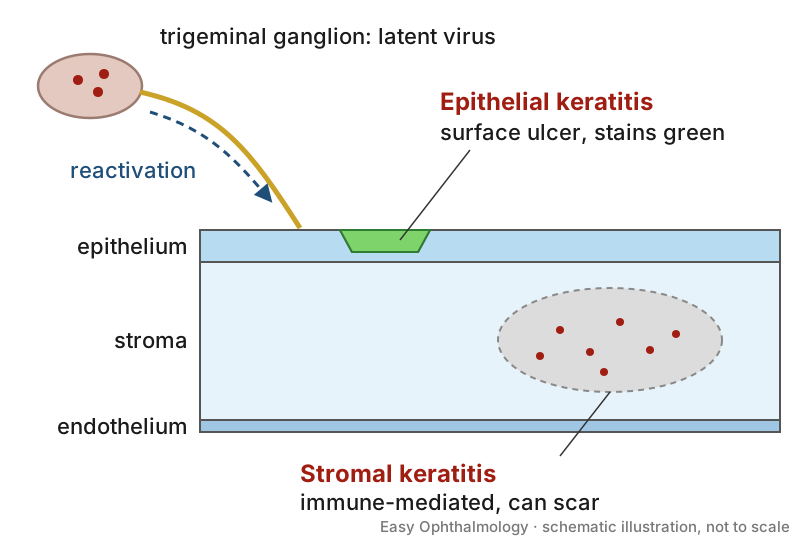
- Course. HSV establishes latency in sensory ganglia, most often the trigeminal ganglion, and reactivates to cause recurrent corneal disease [S4].
- Forms. Epithelial keratitis, which is usually self-limiting but may persist or progress without treatment [S2], and stromal keratitis, an immune-mediated inflammation [S9] that is a leading cause of corneal opacification [S1].
Confirm it
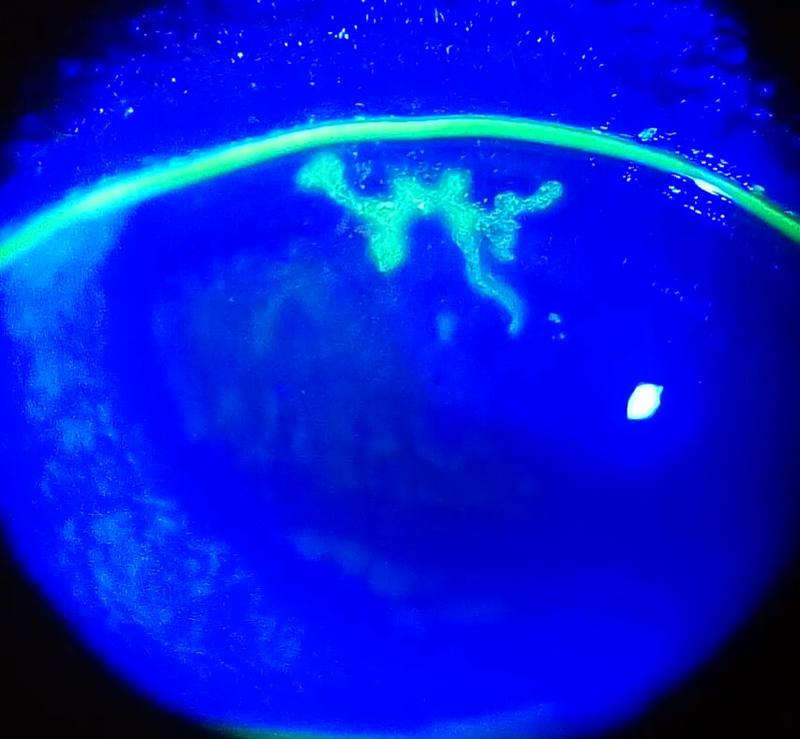
- Diagnosis is usually clinical at the slit lamp, but clinical findings are not always accurate [S4].
- PCR, ELISA, immunofluorescence and viral culture give more definitive diagnosis, each with limitations [S4] [S11]. Laboratory options and their relative advantages are reviewed in [S12].
Manage it
Before acting on this section, check the national and local guidelines, product information and regulatory approvals that apply where you practise. See the medical disclaimer.
Tier A (primary care / no specialist)
- Do not prescribe steroid drops for a red eye with a suspected corneal lesion; steroids are useful in HSK only alongside antivirals [S9] [S10].
- Refer suspected HSK to an eye clinic (see "Refer when").
Tier B (general eye clinic)
Epithelial keratitis - A Cochrane review of 137 studies (8333 eyes) found trifluridine and acyclovir more effective than idoxuridine or vidarabine and similar to each other; ganciclovir is at least as effective as acyclovir [S2]. - In a limited number of studies, oral acyclovir alone (RR 0.92, 95% CI 0.79 to 1.07) appeared as effective as a single topical antiviral [S2], which may help where topical antivirals are unavailable. - Debridement or interferon added to an antiviral had inconsistent effects [S2].
Stromal keratitis - In a systematic review of 7 papers, prednisolone phosphate plus acyclovir gave higher success and longer time to failure than acyclovir alone [S9]. Oral and topical acyclovir did not differ in time to resolution [S9]. - Corticosteroids may give greater benefit when tapered and given for at least 10 weeks [S9]. Randomised trials support their safety and effectiveness with appropriate antiviral therapy [S10]. - Dosing is not covered by these abstracts: follow local formularies.
Tier C (specialist centre)
- Steroid-sparing agents. Cyclosporine A, tacrolimus and flurbiprofen may be safe and effective, on limited evidence [S9]; high-quality trials beyond steroids and antivirals are lacking [S1].
- Refractory and resistant disease. Options include higher acyclovir doses, oral valacyclovir, and topical foscarnet, ganciclovir, trifluridine or cidofovir [S11]; trifluridine, foscarnet and helicase-primase inhibitors such as amenamevir have shown efficacy [S12]. These come from narrative reviews.
- Neurotrophic component. Growth factor therapy, autologous serum, recombinant nerve growth factor or scleral lenses may help [S12].
- Keratoplasty for scarring. Penetrating keratoplasty and DALK gave comparable visual improvement, with fewer complications after DALK in most of 12 studies [S7]. Higher graft survival was associated with acyclovir above 800 mg/day, topical steroids and antibiotics, as reported in [S7].
- Prophylaxis after grafting. A Cochrane review of 3 trials (126 participants) found oral acyclovir for 6 months or more may reduce recurrence (RR 0.29, 95% CI 0.13 to 0.64) and graft failure (RR 0.40, 95% CI 0.16 to 0.97), about 23 fewer recurrences per 100 grafts; evidence was low certainty [S3].
Refer when
| Situation | Urgency |
|---|---|
| Suspected HSK in a child | Same-day to an eye clinic |
| Stromal keratitis, keratouveitis or reduced vision | Emergency referral to an eye clinic [EIC expert opinion] |
| No improvement on antiviral treatment, or thinning | Urgent to a cornea service; timing per your local service or specialist advice |
Pitfalls
- Using steroids alone [S9] [S10].
- Over-relying on the clinical picture; slit-lamp diagnosis is not always accurate [S4].
- Labelling every non-responder as resistant without checking adherence and dosing [S12] or cytomegalovirus [S11].
- Forgetting antiviral prophylaxis after keratoplasty [S3] [S7].
Evidence notes
| Source | Date | Design |
|---|---|---|
| [S1] | 2009 | Evidence-based review (stromal keratitis) |
| [S2] | 2015 | Cochrane systematic review and network meta-analysis, 137 studies |
| [S3] | 2016 | Cochrane systematic review, 3 RCTs |
| [S4] | 2017 | Narrative review |
| [S5] | 2018 | Narrative review (epithelial keratitis) |
| [S6] | 2018 | Narrative review (children) |
| [S7] | 2020 | Systematic review of 12 observational studies |
| [S8] | 2022 | Systematic review of incidence |
| [S9] | 2024 | Systematic review of 7 papers, qualitative |
| [S10] | 2023 | Narrative review (steroids in infectious keratitis) |
| [S11] | 2024 | Narrative review (acyclovir resistance) |
| [S12] | 2026 | Narrative review (refractory HSK) |
- The Herpetic Eye Disease Study trials are not on this PubMed sheet and are not cited directly; stromal keratitis evidence here comes from a qualitative systematic review of 7 papers [S9] and narrative reviews.
- The trials in the graft prophylaxis review were poorly reported and none followed patients beyond two years [S3].
- Placebo-controlled epithelial trials are limited to superseded drugs; the ganciclovir advantage was mitigated by heterogeneity and possible publication bias [S2].
- Incidence data are from the USA and Europe only [S8].
- Main epithelial agents remain trifluridine drops, acyclovir ointment, ganciclovir gel and oral acyclovir [S5].
- Not covered by these sources: dose and duration of long-term suppressive therapy outside grafts, and management of HSV endotheliitis.
Related articles
- Herpes zoster ophthalmicus
- Neurotrophic keratopathy
- Topical and periocular corticosteroids: benefits and risks
References
See the numbered source list below. Each marker [S#] links to its PubMed and DOI record.
Sources
- [S1] Knickelbein JE, Hendricks RL, Charukamnoetkanok P Management of herpes simplex virus stromal keratitis: an evidence-based review. Survey of ophthalmology. (2009). PubMed 19298901 · doi:10.1016/j.survophthal.2008.12.004
- [S2] Wilhelmus KR Antiviral treatment and other therapeutic interventions for herpes simplex virus epithelial keratitis. The Cochrane database of systematic reviews. (2015). PubMed 25879115 · doi:10.1002/14651858.cd002898.pub5
- [S3] Bhatt UK, Abdul Karim MN, Prydal JI, Maharajan SV, Fares U Oral antivirals for preventing recurrent herpes simplex keratitis in people with corneal grafts. The Cochrane database of systematic reviews. (2016). PubMed 27902849 · doi:10.1002/14651858.cd007824.pub2
- [S4] Azher TN, Yin XT, Tajfirouz D, Huang AJ, Stuart PM Herpes simplex keratitis: challenges in diagnosis and clinical management. Clinical ophthalmology (Auckland, N.Z.). (2017). PubMed 28176902 · doi:10.2147/opth.s80475
- [S5] Roozbahani M, Hammersmith KM Management of herpes simplex virus epithelial keratitis. Current opinion in ophthalmology. (2018). PubMed 29697435 · doi:10.1097/icu.0000000000000483
- [S6] Vadoothker S, Andrews L, Jeng BH, Levin MR Management of Herpes Simplex Virus Keratitis in the Pediatric Population. The Pediatric infectious disease journal. (2018). PubMed 29794647 · doi:10.1097/inf.0000000000002114
- [S7] Skarentzos K, Chatzimichael E, Panagiotopoulou EK, Taliantzis S, Konstantinidis A, Labiris G Corneal Graft Success Rates in HSV Keratitis: A Systematic Review. Acta medica (Hradec Kralove). (2020). PubMed 33355075 · doi:10.14712/18059694.2020.57
- [S8] McCormick I, James C, Welton NJ, Mayaud P, Turner KME, Gottlieb SL, et al. INCIDENCE OF HERPES SIMPLEX VIRUS KERATITIS AND OTHER OCULAR DISEASE: GLOBAL REVIEW AND ESTIMATES. Ophthalmic epidemiology. (2022). PubMed 34622738 · doi:10.1080/09286586.2021.1962919
- [S9] Li X, Nayeni M, Malvankar-Mehta MS Antiviral and Anti-Inflammatory Therapeutic Interventions for Treating Herpes Stromal Keratitis: A Systematic Review. Ophthalmic epidemiology. (2024). PubMed 37184084 · doi:10.1080/09286586.2023.2213324
- [S10] Keenan JD Steroids in the Management of Infectious Keratitis. Cornea. (2023). PubMed 38112645 · doi:10.1097/ico.0000000000003340
- [S11] Mirzaei A, Soltani Shahgoli S, Kognati R, Karaca EE, Cheraqpour K, Alahyari F, et al. Overcoming Resistance: A Comprehensive Review and Treatment Approach for Acyclovir-Resistant Herpes Simplex Keratitis. Journal of current ophthalmology. (2024). PubMed 41041036 · doi:10.4103/joco.joco_85_24
- [S12] Rousseau A, Boucher R, Haigh O, Labetoulle M Managing refractory herpes simplex keratitis. The British journal of ophthalmology. (2026). PubMed 42778339 · doi:10.1136/bjo-2025-329213