Educational content only. Not personalised medical advice. Clinical decisions remain the responsibility of the treating clinician.
Corneal abrasion and corneal foreign body
Corneal abrasions are among the most common causes of eye pain in emergency departments; they are often self-limited, but delayed diagnosis or inappropriate management can lead to infectious keratitis, corneal ulceration and permanent vision loss [S12]. Corneal foreign body removal is a common office procedure, and most patients can be managed effectively by community primary eye care practitioners [S10].
Key points - Diagnose with history, visual acuity and fluorescein staining, and exclude a penetrating injury or infection [S12]. - Do not patch simple abrasions: patching does not improve healing or pain [S5] [S8]. - Topical NSAIDs reduce pain and the need for oral analgesia in the first 48 hours [S8]; a Cochrane review rated this evidence as low certainty [S6]. - Evidence for antibiotic prophylaxis is of very low certainty [S11], but in a South Indian village RCT, antibiotic ointment delivered by health workers prevented both bacterial and fungal ulcers after abrasion [S1]. - Outpatient topical anaesthetics remain controversial; the evidence is very uncertain [S9] [S12].
Evidence last checked: 2026-10-17 (PubMed abstracts).
Red flags
- Possible penetrating injury: exclude it before treating as a simple abrasion [S12].
- Infiltrate or ulcer at review: abrasions can progress to infectious keratitis and corneal ulceration [S12].
- Abrasions where fungal keratitis is common: half of corneal ulcers were fungal in the South Indian population of one RCT [S1].
- Repeated episodes of symptoms after an old injury (recurrent corneal erosion), which predisposes the cornea to infection [S7].
Recognise it
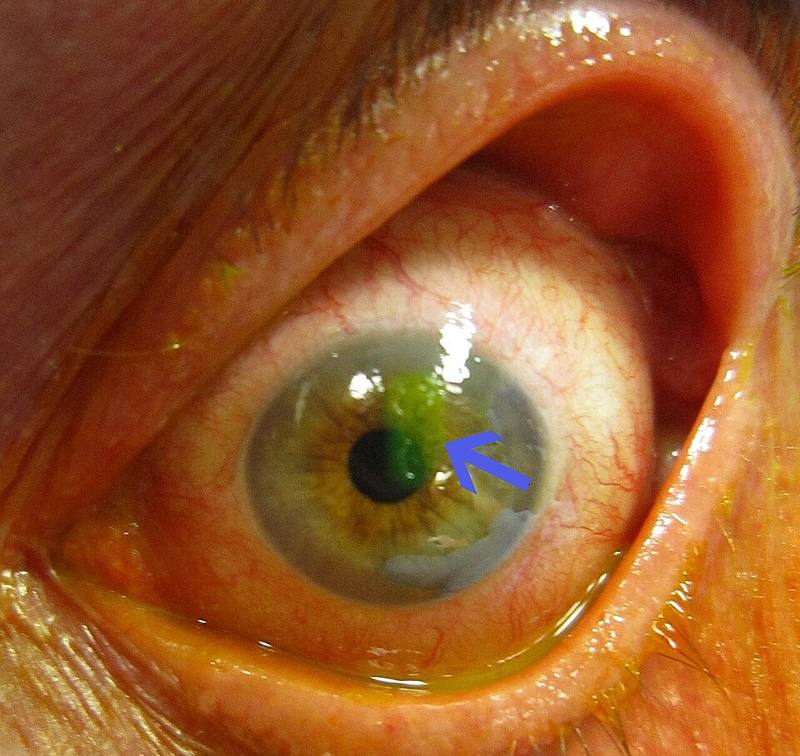
- Typical symptoms include photophobia, lacrimation, foreign body sensation and blurred vision [S5].
- Ocular foreign bodies accounted for more than 44% of eye-related emergency presentations in an Australian estimate [S10].
- Most participants in antibiotic trials had traumatic abrasions after foreign body removal [S11].
- Recurrent corneal erosion may follow corneal trauma [S7].
Confirm it
- Take a careful history and measure visual acuity before any drops [S12].
- Stain with fluorescein and examine with a slit lamp or magnification [S12].
- Exclude a penetrating injury or infection [S12]; where these cannot be excluded, refer (see table).
- Use standardised injury terminology when describing and referring eye injuries [S10].
Manage it
Before acting on this section, check the national and local guidelines, product information and regulatory approvals that apply where you practise. See the medical disclaimer.
Tier A (primary care / no specialist)
- Foreign body: a superficial corneal foreign body can be removed by a trained primary eye care practitioner [S10]; refer if removal is not possible or the foreign body is deep [G2].
- Antibiotic prophylaxis: a Cochrane review (4 RCTs, 998 participants, published 1975 to 1998) found very low-certainty evidence and could not support any specific regimen [S11]. In a village-level RCT in South India, chloramphenicol 1% ointment three times a day for 3 days, with or without clotrimazole 1%, was given by trained village health workers; 98.5% of 374 abrasions healed without complications, as reported in [S1]. Adding the antifungal did not appear necessary [S1].
- Pain: topical NSAIDs reduced pain scores at 24 and 48 hours and oral analgesia use by 53% [S8]. Oral analgesics cost less than NSAID drops [S6].
- No patch: patching may slightly slow healing at 24 hours and did not reduce pain [S5]; it may increase complications [S8].
- Topical anaesthetics: do not routinely supply them for home use; the evidence for benefit and safety is very uncertain [S4] [S9]. See Pitfalls.
Tier B (general eye clinic)
- Remove embedded foreign bodies and manage after removal as in Tier A [S10].
- Bandage contact lens or ointment alone gave similar healing and pain to pressure patching in a small RCT (66 patients) after corneal foreign body removal; all healed by day 7 [S3]. Evidence for bandage lenses and cycloplegics in pain control is insufficient [S8].
- Dilute topical anaesthetic: in a small RCT (33 completers), 0.05% proparacaine as an outpatient analgesic reduced pain more than placebo, with no complications seen, as reported in [S2]; larger studies are needed to evaluate safety [S2].
Tier C (specialist centre)
- Recurrent corneal erosion: after epithelial debridement, diamond burr superficial keratectomy reduced recurrences compared with sham (RR 0.07, moderate certainty) in one study of 48 participants [S7]. Other treatments, including therapeutic contact lenses, phototherapeutic keratectomy and alcohol delamination, are supported only by low-certainty evidence [S7].
Refer when
| Situation | Urgency |
|---|---|
| Possible penetrating injury or intraocular foreign body | Immediate [S12] |
| Corneal infiltrate, ulcer or worsening pain after an abrasion | Same-day eye clinic (possible keratitis) [G1] [S12] |
| Embedded foreign body that cannot be removed safely | Same-day [G2] |
| Recurrent erosion episodes not settling with simple treatment | Routine, within weeks [S7] |
Pitfalls
- Treating a penetrating injury as a simple abrasion [S12].
- Patching: no benefit for healing or pain [S5].
- Assuming antibiotic drops are proven; the Cochrane evidence is very low certainty [S11].
- Prescribing undiluted topical anaesthetics for outpatient use: one Cochrane review found more unresolved defects with them in post-trauma trials, though the estimate was very uncertain [S9].
- Forgetting that in some settings, half of corneal ulcers are fungal [S1].
Evidence notes
| Source | Date | Design |
|---|---|---|
| [S1] | 2006 | Community RCT, 374 abrasions, South India |
| [S2] | 2010 | RCT, 33 completers |
| [S3] | 2013 | Three-arm RCT, 66 patients |
| [S4] | 2015 | Meta-analysis, 2 RCTs, 140 patients |
| [S5] | 2016 | Cochrane review, 12 trials, 1080 participants |
| [S6] | 2017 | Cochrane review, 9 RCTs, 637 participants |
| [S7] | 2018 | Cochrane review, 10 trials, 505 participants |
| [S8] | 2021 | Meta-analysis, 33 studies, 4167 patients |
| [S9] | 2023 | Cochrane review, 9 RCTs, 556 participants |
| [S10] | 2026 | Narrative review (primary eye care) |
| [S11] | 2025 | Cochrane review, 4 RCTs, 998 participants |
| [S12] | 2026 | Narrative review |
- Conflict on NSAIDs: a 2021 meta-analysis called the evidence strong [S8], while the 2017 Cochrane review found low-certainty evidence that did not strongly support them [S6].
- Conflict on topical anaesthetics: one small RCT found benefit without complications [S2]; the meta-analyses found no clear benefit and sparse safety data [S4] [S9].
- Antibiotics: trials were old, from high-income countries, mostly at high risk of bias, and two had industry support [S11]. In one trial antibiotics may even have increased infection risk [S11]. The village-level RCT from India is the main low-resource evidence but had no antibiotic-free arm [S1].
- Not covered by these sources: foreign body removal technique, rust ring management, contact lens-related abrasions and follow-up intervals.
Related articles
References
See the numbered source list below. Each marker [S#] links to its PubMed and DOI record.
Sources
- [S1] Srinivasan M, Upadhyay MP, Priyadarsini B, Mahalakshmi R, Whitcher JP Corneal ulceration in south-east Asia III: prevention of fungal keratitis at the village level in south India using topical antibiotics. The British journal of ophthalmology. (2006). PubMed 16916874 · doi:10.1136/bjo.2006.103028
- [S2] Ball IM, Seabrook J, Desai N, Allen L, Anderson S Dilute proparacaine for the management of acute corneal injuries in the emergency department. CJEM. (2010). PubMed 20880433 · doi:10.1017/s1481803500012537
- [S3] Menghini M, Knecht PB, Kaufmann C, Kovacs R, Watson SL, Landau K, et al. Treatment of traumatic corneal abrasions: a three-arm, prospective, randomized study. Ophthalmic research. (2013). PubMed 23652196 · doi:10.1159/000347125
- [S4] Puls HA, Cabrera D, Murad MH, Erwin PJ, Bellolio MF Safety and Effectiveness of Topical Anesthetics in Corneal Abrasions: Systematic Review and Meta-Analysis. The Journal of emergency medicine. (2015). PubMed 26472608 · doi:10.1016/j.jemermed.2015.02.051
- [S5] Lim CH, Turner A, Lim BX Patching for corneal abrasion. The Cochrane database of systematic reviews. (2016). PubMed 27457359 · doi:10.1002/14651858.cd004764.pub3
- [S6] Wakai A, Lawrenson JG, Lawrenson AL, Wang Y, Brown MD, Quirke M, et al. Topical non-steroidal anti-inflammatory drugs for analgesia in traumatic corneal abrasions. The Cochrane database of systematic reviews. (2017). PubMed 28516471 · doi:10.1002/14651858.cd009781.pub2
- [S7] Watson SL, Leung V Interventions for recurrent corneal erosions. The Cochrane database of systematic reviews. (2018). PubMed 29985545 · doi:10.1002/14651858.cd001861.pub4
- [S8] Yu CW, Kirubarajan A, Yau M, Armstrong D, Johnson DE Topical pain control for corneal abrasions: A systematic review and meta-analysis. Academic emergency medicine : official journal of the Society for Academic Emergency Medicine. (2021). PubMed 33508879 · doi:10.1111/acem.14222
- [S9] Sulewski M, Leslie L, Liu SH, Ifantides C, Cho K, Kuo IC Topical ophthalmic anesthetics for corneal abrasions. The Cochrane database of systematic reviews. (2023). PubMed 37555621 · doi:10.1002/14651858.cd015091.pub2
- [S10] Xu P, Lim JK Managing corneal foreign body injuries in a primary eye care setting. Clinical & experimental optometry. (2026). PubMed 40174878 · doi:10.1080/08164622.2025.2485237
- [S11] Ng SM, Leslie L, Tzang CC, Algarni AM, Kuo IC, Lawrenson AL, et al. Antibiotic prophylaxis for corneal abrasion. The Cochrane database of systematic reviews. (2025). PubMed 41017778 · doi:10.1002/14651858.cd014617.pub3
- [S12] Cooper CM, Berg E, Ashurst J Scratching the Surface: Re-evaluating the Management of Corneal Abrasions. Cureus. (2026). PubMed 41835781 · doi:10.7759/cureus.103351
Guidelines
- [G1] NHS Scotland (Community Eyecare Guidelines, eyes.nhs.scot). 5.3 Abrasion, Corneal (2026). https://www.eyes.nhs.scot/eyecare-guidelines/section-5-corneal/53-abrasion-corneal/
- [G2] NHS Scotland (Community Eyecare Guidelines, eyes.nhs.scot). 5.4 Foreign Body, Corneal (2025). https://www.eyes.nhs.scot/eyecare-guidelines/section-5-corneal/54-foreign-body-corneal/