Educational content only. Not personalised medical advice. Clinical decisions remain the responsibility of the treating clinician.
Dry eye disease
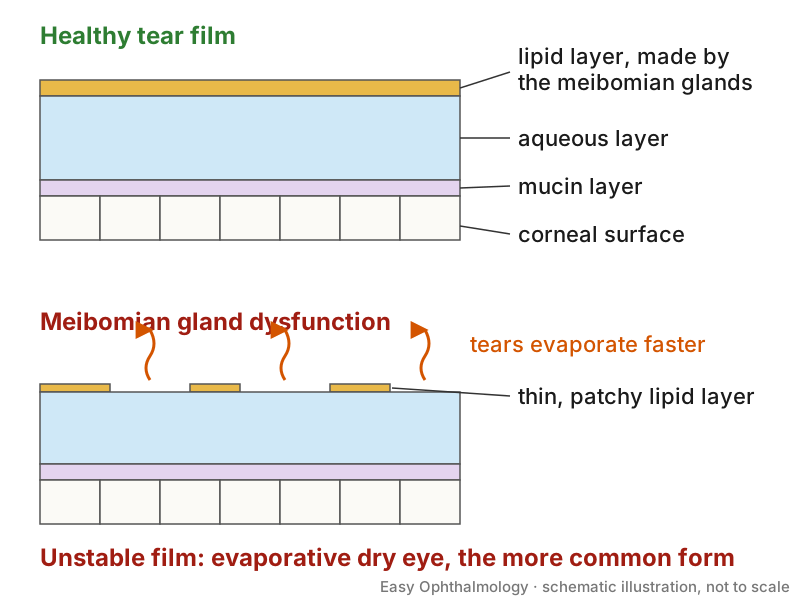
Dry eye disease (DED) is common, with prevalence ranging from 5 to 50% worldwide, and it has a considerable impact on vision, quality of life, work productivity and pain [S3]. It leads to tear film instability, ocular surface damage and neurosensory changes [S7]. Meibomian gland dysfunction (MGD) causes evaporative dry eye, the more prevalent form [S6] [S8].
Key points - Prevalence rises with age and is higher in women; Asian ethnicity is a mostly consistent risk factor [S3]. - Treatment should be guided by the DED subtype and cause [S8]. - MGD is treated first with warm compresses, lid massage and lid hygiene [S8]. - Prescription topical drugs improve signs more often than symptoms in RCTs [S12]; topical steroids probably give small to moderate short-term symptom relief beyond lubricants [S7]. - Evidence for punctal plugs, autologous serum, intense pulsed light and LipiFlow is low or very low certainty [S1] [S2] [S6] [S9].
Evidence last checked: 2026-10-17 (PubMed abstracts).
Red flags
Dry eye is usually not sight-threatening, but the following need a different approach:
- Raised eye pressure on topical steroids. Steroids may increase the risk of intraocular pressure elevation compared with lubricants (RR 5.96, 95% CI 1.30 to 27.38) [S7].
- Possible Sjögren disease or other systemic disease in a patient with severe dryness: the cause guides treatment [S8].
- Pain, reduced vision or a corneal ulcer: see "Refer when".
Recognise it
- Symptoms include dryness, burning, itching, pain and visual impairment [S7].
- Risk factors. Age and female sex [S3]. In a meta-analysis of observational studies: allergic conjunctivitis (OR 4.59), anxiety (OR 2.39), rosacea or acne (OR 1.96), refractive surgery (OR 1.78), depression (OR 1.59), stress (OR 1.59), thyroid disease (OR 1.57), viral infections (OR 1.54), smoking (OR 1.18), alcohol (OR 1.18) and diabetes (OR 1.14) [S11].
- Signs and symptoms differ. The prevalence of signs was higher and more variable than symptoms [S3].
Confirm it
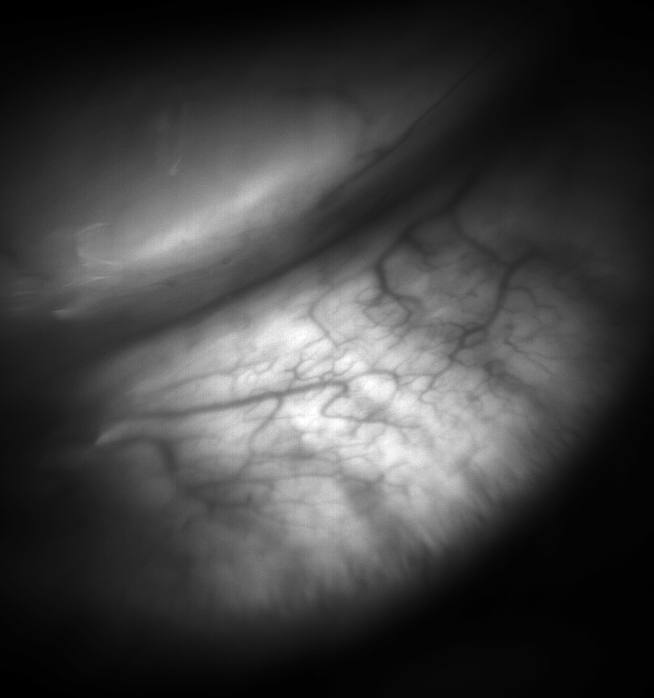
- Diagnosis uses a combination of clinical features and diagnostic tests [S8]. Common trial measures are symptom questionnaires (for example OSDI and SPEED), corneal staining, Schirmer test and tear break-up time [S9] [S12].
- Questionnaires vary in their utility [S3].
- Distinguishing evaporative dry eye from other subtypes can be difficult, and matters because subtype guides treatment [S8].
Manage it
Before acting on this section, check the national and local guidelines, product information and regulatory approvals that apply where you practise. See the medical disclaimer.
Tier A (primary care / no specialist)
- Lid care for MGD: warm compresses, lid massage and lid hygiene [S8].
- Lifestyle and counselling so that patients have realistic expectations [S8].
- Lubricants. Artificial tears are the usual comparator and adjunct in trials [S4] [S7]; product choice and frequency are not covered by these abstracts: follow local formularies.
- Do not start long-term topical steroids without pressure monitoring [S7].
Tier B (general eye clinic)
- Topical corticosteroids. A Cochrane review of 22 RCTs (4169 participants) found they probably give small to moderate symptom relief beyond lubricants (SMD 0.29) and lower corneal staining, on moderate-certainty evidence; trials were short (mostly 3 to 8 weeks) [S7].
- Topical cyclosporine A. A Cochrane review of 30 RCTs found inconsistent effects on discomfort, staining, Schirmer and TBUT, with more non-serious adverse effects, particularly burning (RR 1.33) [S4]. It may increase conjunctival goblet cells, but this was not shown to improve symptoms [S4].
- Other prescription drops. A systematic review of 107 publications covering cyclosporine, lifitegrast, diquafosol, rebamipide, perfluorohexyloctane and varenicline nasal spray found improvements in signs more often than symptoms, good tolerability and rare head-to-head trials [S12]. A meta-analysis of perfluorohexyloctane RCTs found reduced corneal staining and eye dryness scores at 8 weeks but no difference in TBUT or OSDI [S10].
- Omega-3 supplements. A Cochrane review of 34 RCTs found little to no reduction in symptoms with long-chain omega-3 versus placebo (low certainty), and a possible role overall that is uncertain and inconsistent [S5].
- Punctal plugs. A Cochrane review of 18 trials found inconclusive effects on symptoms and signs; epiphora is common and dacryocystitis less common [S2].
Tier C (specialist centre)
- Autologous serum drops. Five RCTs (92 participants) gave inconsistent results; there may be short-term symptom benefit over artificial tears, but no evidence of an effect after two weeks [S1].
- Intense pulsed light for MGD. Three RCTs (114 adults) left its value uncertain, with very low-certainty evidence and poorly reported adverse events [S6].
- LipiFlow thermal pulsation. In 13 trials (1155 participants) it performed similarly to other common treatments, including warm compresses, on low or very low certainty evidence [S9].
- A customised rather than generalised approach is advised [S8], with shared decision-making on aetiology and patient preference [S12].
Refer when
| Situation | Urgency |
|---|---|
| Eye pain, reduced vision, corneal ulcer or suspected infection in a dry eye patient | Same-day to an eye clinic |
| Severe dry eye, suspected Sjögren disease or failure of lid care and lubricants | Routine, within a few weeks, to an eye clinic [EIC expert opinion] |
| On topical steroids without pressure checks | Urgent for IOP measurement; timing per your local service or specialist advice [S7] |
Pitfalls
- Treating all dry eye the same way; subtype matters [S8].
- Expecting symptom relief to match improved signs [S12].
- Long-term steroids without IOP monitoring [S7].
- Promising benefit from devices or supplements: evidence is low certainty [S5] [S6] [S9].
Evidence notes
| Source | Date | Design |
|---|---|---|
| [S1] | 2017 | Cochrane systematic review, 5 RCTs |
| [S2] | 2017 | Cochrane systematic review, 18 trials |
| [S3] | 2017 | TFOS DEWS II epidemiology report with meta-analysis |
| [S4] | 2019 | Cochrane systematic review, 30 RCTs |
| [S5] | 2019 | Cochrane systematic review, 34 RCTs |
| [S6] | 2020 | Cochrane systematic review, 3 RCTs |
| [S7] | 2022 | Cochrane systematic review, 22 RCTs |
| [S8] | 2023 | Preferred practice pattern guideline (India) |
| [S9] | 2024 | Cochrane systematic review, 13 trials |
| [S10] | 2025 | Meta-analysis of RCTs (perfluorohexyloctane) |
| [S11] | 2024 | Meta-analysis of observational studies |
| [S12] | 2025 | Systematic review of 107 publications |
- Nearly half the steroid trials were at high risk of selective reporting bias, and 8 of 22 were industry sponsored [S7].
- Cyclosporine trials were short and poorly reported [S4]; perfluorohexyloctane trials were mostly sponsored [S10].
- Two IPL trial first authors had funding from patents or device manufacturers [S6].
- Prevalence data are limited for youth and populations south of the equator [S3].
- Not covered by these sources: choice of artificial tear formulation, cost, availability in low-resource settings, and management of exposure keratopathy.
Related articles
References
See the numbered source list below. Each marker [S#] links to its PubMed and DOI record.
Sources
- [S1] Pan Q, Angelina A, Marrone M, Stark WJ, Akpek EK Autologous serum eye drops for dry eye. The Cochrane database of systematic reviews. (2017). PubMed 28245347 · doi:10.1002/14651858.cd009327.pub3
- [S2] Ervin AM, Law A, Pucker AD Punctal occlusion for dry eye syndrome. The Cochrane database of systematic reviews. (2017). PubMed 28649802 · doi:10.1002/14651858.cd006775.pub3
- [S3] Stapleton F, Alves M, Bunya VY, Jalbert I, Lekhanont K, Malet F, et al. TFOS DEWS II Epidemiology Report. The ocular surface. (2017). PubMed 28736337 · doi:10.1016/j.jtos.2017.05.003
- [S4] de Paiva CS, Pflugfelder SC, Ng SM, Akpek EK Topical cyclosporine A therapy for dry eye syndrome. The Cochrane database of systematic reviews. (2019). PubMed 31517988 · doi:10.1002/14651858.cd010051.pub2
- [S5] Downie LE, Ng SM, Lindsley KB, Akpek EK Omega-3 and omega-6 polyunsaturated fatty acids for dry eye disease. The Cochrane database of systematic reviews. (2019). PubMed 31847055 · doi:10.1002/14651858.cd011016.pub2
- [S6] Cote S, Zhang AC, Ahmadzai V, Maleken A, Li C, Oppedisano J, et al. Intense pulsed light (IPL) therapy for the treatment of meibomian gland dysfunction. The Cochrane database of systematic reviews. (2020). PubMed 32182637 · doi:10.1002/14651858.cd013559
- [S7] Liu SH, Saldanha IJ, Abraham AG, Rittiphairoj T, Hauswirth S, Gregory D, et al. Topical corticosteroids for dry eye. The Cochrane database of systematic reviews. (2022). PubMed 36269562 · doi:10.1002/14651858.cd015070.pub2
- [S8] Narang P, Donthineni PR, D'Souza S, Basu S Evaporative dry eye disease due to meibomian gland dysfunction: Preferred practice pattern guidelines for diagnosis and treatment. Indian journal of ophthalmology. (2023). PubMed 37026266 · doi:10.4103/ijo.ijo_2841_22
- [S9] Pucker AD, Yim TW, Rueff E, Ngo W, Tichenor AA, Conto JE LipiFlow for the treatment of dry eye disease. The Cochrane database of systematic reviews. (2024). PubMed 38314898 · doi:10.1002/14651858.cd015448.pub2
- [S10] Taloni A, Coco G, Pellegrini M, Scorcia V, Giannaccare G Efficacy of Perfluorohexyloctane for the Treatment of Patients with Dry Eye Disease: A Meta-Analysis. Ophthalmic research. (2025). PubMed 39622217 · doi:10.1159/000542149
- [S11] Yang K, Wu S, Ke L, Zhang H, Wan S, Lu M, et al. Association between potential factors and dry eye disease: A systematic review and meta-analysis. Medicine. (2024). PubMed 39969375 · doi:10.1097/md.0000000000041019
- [S12] Tong L, Liu Z, Şahin A, Gümüş K, Messmer EM, Benítez-Del-Castillo JM, et al. Topical pharmacologic treatments for dry eye disease: A systematic review. The ocular surface. (2025). PubMed 40749992 · doi:10.1016/j.jtos.2025.07.010