Educational content only. Not personalised medical advice. Clinical decisions remain the responsibility of the treating clinician.
Post-operative endophthalmitis
Postoperative endophthalmitis is a sight-threatening emergency: purulent intraocular inflammation caused by an infective agent introduced during surgery, requiring prompt diagnosis and treatment [S7]. It is rare after cataract surgery, but outcomes are often poor, especially in low-resource settings and with virulent organisms [S1] [S2] [S6].
Key points - The ESCRS 2024 guideline recommends intracameral antibiotics to prevent endophthalmitis [S12]; they reduced its incidence 3.5-fold in pooled evidence summarised in a review [S9]. - Treatment starts with prompt intravitreal antibiotics; most post-cataract pathogens are susceptible to vancomycin and ceftazidime, and sampling can be deferred if it would delay injection [S10]. - In the only RCT (EVS, 420 participants), early vitrectomy did not improve acuity compared with vitreous tap and injection [S7]; newer non-randomised studies suggest a role for early complete vitrectomy [S8]. - Toxic anterior segment syndrome (TASS) is non-infectious, typically starts within 12 to 48 hours, and must be distinguished from infection [S5]. - Contaminated surgical solutions can cause outbreaks; one Pseudomonas outbreak after MSICS had a poor outcome in about 50% of patients [S6].
Evidence last checked: 2026-10-17 (PubMed abstracts).
Red flags
- Pain, reduced vision and increasing inflammation after intraocular surgery: treat as endophthalmitis until proven otherwise [S7].
- Very poor presenting acuity: initial visual acuity and organism virulence are the most important predictors of a poor outcome [S2].
- Several cases from one theatre list or batch: suspect a contaminated solution or instrument; an outbreak was traced to trypan blue [S6].
- Previous vitrectomy: a major risk factor in several Asian studies [S2].
Recognise it
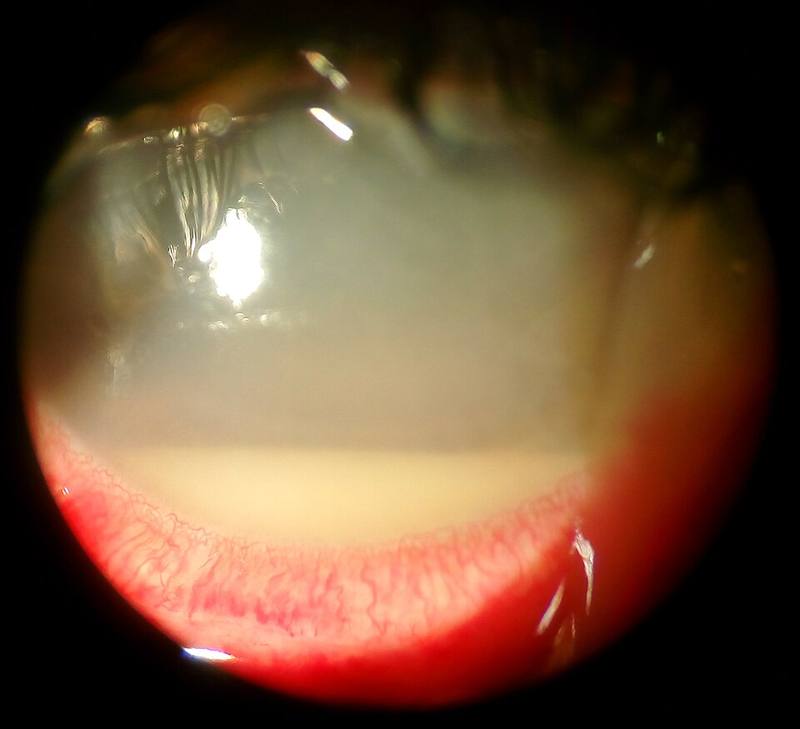
- Incidence. 0.06% (140/233,115) after cataract surgery in Chinese reports 1995 to 2009 [S1]; incidence in Asian populations is generally consistent with Caucasian data [S2].
- Organisms. Coagulase-negative staphylococci were most frequent in most Asian studies, but Pseudomonas aeruginosa and Nocardia predominated in some [S2]. In China, 60.1% of samples were culture positive: 87.3% bacterial, 12.7% fungal [S1].
- Presentation. In the Chinese series, 75.3% of eyes presented with acuity worse than 5/200 [S1].
- TASS vs infection. TASS shows prominent limbus-to-limbus corneal oedema and anterior chamber inflammation, usually within 12 to 48 hours of surgery; most patients do well with prompt diagnosis and treatment [S5]. Distinguishing sterile from infectious inflammation remains a recognised area of uncertainty [S11].
Confirm it
- Vitreous cultures have a better diagnostic yield than aqueous cultures [S10].
- Culture results help prognosis but rarely change management; eyes managed without cultures had similar outcomes in the studies reviewed [S10].
- Microbiological yield is limited and molecular techniques have uncertain clinical interpretation [S11].
Manage it
Before acting on this section, check the national and local guidelines, product information and regulatory approvals that apply where you practise. See the medical disclaimer.
Tier A (primary care / no specialist)
- Any patient with pain, redness or falling vision in the weeks after eye surgery needs same-day transfer to an eye surgeon able to give intravitreal antibiotics [G1]. Do not delay transfer for tests.
Tier B (general eye clinic)
- Give intravitreal antibiotics promptly. Empiric antibiotics are given before microbiology results; vancomycin and ceftazidime cover the large majority of post-cataract pathogens [S10]. Doses are not given in these abstracts: follow your national or local protocol.
- Take a sample if it does not delay treatment. Vitreous sampling is preferred to aqueous [S10].
- Prevention. Use intracameral antibiotics [S12]. Moxifloxacin and cefuroxime are the most common choices; 500 μg intracameral moxifloxacin (as reported in [S9]) was cost-effective, including after posterior capsule rupture [S9]. One analysis estimated 2500 patients treated to prevent one case [S9]. Topical antibiotics added no prophylactic benefit to intracameral regimens [S9].
- Prepare intracameral drugs carefully. Adverse events are rare and mostly due to preparation errors [S9]; compounding or dilution errors with cefuroxime cause ocular toxicity [S4]. Cefuroxime can be given safely to penicillin-allergic patients (level 2a evidence) [S4].
Tier C (specialist centre)
- Vitrectomy. The EVS found no significant difference in acuity between vitrectomy and tap at three months; 41% of all participants reached 20/40 or better (very low-certainty evidence, a single trial published 27 years before the Cochrane review) [S7]. Recent, less rigorous studies propose early complete vitrectomy regardless of presenting acuity; treat this with caution [S8].
- Outbreak investigation. Culture patient and environmental samples; genomic typing linked a multidrug-resistant Pseudomonas outbreak to contaminated trypan blue, susceptible only to imipenem [S6].
- Unresolved issues. Adjunctive corticosteroids, fungal and culture-negative disease, and rising antimicrobial resistance remain areas of uncertainty [S11].
Refer when
| Situation | Urgency |
|---|---|
| Suspected endophthalmitis after any intraocular surgery | Immediate, same-day, for intravitreal antibiotics [G1] [S7] |
| No improvement or worsening after intravitreal antibiotics | Within hours to a vitreoretinal service [EIC expert opinion] [S8] |
| Two or more cases linked to the same surgical session | Immediate suspension and investigation of the theatre supplies [EIC expert opinion] [S6] |
Pitfalls
- Waiting for culture results before injecting antibiotics [S10].
- Labelling infection as TASS, or TASS as infection, without close review [S5] [S11].
- Dilution errors when preparing intracameral cefuroxime [S4].
- Relying on topical antibiotics instead of intracameral prophylaxis [S9].
- Assuming coagulase-negative staphylococci everywhere; Pseudomonas and Nocardia predominate in some regions [S2].
Evidence notes
| Source | Date | Design |
|---|---|---|
| [S1] | 2011 | Review of 57 Chinese articles, 403 eyes |
| [S2] | 2011 | Narrative review, Asian populations |
| [S3] | 2017 | Narrative review |
| [S4] | 2017 | Systematic review |
| [S5] | 2019 | Narrative review |
| [S6] | 2019 | Retrospective outbreak case series, 13 patients |
| [S7] | 2022 | Cochrane systematic review, 1 RCT |
| [S8] | 2023 | Narrative review |
| [S9] | 2024 | Narrative review |
| [S10] | 2025 | Narrative review |
| [S11] | 2026 | Narrative review |
| [S12] | 2026 | ESCRS guideline (GRADE) |
- The triage sheet contained no RCT of intracameral antibiotics; efficacy figures come from reviews [S9] and a guideline [S12]. The ESCRS study is referred to as level 1 evidence that has not been adopted universally [S3].
- Vitrectomy evidence conflicts: the only RCT is old [S7], and newer supporting studies are less rigorous [S8].
- Endophthalmitis incidence fell after 2007 as intracameral use grew; nearly all drugs used gave comparable protection [S3].
- Not covered by these sources: intravitreal antibiotic doses, systemic antibiotics, post-injection and post-traumatic endophthalmitis, and povidone-iodine regimens.
Related articles
- Complications of cataract surgery
- Safety of intravitreal drugs: inflammation, vasculitis and endophthalmitis
- Open-globe injury
References
See the numbered source list below. Each marker [S#] links to its PubMed and DOI record.
Sources
- [S1] Sheng Y, Sun W, Gu Y, Lou J, Liu W Endophthalmitis after cataract surgery in China, 1995-2009. Journal of cataract and refractive surgery. (2011). PubMed 21855767 · doi:10.1016/j.jcrs.2011.06.019
- [S2] Choi JA, Chung SK Postoperative Endophthalmitis following Cataract Surgery in Asia. ISRN ophthalmology. (2011). PubMed 24555121 · doi:10.5402/2011/917265
- [S3] Garg P, Roy A, Sharma S Endophthalmitis after cataract surgery: epidemiology, risk factors, and evidence on protection. Current opinion in ophthalmology. (2017). PubMed 27661662 · doi:10.1097/icu.0000000000000326
- [S4] Al-Abduljabbar KA, Stone DU Risks of Cefuroxime Prophylaxis for Postcataract Endophthalmitis. Middle East African journal of ophthalmology. (2017). PubMed 28546689 · doi:10.4103/meajo.meajo_255_16
- [S5] Hernandez-Bogantes E, Navas A, Naranjo A, Amescua G, Graue-Hernandez EO, Flynn HW, et al. Toxic anterior segment syndrome: A review. Survey of ophthalmology. (2019). PubMed 30703402 · doi:10.1016/j.survophthal.2019.01.009
- [S6] Bawankar P, Bhattacharjee H, Barman M, Soibam R, Deka H, Chandra Kuri G, et al. Outbreak of Multidrug-resistant Pseudomonas Aeruginosa Endophthalmitis Due to Contaminated Trypan Blue Solution. Journal of ophthalmic & vision research. (2019). PubMed 31660104 · doi:10.18502/jovr.v14i3.4781
- [S7] Muqit MM, Mehat M, Bunce C, Bainbridge JW Early vitrectomy for exogenous endophthalmitis following surgery. The Cochrane database of systematic reviews. (2022). PubMed 36398614 · doi:10.1002/14651858.cd013760.pub2
- [S8] Panahi P, Mirzakouchaki-Borujeni N, Pourdakan O, Arévalo JF Early Vitrectomy for Endophthalmitis: Are EVS Guidelines Still Valid? Ophthalmic research. (2023). PubMed 37857260 · doi:10.1159/000534650
- [S9] Lieu AC, Jun JH, Afshari NA Intracameral antibiotics during cataract surgery: efficacy, safety, and cost-benefit considerations. Current opinion in ophthalmology. (2024). PubMed 37877364 · doi:10.1097/icu.0000000000001010
- [S10] Samuelson AG, Patel SN, Garg SJ Management of endophthalmitis: to culture or not to culture? Current opinion in ophthalmology. (2025). PubMed 40396379 · doi:10.1097/icu.0000000000001152
- [S11] Venkatesh R, Hande P, James E, Chokkahalli NK, Ranganath P, Kathare R, et al. Areas of uncertainty in endophthalmitis care. World journal of clinical cases. (2026). PubMed 41810053 · doi:10.12998/wjcc.v14.i6.118263
- [S12] Wanten JC, Till V, Findl O, Cochener-Lamard B, Kohnen T, Nuijts RMMA, et al. ESCRS guideline for cataract surgery 2024: executive summary. Journal of cataract and refractive surgery. (2026). PubMed 42674864 · doi:10.1097/j.jcrs.0000000000002012
Guidelines
- [G1] NHS Scotland (Community Eyecare Guidelines, eyes.nhs.scot). 7.4 Endophthalmitis, Post-Operative, (Exogenous Endophthalmitis) (2026). https://www.eyes.nhs.scot/eyecare-guidelines/section-7-uvea/74-endophthalmitis-post-operative-exogenous-endophthalmitis/