Educational content only. Not personalised medical advice. Clinical decisions remain the responsibility of the treating clinician.
Safety of intravitreal drugs: inflammation, vasculitis and endophthalmitis
Intravitreal injection is one of the most commonly performed procedures in ophthalmology [S7] [S9]. Injections are generally well tolerated, but sight-threatening complications can occur, including endophthalmitis, retinal detachment and retinal vasculitis [S7]. Some newer anti-VEGF drugs carry higher rates of intraocular inflammation and occlusive vasculitis than established agents [S5] [S12].
Key points - The three inflammatory adverse events after anti-VEGF injection are sterile intraocular inflammation, brolucizumab-associated retinal vasculitis and post-injection endophthalmitis; their overlapping features can make them hard to tell apart [S6]. - Across phase 3 nAMD trials, abicipar pegol and brolucizumab had more intraocular inflammation, retinal vasculitis and retinal artery occlusion than established agents [S12]. - Intravitreal vancomycin can cause haemorrhagic occlusive retinal vasculitis with severe vision loss [S7]. - Endophthalmitis is the most feared complication; povidone-iodine effectively reduces its risk [S4] [S8]. - Systemic adverse events (cardiovascular, renal, neurological) are possible despite intraocular delivery, especially in people with diabetes and older patients with multimorbidity [S11].
Evidence last checked: 2026-10-17 (PubMed abstracts).
Red flags
- Pain, worsening vision or increasing inflammation after an injection: consider endophthalmitis first, as it is the most concerning complication [S7] [S4].
- Vision loss with inflammation after brolucizumab: occlusive retinal vasculitis has been reported in the setting of intraocular inflammation [S5].
- Severe vision loss after intravitreal vancomycin (haemorrhagic occlusive retinal vasculitis) [S7].
- Recent or multiple strokes in a patient starting anti-VEGF therapy [S1].
Recognise it
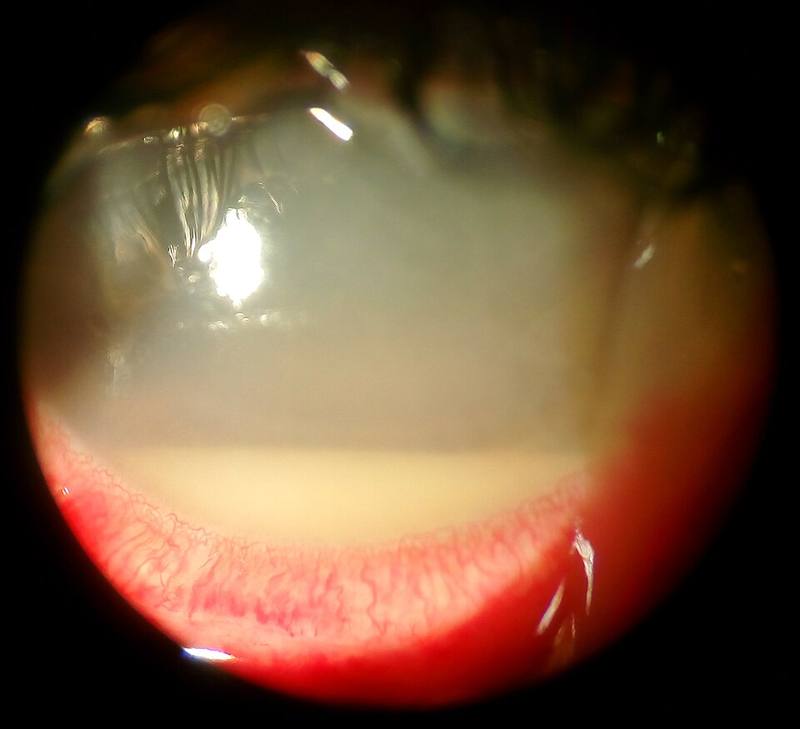
- Anterior segment complications include hyphaema, sterile anterior segment inflammation (incidence 0.05 to 1.1% depending on the drug), implant migration with corneal decompensation (0.43%), lens damage (0.07%) and accelerated cataract (up to 50% with steroids and 10.9% with anti-VEGF) [S9]. Most occur immediately and have a good prognosis if treated correctly [S9].
- Later surgery. Each injection is associated with an increased complication rate in subsequent cataract surgery (up to 4% per injection) [S9].
- Diabetes. People with diabetes may be at higher risk of adverse events because of cardiovascular and renal comorbidity and greater susceptibility to infection [S2].
- Systemic risk. In patients at high arteriothrombotic risk with high exposure (for example monthly aflibercept or ranibizumab for DMO), studies show increased all-cause mortality vs randomised controls; overall the evidence is inconsistent [S1].
Confirm it
- A narrative review describes distinguishing features of sterile inflammation, brolucizumab vasculitis and endophthalmitis [S6]; details are in the full text, not the abstract.
- Endophthalmitis is the most concerning complication, so keep it at the top of the differential for any post-injection inflammation [S7].
Manage it: safe injection practice
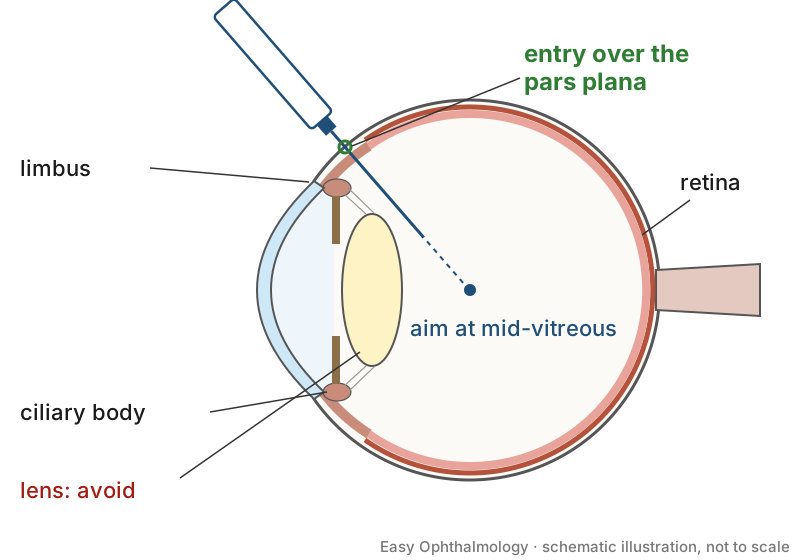
Before acting on this section, check the national and local guidelines, product information and regulatory approvals that apply where you practise. See the medical disclaimer.
Tier A (primary care / no specialist)
- Tier A staff do not give injections. Teach injected patients to report pain, redness or reduced vision promptly after any injection, and refer at once (see Refer when) [S7].
- Ask injected patients about recent stroke and cardiovascular events and pass this to the eye team [S1] [S11].
Tier B (general eye clinic, injecting service)
- Antisepsis. Povidone-iodine reduces endophthalmitis after intravitreal injection [S8]. If it is poorly tolerated, lower concentrations or chlorhexidine are alternatives [S8]. Povidone-iodine can cause eye pain, persistent epithelial defects and inflammation [S8].
- Technique. Topical antisepsis, hand hygiene, gloves, masks and drapes have been proposed, with significant variation in protocols [S4]. Face mask use by patient and physician is not associated with increased endophthalmitis and may reduce culture-positive cases [S7].
- Drug choice. Weigh the benefits of brolucizumab and abicipar pegol against their higher ocular adverse event rates [S12]. In HAWK and HARRIER, overall safety of brolucizumab looked similar to aflibercept at 48 weeks [S3]; inflammation and vasculitis signals emerged in later analyses [S5] [S12].
- Doses are not covered here: follow product labelling and local protocols.
Tier C (specialist centre)
- Manage suspected endophthalmitis, vasculitis and retinal artery occlusion as vitreoretinal emergencies [S7] [S12].
- Consider special measures for patients at higher systemic risk, such as those with recent or multiple strokes [S1].
- Monitor real-world safety of newly approved agents, including faricimab, aflibercept 8 mg, the ranibizumab port delivery system and complement inhibitors for geographic atrophy [S10].
- Report suspected adverse events to pharmacovigilance systems; early identification of systemic adverse effects can lessen severity [S11].
Refer when
| Situation | Urgency |
|---|---|
| Pain, redness or reduced vision after an intravitreal injection | Immediate, same-day to an injecting or vitreoretinal service [S7] [G1] |
| New floaters or reduced vision with inflammation after brolucizumab | Immediate, same-day [S5] |
| New cardiovascular or neurological event during anti-VEGF therapy | Medical emergency assessment, and inform the eye team [S11]; follow your national protocol [EIC expert opinion] |
Pitfalls
- Treating post-injection inflammation as sterile without considering endophthalmitis [S6].
- Assuming all anti-VEGF drugs have the same safety profile [S5] [S12].
- Relying only on registration trial safety data [S3] [S10].
- Forgetting the systemic effects of intraocular drugs in frail and diabetic patients [S2] [S11].
Evidence notes
| Source | Date | Design |
|---|---|---|
| [S1] | 2018 | Narrative review |
| [S2] | 2018 | Narrative review |
| [S3] | 2020 | Two phase 3 RCTs (HAWK, HARRIER), 1817 patients |
| [S4] | 2020 | Narrative review of consensus guidelines and literature |
| [S5] | 2021 | Narrative review |
| [S6] | 2021 | Narrative review |
| [S7] | 2022 | Narrative review |
| [S8] | 2024 | Narrative review |
| [S9] | 2024 | Narrative review |
| [S11] | 2025 | Focused review of 84 articles |
| [S12] | 2025 | Review of phase 3 RCTs in nAMD |
| [S10] | 2025 | Narrative review |
- Conflict: the registration trials reported brolucizumab safety similar to aflibercept [S3], whereas pooled phase 3 data and later reviews found more inflammation, vasculitis and artery occlusion [S5] [S12].
- Evidence on systemic risk is inconsistent, partly because trials exclude high-risk patients and are underpowered for rare events [S1].
- Incidence figures in [S9] come from a narrative review, not a systematic one.
- Not covered by these sources: treatment protocols for post-injection endophthalmitis, intravitreal steroid implant complications in detail, compounding and repackaging of bevacizumab, and injection safety in low-resource settings.
Related articles
- Post-operative endophthalmitis
- Anti-VEGF biosimilars and off-label bevacizumab
- Next-Generation Anti-VEGF and Long-Acting Retinal Drugs
References
See the numbered source list below. Each marker [S#] links to its PubMed and DOI record.
Sources
- [S1] Zarbin MA Anti-VEGF Agents and the Risk of Arteriothrombotic Events. Asia-Pacific journal of ophthalmology (Philadelphia, Pa.). (2018). PubMed 29405046 · doi:10.22608/apo.2017495
- [S2] Gupta A, Sun JK, Silva PS Complications of Intravitreous Injections in Patients with Diabetes. Seminars in ophthalmology. (2018). PubMed 29420143 · doi:10.1080/08820538.2017.1353811
- [S3] Dugel PU, Koh A, Ogura Y, Jaffe GJ, Schmidt-Erfurth U, Brown DM, et al. HAWK and HARRIER: Phase 3, Multicenter, Randomized, Double-Masked Trials of Brolucizumab for Neovascular Age-Related Macular Degeneration. Ophthalmology. (2020). PubMed 30986442 · doi:10.1016/j.ophtha.2019.04.017
- [S4] Patel SN, Gangaputra S, Sternberg P, Kim SJ Prophylaxis measures for postinjection endophthalmitis. Survey of ophthalmology. (2020). PubMed 31923477 · doi:10.1016/j.survophthal.2019.12.005
- [S5] Iyer PG, Albini TA Drug-related adverse effects of antivascular endothelial growth factor agents. Current opinion in ophthalmology. (2021). PubMed 33770015 · doi:10.1097/icu.0000000000000757
- [S6] Cox JT, Eliott D, Sobrin L Inflammatory Complications of Intravitreal Anti-VEGF Injections. Journal of clinical medicine. (2021). PubMed 33801185 · doi:10.3390/jcm10050981
- [S7] Patel D, Patel SN, Chaudhary V, Garg SJ Complications of intravitreal injections: 2022. Current opinion in ophthalmology. (2022). PubMed 35266893 · doi:10.1097/icu.0000000000000850
- [S8] Soleimani M, Haydar AA, Cheraqpour K, Zeidabadinejad H, Esfandiari A, Eshaghhosseiny N, et al. In praise of povidone-iodine application in ophthalmology. Survey of ophthalmology. (2024). PubMed 37944600 · doi:10.1016/j.survophthal.2023.11.002
- [S9] Mackenbrock LHB, Auffarth GU, Albrecht M, Naujokaitis T, Kessler LJ, Mayer CS, et al. Anterior Segment Complications Following Intravitreal Injection. Klinische Monatsblatter fur Augenheilkunde. (2024). PubMed 39146576 · doi:10.1055/a-2349-2224
- [S10] Khanani I, Aziz AA, Khanani ZA, Khan H, Mojumder O, Sulahria H, et al. The Safety of Recently Approved Therapeutics in Age-Related Macular Degeneration. International ophthalmology clinics. (2025). PubMed 39710898 · doi:10.1097/iio.0000000000000547
- [S11] Shahsuvaryan ML Pharmacovigilance in intraocular antiangiogenic therapy. Cutaneous and ocular toxicology. (2025). PubMed 40084564 · doi:10.1080/15569527.2025.2475445
- [S12] Stevanovic M, Koulisis N, Chen T, Moysidis SN, Burkemper B, Toy BC, et al. Intraocular Inflammation, Safety Events, and Outcomes After Intravitreal Injection of Ranibizumab, Aflibercept, Brolucizumab, Abicipar Pegol, and Faricimab for nAMD. Journal of vitreoretinal diseases. (2025). PubMed 40271423 · doi:10.1177/24741264251332515
Guidelines
- [G1] NHS Scotland (Community Eyecare Guidelines, eyes.nhs.scot). 7.4 Endophthalmitis, Post-Operative, (Exogenous Endophthalmitis) (2026). https://www.eyes.nhs.scot/eyecare-guidelines/section-7-uvea/74-endophthalmitis-post-operative-exogenous-endophthalmitis/