Educational content only. Not personalised medical advice. Clinical decisions remain the responsibility of the treating clinician.
Femtosecond laser-assisted cataract surgery
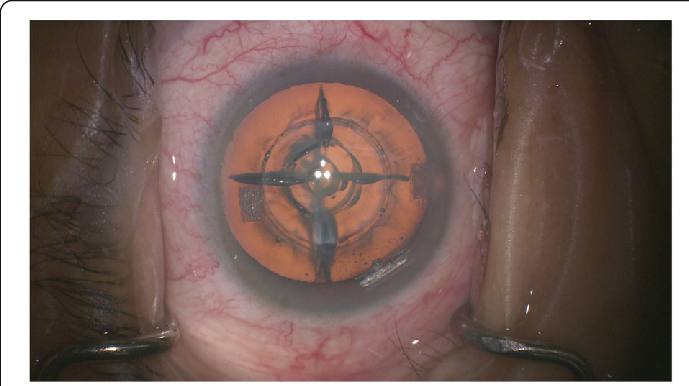
Femtosecond laser-assisted cataract surgery (FLACS) uses a laser to perform corneal incisions, capsulotomy and lens fragmentation, aiming for greater precision than manual steps, at higher cost [S6]. Large trials and meta-analyses show outcomes similar to standard phacoemulsification, and the ESCRS guideline rates the two as comparably safe and effective [S2] [S6] [S11].
Key points - A Cochrane review of 42 RCTs (7298 eyes) found probably little or no difference in complications, visual acuity or quality of life between FLACS and phacoemulsification [S6]. - The UK FACT trial (785 patients) found FLACS non-inferior for vision at 3 months but not cost-effective (ICER £167,620 per QALY) [S2]. - FLACS gives a rounder, more accurate capsulotomy and better IOL centration, and may reduce endothelial cell loss [S5] [S8] [S9]. - An earlier meta-analysis found higher risks of incomplete capsulotomy, capsulotomy tags and anterior capsule tears with FLACS [S1]; the later Cochrane review found little or no difference in anterior capsule tears [S6]. - Toric IOLs corrected astigmatism better than femtosecond laser arcuate keratotomy [S7].
Evidence last checked: 2026-10-17 (PubMed abstracts).
Red flags
- Selling FLACS as safer: pooled evidence does not show fewer overall complications [S6] [S10].
- Laser-specific capsule problems: incomplete capsulotomy (RR 22.42), anterior capsulotomy tags (RR 33.07) and anterior capsule tears (RR 4.74) were more frequent with FLACS in a 2019 meta-analysis [S1].
- Early postoperative pressure and oedema: the same meta-analysis found more macular or corneal oedema (RR 2.05) and raised IOP (RR 3.24) with FLACS [S1].
Recognise it: where FLACS may help
- Dense cataract and low endothelial counts. One meta-analysis suggests FLACS may help these patients [S8]. In a Singapore RCT of grade above 5 nuclear opacities, a 600 μm grid pattern, but not 16-segment fragmentation, reduced endothelial cell loss; acuity at 1 month did not differ [S3].
- Corneal dysfunction. Endothelial cell loss percentage was lower with FLACS up to 6 months, and corneal oedema recovered faster [S5].
- Junior surgeons. In an Indian RCT (320 eyes), FLACS used less ultrasound energy and fluid, gave clearer corneas on day 1 (72% vs 39%) and less endothelial loss at 6 months (9.3% vs 12.7%), with comparable acuity [S4].
Confirm it: what the outcomes show
- Vision. FACT: mean uncorrected acuity 0.13 vs 0.14 logMAR at 3 months; no difference in secondary outcomes at 3 months [S2]. Cochrane: a CDVA difference of about 1 letter, not clinically important [S6]. FLACS gave better CDVA at 1 week only [S10]; another meta-analysis found small UDVA and CDVA advantages at 12 months [S9].
- Posterior capsule tears. Cochrane: Peto OR 0.50 (95% CI 0.25 to 1.00), four fewer per 1000 operations, low certainty [S6]; [S8] reported OR 0.29.
- Capsulotomy and IOL position. More circular capsulorhexis, better IOL centration and lower mean absolute refractive error [S8]; fewer decentred IOLs (OR 0.06) but more subconjunctival haemorrhage [S9].
- Cost. FLACS may be the less cost-effective option [S6]; no clear cost-effectiveness advantage [S10].
Manage it
Before acting on this section, check the national and local guidelines, product information and regulatory approvals that apply where you practise. See the medical disclaimer.
Tier A (primary care / no specialist)
- Tier A / Tier B / Tier C tiers apply only partly: FLACS is a specialist-centre technology. At Tier A and Tier B, advise patients that standard surgery gives comparable results [S6] [S11].
Tier B (general eye clinic)
- Do not delay surgery to wait for FLACS: outcomes are comparable and FLACS is not cost-effective in the trials reviewed [S2] [S6].
- For astigmatism of 1.0 D or more, the ESCRS guideline recommends toric IOLs [S11]; toric IOLs outperformed laser arcuate keratotomy [S7].
Tier C (specialist centre)
- Consider FLACS selectively for dense cataracts or compromised endothelium, using fragmentation patterns that reduce energy [S3] [S5] [S8].
- Audit laser-specific complications such as incomplete capsulotomy and tags [S1].
Refer when
| Situation | Urgency |
|---|---|
| Pain, redness or falling vision after any cataract surgery | Immediate, same-day [G1] |
| Raised IOP or persistent corneal oedema after surgery | Urgent to the operating centre; timing per your local service or specialist advice [S1] |
| Dense cataract with low endothelial cell count | Routine to a specialist cataract surgeon; timing per your local service or specialist advice [S3] [S8] |
Pitfalls
- Claiming better vision or safety from FLACS for routine cases [S2] [S6].
- Ignoring cost: the ICER per QALY was £167,620 in FACT [S2].
- Using laser arcuate keratotomy instead of a toric IOL when one is available [S7].
- Overlooking anterior capsule tags and incomplete capsulotomy [S1].
Evidence notes
| Source | Date | Design |
|---|---|---|
| [S1] | 2019 | Meta-analysis, 7156 participants |
| [S2] | 2021 | Multicentre non-inferiority RCT (FACT), 785 patients |
| [S3] | 2021 | RCT, 93 patients, dense cataract, Singapore |
| [S4] | 2023 | Single-masked RCT, 320 eyes, India |
| [S5] | 2023 | Meta-analysis, 23 RCTs and 19 cohort studies |
| [S6] | 2023 | Cochrane systematic review, 42 RCTs |
| [S7] | 2023 | Meta-analysis of 5 comparative studies |
| [S8] | 2024 | Meta-analysis of 23 RCTs |
| [S9] | 2025 | Meta-analysis of 41 RCTs |
| [S10] | 2025 | Meta-analysis of 46 RCTs |
| [S11] | 2026 | ESCRS guideline (GRADE) |
- In the Cochrane review, 16 studies had financial links with the laser manufacturer, and 13 paired-eye studies were analysed ignoring the pairing [S6].
- FACT was publicly funded (NIHR HTA) and outcome-masked, but participants were not masked [S2].
- Sources conflict on anterior capsule tears ([S1] vs [S6]) and on long-term acuity ([S9] vs [S10]); the larger and more recent syntheses [S6] [S10] show no meaningful difference.
- Not covered by these sources: FLACS in low-income settings, paediatric or traumatic cataract, and comparison with MSICS.
Related articles
References
See the numbered source list below. Each marker [S#] links to its PubMed and DOI record.
Sources
- [S1] Wang J, Su F, Wang Y, Chen Y, Chen Q, Li F Intra and post-operative complications observed with femtosecond laser-assisted cataract surgery versus conventional phacoemulsification surgery: a systematic review and meta-analysis. BMC ophthalmology. (2019). PubMed 31399070 · doi:10.1186/s12886-019-1190-2
- [S2] Day AC, Burr JM, Bennett K, Hunter R, Bunce C, Doré CJ, et al. Femtosecond laser-assisted cataract surgery compared with phacoemulsification: the FACT non-inferiority RCT. Health technology assessment (Winchester, England). (2021). PubMed 33511963 · doi:10.3310/hta25060
- [S3] Chee SP, Yang Y, Wong MHY Randomized Controlled Trial Comparing Femtosecond Laser-Assisted with Conventional Phacoemulsification on Dense Cataracts. American journal of ophthalmology. (2021). PubMed 33662301 · doi:10.1016/j.ajo.2020.12.024
- [S4] Vasavada AR, Vasavada SA, Nath V, Vasavada V, Patel P FLACS vs conventional phacoemulsification by junior cataract surgeons: randomized trial. Journal of cataract and refractive surgery. (2023). PubMed 36194106 · doi:10.1097/j.jcrs.0000000000001061
- [S5] Wang H, Chen X, Xu J, Yao K Comparison of femtosecond laser-assisted cataract surgery and conventional phacoemulsification on corneal impact: A meta-analysis and systematic review. PloS one. (2023). PubMed 37058458 · doi:10.1371/journal.pone.0284181
- [S6] Narayan A, Evans JR, O'Brart D, Bunce C, Gore DM, Day AC Laser-assisted cataract surgery versus standard ultrasound phacoemulsification cataract surgery. The Cochrane database of systematic reviews. (2023). PubMed 37369549 · doi:10.1002/14651858.cd010735.pub3
- [S7] Zheng J, He L, Zhong J Effect of femtosecond laser-assisted arcuate keratotomy versus toric intraocular lens implantation on correction of astigmatism in cataract surgery: a systematic review and meta-analysis. Lasers in medical science. (2023). PubMed 37773468 · doi:10.1007/s10103-023-03893-0
- [S8] Pichardo-Loera NS, Corredor-Ortega C, Castro-Monreal MA, Massaro-Corredor MG, Pérez-Vázquez JF, Gonzalez-Salinas R Femtosecond laser-assisted cataract surgery versus conventional phacoemulsification: A meta-analysis of randomized controlled trials. European journal of ophthalmology. (2024). PubMed 38291620 · doi:10.1177/11206721241229129
- [S9] Song X, Li L, Zhang X, Ma J Comparing the efficacy and safety between femtosecond laser-assisted cataract surgery and conventional phacoemulsification cataract surgery: systematic review and meta-analysis. Canadian journal of ophthalmology. Journal canadien d'ophtalmologie. (2025). PubMed 39043258 · doi:10.1016/j.jcjo.2024.05.030
- [S10] Lee SH, Chiu YC, Tsai PC, Wang JH, Chiu CJ Femtosecond laser-assisted cataract surgery versus conventional phacoemulsification cataract surgery: a meta-analysis of randomized controlled trials. Scientific reports. (2025). PubMed 40731148 · doi:10.1038/s41598-025-13174-1
- [S11] Wanten JC, Till V, Findl O, Cochener-Lamard B, Kohnen T, Nuijts RMMA, et al. ESCRS guideline for cataract surgery 2024: executive summary. Journal of cataract and refractive surgery. (2026). PubMed 42674864 · doi:10.1097/j.jcrs.0000000000002012
Guidelines
- [G1] NHS Scotland (Community Eyecare Guidelines, eyes.nhs.scot). 7.4 Endophthalmitis, Post-Operative, (Exogenous Endophthalmitis) (2026). https://www.eyes.nhs.scot/eyecare-guidelines/section-7-uvea/74-endophthalmitis-post-operative-exogenous-endophthalmitis/