Educational content only. Not personalised medical advice. Clinical decisions remain the responsibility of the treating clinician.
Idiopathic Intracranial Hypertension and Papilloedema
Idiopathic intracranial hypertension (IIH) is raised intracranial pressure without an identified cause; it occurs most often in young women with obesity and threatens sight and causes severe headache [S2] [S8]. The estimated incidence is one to three people per 100,000 per year [S2]. Weight loss, acetazolamide and, for refractory or sight-threatening disease, surgery are the main treatments, although the RCT base is small [S2] [S7].
Key points - In the IIH Treatment Trial (IIHTT), acetazolamide added to a low-sodium weight-reduction diet gave a modest improvement in visual field function, papilloedema grade and quality of life in mild visual loss [S1] [S11]. - A Cochrane review judged the evidence low certainty and insufficient to recommend or reject any treatment [S2]. - Weight loss correlates closely with reduced intracranial pressure; bariatric surgery should be considered with BMI 35 kg/m² or more [S7]. - Check a full blood count in papilloedema: anaemia is more common in IIH [S4]. - Optic nerve sheath fenestration, CSF shunting and venous sinus stenting are options for refractory disease, supported by observational data only [S5] [S8] [S9].
Evidence last checked: 2026-10-17 (PubMed abstracts).
Red flags
- Risk factors for treatment failure in the IIHTT: high-grade papilloedema, more than 30 transient visual obscurations per month, visual acuity loss and male sex [S11].
- Atypical presentation (male, not obese, non-peripapillary retinal haemorrhages, risk factors for anaemia) or treatment-refractory disease: check for anaemia [S4].
- Pregnancy: headache worsened in 62.9% and visual disturbance occurred in 66.8% of reported cases, figures that may be overestimated by selection bias [S10].
- Shunted patients: revision is common [S5].
Recognise it
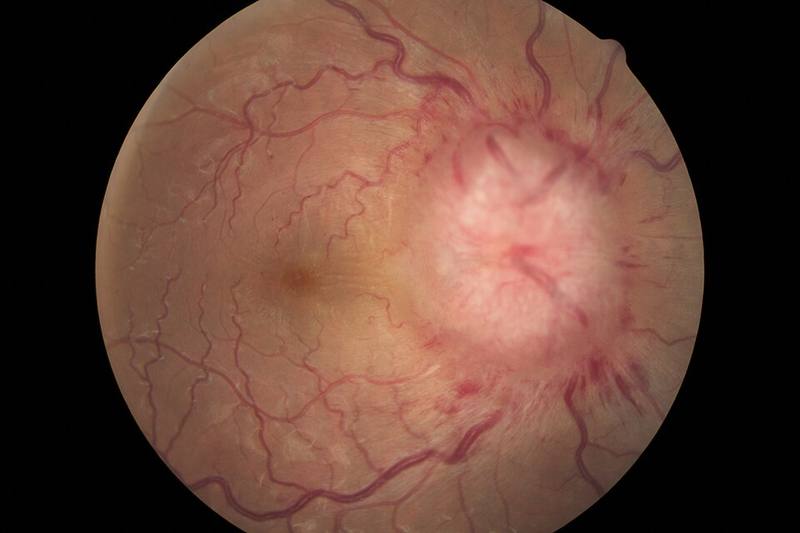
- IIH typically affects obese women of reproductive age [S8]. In the IIHTT, mean age was 29 years and all but 4 of 165 participants were women [S1].
- Papilloedema, headache, visual disturbance and tinnitus are the outcomes most reported after treatment [S8].
- In a meta-analysis, anaemia occurred in 18.2% of patients with IIH (relative risk 1.44 vs controls), mostly from iron deficiency (51.6%) or aplastic anaemia (19.4%) [S4].
Confirm it
- IIHTT participants met the modified Dandy criteria [S1].
- Perform perimetry: the IIHTT used Humphrey perimetric mean deviation to grade visual loss [S1].
- Full blood count should be considered in all patients with papilloedema [S4].
- Imaging protocols and lumbar puncture technique are not described in these abstracts; follow local guidance.
Manage it
Before acting on this section, check the national and local guidelines, product information and regulatory approvals that apply where you practise. See the medical disclaimer.
Tier A (primary care / no specialist)
- Refer suspected papilloedema to an eye service for fundus examination and perimetry, which grade visual loss [S1] (timing: see Refer when).
- Support weight loss: a multicomponent lifestyle programme (diet, physical activity, behaviour) has the most robust evidence for modest weight loss with BMI below 35 kg/m² [S7].
- Check and treat anaemia; in reported cases 59.7% improved or resolved with anaemia treatment alone [S4].
Tier B (general eye clinic)
- Acetazolamide with diet for mild visual loss: in the IIHTT, mean deviation improved 1.43 dB vs 0.71 dB with placebo (difference 0.71 dB, P = .050), papilloedema grade improved more, and CSF pressure fell by an additional 60 mmH2O [S1] [S11]. Benefit was greatest with high-grade papilloedema (2.27 dB) [S11]. Dosing as reported in [S11]: started at 1 g/day and titrated weekly to a maximum of 4 g/day.
- Side effects: paraesthesia, dysgeusia, vomiting, diarrhoea, nausea and fatigue were more common with acetazolamide; 44.1% tolerated 4 g/day and most tolerated more than 1 g/day for 6 months [S3].
- Monitor perimetric mean deviation and papilloedema grade, the outcomes used in the IIHTT [S1].
- Pregnancy: acetazolamide and serial lumbar punctures were reported as safe and effective first-line options in a systematic review of case series; acetazolamide did not show a causal relationship with congenital malformations [S10].
Tier C (specialist centre)
- Weight: bariatric surgery gave 27.2 to 27.8 kg weight loss and the largest fall in intracranial pressure (-11.9 cmH2O) at 24 months [S7].
- GLP-1 receptor agonists: a small RCT of exenatide (15 women completed) lowered intracranial pressure by 5.6 to 6.4 cmCSF [S6]. A 2026 meta-analysis (8 studies, 13,243 patients, mostly observational) found less papilloedema, headache and visual disturbance, but the evidence is low certainty and hypothesis-generating [S12].
- Optic nerve sheath fenestration: meta-analysis of 19 studies: visual acuity improved in 41.09% and fields in 76.34%; heterogeneity was high [S9].
- CSF shunting: improvement in headache 91%, papilloedema 96% and vision 85%, but revision rate 42% and low-pressure headache in 20% [S5].
- Venous sinus stenting: 36 studies (1066 patients): papilloedema improved in 89% and visual disturbance in 88%; treatment failure 8.35% and complications 5.35%, including subdural haemorrhage and stent thrombosis [S8].
Refer when
| Situation | Urgency |
|---|---|
| Papilloedema with visual acuity loss or worsening fields | Same-day specialist assessment [EIC expert opinion] [S11] |
| New papilloedema without visual loss | Urgent, for diagnosis; timing per your local service or specialist advice |
| Atypical patient (male, not obese) or refractory disease | Urgent, with blood count; timing per your local service or specialist advice [S4] |
| Stable IIH on treatment | Routine review with perimetry; timing per your local service or specialist advice [S1] |
Pitfalls
- Relying on headache improvement alone; vision is the key outcome [S1] [S11].
- Missing anaemia as a treatable contributor [S4].
- Stopping acetazolamide for expected paraesthesia without discussion [S3].
- Assuming surgery is low-maintenance: shunts often need revision [S5].
Evidence notes
| Source | Date | Design |
|---|---|---|
| [S1] | 2014 | RCT (IIHTT), 165 participants, North America; NIH funded |
| [S2] | 2015 | Cochrane systematic review, 2 RCTs, 211 participants |
| [S3] | 2016 | Safety analysis of the IIHTT RCT |
| [S4] | 2022 | Systematic review and meta-analysis, observational and case reports |
| [S5] | 2022 | Meta-analysis, 15 studies, 372 patients |
| [S6] | 2023 | Small RCT (exenatide), 16 women |
| [S7] | 2023 | Systematic review with graded recommendations, 17 studies |
| [S8] | 2024 | Meta-analysis, 36 studies, 1066 patients |
| [S9] | 2024 | Meta-analysis, 19 studies |
| [S10] | 2025 | Systematic review of case reports and series, 178 pregnancies |
| [S11] | 2026 | Lecture summarising the IIHTT RCT |
| [S12] | 2026 | Meta-analysis, mostly observational, low certainty |
- Conflict: the IIHTT showed a statistically significant but modest field benefit whose clinical importance was uncertain [S1]; the Cochrane review found insufficient evidence to recommend or reject acetazolamide [S2].
- All surgical evidence is observational and heterogeneous; no RCT compares stenting, shunting and fenestration [S5] [S8] [S9].
- The European and Spanish guideline abstracts in the sheet gave no extractable recommendations and were not cited.
- Not covered by these sources: diagnostic criteria in detail, imaging (MRI, MR venography), topiramate, fulminant IIH management, and paediatric IIH.
Related articles
- Optic disc assessment in glaucoma
- GLP-1 receptor agonists and the eye
- Visual field testing and interpretation
References
See the numbered source list below. Each marker [S#] links to its PubMed and DOI record.
Sources
- [S1] NORDIC Idiopathic Intracranial Hypertension Study Group Writing Committee, Wall M, McDermott MP, Kieburtz KD, Corbett JJ, Feldon SE, et al. Effect of acetazolamide on visual function in patients with idiopathic intracranial hypertension and mild visual loss: the idiopathic intracranial hypertension treatment trial. JAMA. (2014). PubMed 24756514 · doi:10.1001/jama.2014.3312
- [S2] Piper RJ, Kalyvas AV, Young AM, Hughes MA, Jamjoom AA, Fouyas IP Interventions for idiopathic intracranial hypertension. The Cochrane database of systematic reviews. (2015). PubMed 26250102 · doi:10.1002/14651858.cd003434.pub3
- [S3] ten Hove MW, Friedman DI, Patel AD, Irrcher I, Wall M, McDermott MP, et al. Safety and Tolerability of Acetazolamide in the Idiopathic Intracranial Hypertension Treatment Trial. Journal of neuro-ophthalmology : the official journal of the North American Neuro-Ophthalmology Society. (2016). PubMed 26587993 · doi:10.1097/wno.0000000000000322
- [S4] Yu CW, Waisberg E, Kwok JM, Micieli JA Anemia and Idiopathic Intracranial Hypertension: A Systematic Review and Meta-analysis. Journal of neuro-ophthalmology : the official journal of the North American Neuro-Ophthalmology Society. (2022). PubMed 34812762 · doi:10.1097/wno.0000000000001408
- [S5] Salih M, Enriquez-Marulanda A, Khorasanizadeh M, Moore J, Prabhu VC, Ogilvy CS Cerebrospinal Fluid Shunting for Idiopathic Intracranial Hypertension: A Systematic Review, Meta-Analysis, and Implications for a Modern Management Protocol. Neurosurgery. (2022). PubMed 35916578 · doi:10.1227/neu.0000000000002086
- [S6] Mitchell JL, Lyons HS, Walker JK, Yiangou A, Grech O, Alimajstorovic Z, et al. The effect of GLP-1RA exenatide on idiopathic intracranial hypertension: a randomized clinical trial. Brain : a journal of neurology. (2023). PubMed 36907221 · doi:10.1093/brain/awad003
- [S7] Abbott S, Chan F, Tahrani AA, Wong SH, Campbell FEJ, Parmar C, et al. Weight Management Interventions for Adults With Idiopathic Intracranial Hypertension: A Systematic Review and Practice Recommendations. Neurology. (2023). PubMed 37813577 · doi:10.1212/wnl.0000000000207866
- [S8] Azzam AY, Mortezaei A, Morsy MM, Essibayi MA, Ghozy S, Elamin O, et al. Venous sinus stenting for idiopathic intracranial hypertension: An updated Meta-analysis. Journal of the neurological sciences. (2024). PubMed 38457956 · doi:10.1016/j.jns.2024.122948
- [S9] Prokop K, Opęchowska A, Sieśkiewicz A, Lisowski Ł, Mariak Z, Łysoń T Effectiveness of optic nerve sheath fenestration in preserving vision in idiopathic intracranial hypertension: an updated meta-analysis and systematic review. Acta neurochirurgica. (2024). PubMed 39585430 · doi:10.1007/s00701-024-06345-y
- [S10] Palermo M, Trevisi G, D'Arrigo S, Sturiale CL Idiopathic Intracranial Hypertension in Pregnancy. A Systematic Review on Clinical Course, Treatments, Delivery and Maternal-Fetal Outcome. European journal of neurology. (2025). PubMed 40391885 · doi:10.1111/ene.70186
- [S11] Wall M What Have We Learned From the Idiopathic Intracranial Hypertension Treatment Trial the William F. Hoyt Lecture. Journal of neuro-ophthalmology : the official journal of the North American Neuro-Ophthalmology Society. (2026). PubMed 42133960 · doi:10.1097/wno.0000000000002481
- [S12] Falcão L, Brenner LBO, Machado Magalhães PL, Goyal A, de Bastos Maximiano ML, Donato KO, et al. Glucagon-like peptide-1 receptor agonists in idiopathic intracranial hypertension: A systematic review and meta-analysis. Headache. (2026). PubMed 42619634 · doi:10.1111/head.70131