Educational content only. Not personalised medical advice. Clinical decisions remain the responsibility of the treating clinician.
Ocular antibiotics and antimicrobial resistance
Topical antibiotics are among the most widely used drugs in eye care, for conjunctivitis, keratitis, trachoma and surgical prophylaxis [S2] [S4] [S7]. Antimicrobial resistance (AMR) in ocular pathogens is a global threat to treatment outcomes, with fluoroquinolone resistance increasing particularly in Asia and North America [S8]. Good prescribing, antiseptics where they work, and local surveillance data help keep these drugs effective [S1] [S2] [S8].
Key points - Acute bacterial conjunctivitis often resolves without antibiotics: 55.5% of placebo-treated participants recovered by days 4 to 9 vs 68.2% with antibiotics in a Cochrane review [S7]. - For bacterial keratitis, a Cochrane network meta-analysis ranked vancomycin + ceftazidime, moxifloxacin and cefazolin + tobramycin as most effective for healing time, and ciprofloxacin monotherapy as least effective; most evidence was not high certainty [S11]. - Mass azithromycin for trachoma reduces infection in communities but increases resistance of other bacteria to azithromycin, tetracycline and clindamycin at 12 months (high-certainty evidence) [S4]. - Even a short pre-operative course of topical moxifloxacin was followed by moxifloxacin-resistant surface bacteria in 17% of patients in a small RCT [S10]. - Povidone-iodine has no reported resistance and does not induce cross-resistance to antibiotics [S1].
Evidence last checked: 2026-10-17 (PubMed abstracts).
Red flags
- Suspected microbial keratitis: a potentially blinding condition that must be treated emergently to preserve vision [S3]; infectious keratitis is the leading cause of corneal blindness [S5].
- Keratitis not improving on first-line drops: consider resistance, including multidrug resistance, which is emerging in some parts of the world [S5] [S8].
- Contact lens wear, trauma, ocular surface or lid disease, or recent eye surgery in a patient with a corneal infection: these are the major risk factors for infectious keratitis [S5].
Recognise it: where resistance matters
- The most common ocular pathogens are Pseudomonas aeruginosa, Staphylococcus spp., Streptococcus pneumoniae and Haemophilus influenzae [S8].
- Methicillin resistance and multidrug resistance are emerging and need ongoing monitoring [S8]. In keratitis, methicillin resistance in S. aureus and coagulase-negative staphylococci has remained stable [S8].
- Bacteria predominate in microbial keratitis in economically developed countries and fungi in developing countries [S3]; microbial keratitis may be epidemic in parts of South, South-East and East Asia [S3].
- Chloramphenicol. An integrative review of 44 studies found resistance rates from 0% to 74.1%, with most studies below 50% and no consistent trend over time [S6]. Another review argues that its US reputation for serious harm rests on weak evidence and supports it as a first-line agent for simple ophthalmic infections [S9]. Both are narrative or integrative reviews, not trials.
Confirm it: using microbiology
- Stain and culture remain the gold standard for microbial keratitis but are time consuming and often yield no clinically useful result [S3]; molecular tools are being developed to speed diagnosis and limit AMR [S3].
- Stewardship programmes must be informed by up-to-date AMR surveillance data [S8].
Manage it: prescribing that limits resistance
Before acting on this section, check the national and local guidelines, product information and regulatory approvals that apply where you practise. See the medical disclaimer.
Tier A (primary care / no specialist)
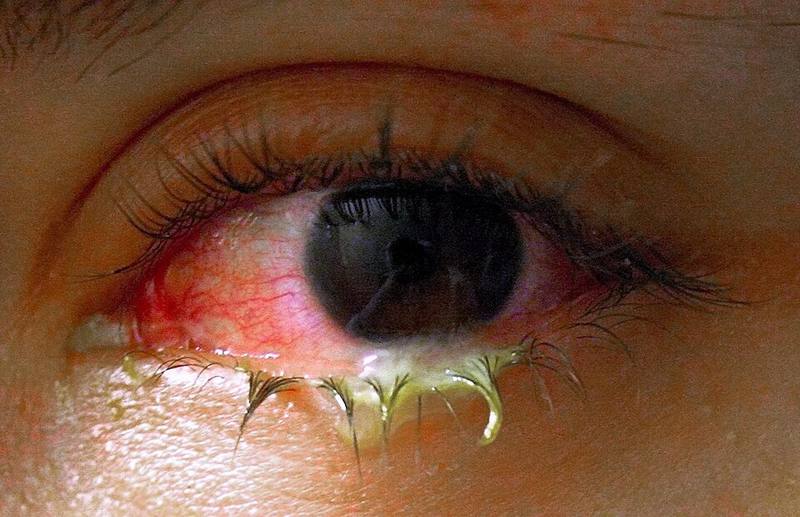
- Simple conjunctivitis. Antibiotics modestly improve clinical cure (RR 1.26) and microbiological cure (RR 1.53) compared with placebo, with no serious systemic side effects reported [S7]. Many cases resolve without treatment [S7], which is worth explaining to patients.
- No difference by antibiotic class or treatment duration was found for clinical cure [S7], so a broad-spectrum or newer drug is not needed for routine conjunctivitis.
- Suspected keratitis needs emergent treatment to preserve vision [S3]; refer it (see Refer when).
- Dosing is not covered here: follow your local or national formulary.
Tier B (general eye clinic)
- Bacterial keratitis. Base the first choice on local microbiological and resistance patterns [S11]. In the network meta-analysis of 23 RCTs (2692 participants), moxifloxacin and vancomycin + ceftazidime healed faster than ciprofloxacin by more than two to seven days; ofloxacin and lomefloxacin were similar to ciprofloxacin [S11]. Over half of the trials were at high risk of bias [S11].
- Take corneal scrapes for stain and culture where available, accepting that results are often slow or negative [S3].
- Surgical prophylaxis. Pre-operative topical antibiotics reduced but did not eradicate surface bacteria, and may induce resistance [S10]. Antiseptics may be an adjunct or sometimes an alternative to antibiotics for prevention [S2]; povidone-iodine is the pre-eminent antiseptic in ophthalmology and is economical [S1].
Tier C (specialist centre)
- Run or join AMR surveillance and an antimicrobial stewardship programme [S8].
- Trachoma programmes. Single-dose oral azithromycin mass treatment reduced community ocular infection at 12 months (RR 0.36) [S4]. Monitor for resistance, as resistance of S. pneumoniae, S. aureus and E. coli rose about 5-fold at 12 months in treated communities [S4]. No strong evidence supports changing the recommended annual mass treatment interval [S4].
- Use culture and sensitivity results to adjust therapy in keratitis not responding to treatment [S5] [S8].
Refer when
| Situation | Urgency |
|---|---|
| Suspected microbial keratitis (corneal infiltrate or ulcer) | Immediate, same-day to an eye unit [S3] [G1] |
| Keratitis worsening or not healing on treatment | Urgent, same-day specialist review [S5] [S8] [G1] |
| Conjunctivitis not settling after a course of antibiotics | Routine, for review; timing per your local service or specialist advice |
Pitfalls
- Treating every red eye with antibiotics: much conjunctivitis is self-limiting [S7].
- Assuming that fluoroquinolones remain reliable everywhere [S8].
- Using ciprofloxacin alone for keratitis without considering local resistance data [S11].
- Routine pre-operative topical antibiotics that may select resistant flora [S10].
Evidence notes
| Source | Date | Design |
|---|---|---|
| [S1] | 2018 | Narrative review |
| [S2] | 2018 | Narrative review |
| [S3] | 2019 | Narrative review |
| [S4] | 2019 | Cochrane systematic review (individual and cluster RCTs) |
| [S5] | 2021 | Narrative review |
| [S6] | 2023 | Integrative review of 53 publications |
| [S7] | 2023 | Cochrane systematic review, 21 RCTs |
| [S8] | 2024 | Narrative review |
| [S9] | 2025 | Narrative review |
| [S10] | 2024 | Small RCT, 28 patients |
| [S11] | 2025 | Cochrane network meta-analysis, 23 RCTs |
- The keratitis NMA had mostly moderate to very low certainty evidence; certainty for harms was not assessed [S11].
- The trachoma Cochrane studies in individuals were poorly reported, and none measured resistance of C. trachomatis [S4].
- The chloramphenicol reviews reach somewhat different emphases: one is reassuring on safety [S9], the other warns that high resistance rates in some studies may limit future use [S6].
- The moxifloxacin resistance RCT was small and the difference vs control was not statistically significant [S10].
- Not covered by these sources: doses and durations, fortified antibiotic preparation, local resistance data for specific countries, and neonatal conjunctivitis prophylaxis.
Related articles
References
See the numbered source list below. Each marker [S#] links to its PubMed and DOI record.
Sources
- [S1] Grzybowski A, Kanclerz P, Myers WG The use of povidone-iodine in ophthalmology. Current opinion in ophthalmology. (2018). PubMed 28984794 · doi:10.1097/icu.0000000000000437
- [S2] Grzybowski A, Turczynowska M More Antisepsis, Less Antibiotics Whenever Possible. Asia-Pacific journal of ophthalmology (Philadelphia, Pa.). (2018). PubMed 29280365 · doi:10.22608/apo.2017343
- [S3] Ung L, Bispo PJM, Shanbhag SS, Gilmore MS, Chodosh J The persistent dilemma of microbial keratitis: Global burden, diagnosis, and antimicrobial resistance. Survey of ophthalmology. (2019). PubMed 30590103 · doi:10.1016/j.survophthal.2018.12.003
- [S4] Evans JR, Solomon AW, Kumar R, Perez Á, Singh BP, Srivastava RM, et al. Antibiotics for trachoma. The Cochrane database of systematic reviews. (2019). PubMed 31554017 · doi:10.1002/14651858.cd001860.pub4
- [S5] Ting DSJ, Ho CS, Deshmukh R, Said DG, Dua HS Infectious keratitis: an update on epidemiology, causative microorganisms, risk factors, and antimicrobial resistance. Eye (London, England). (2021). PubMed 33414529 · doi:10.1038/s41433-020-01339-3
- [S6] Bale BI, Elebesunu EE, Manikavasagar P, Agwuna FO, Ogunkola IO, Sow AU, et al. Antibiotic resistance in ocular bacterial infections: an integrative review of ophthalmic chloramphenicol. Tropical medicine and health. (2023). PubMed 36895063 · doi:10.1186/s41182-023-00496-x
- [S7] Chen YY, Liu SH, Nurmatov U, van Schayck OC, Kuo IC Antibiotics versus placebo for acute bacterial conjunctivitis. The Cochrane database of systematic reviews. (2023). PubMed 36912752 · doi:10.1002/14651858.cd001211.pub4
- [S8] Cabrera-Aguas M, Chidi-Egboka N, Kandel H, Watson SL Antimicrobial resistance in ocular infection: A review. Clinical & experimental ophthalmology. (2024). PubMed 38494451 · doi:10.1111/ceo.14377
- [S9] Moledina M, Patel BCK, Malhotra R Topical Chloramphenicol in Ophthalmology: Old is Gold. Seminars in ophthalmology. (2025). PubMed 39058414 · doi:10.1080/08820538.2024.2381772
- [S10] Meide E, Ferguson T, Terveen D Induced Resistance of Ocular Surface Flora in Patients Undergoing Cataract Surgery. South Dakota medicine : the journal of the South Dakota State Medical Association. (2024). PubMed 39821258
- [S11] Song A, Yang Y, Henein C, Bunce C, Qureshi R, Ting DSJ Topical antibiotics for treating bacterial keratitis: a network meta-analysis. The Cochrane database of systematic reviews. (2025). PubMed 40728038 · doi:10.1002/14651858.cd015350.pub2
Guidelines
- [G1] NHS Scotland (Community Eyecare Guidelines, eyes.nhs.scot). 5.12 Keratitis, Microbial, Bacterial (2026). https://www.eyes.nhs.scot/eyecare-guidelines/section-5-corneal/512-keratitis-microbial-bacterial/